Notice: Function WP_Scripts::add was called incorrectly. The script with the handle "datatables-responsive" was enqueued with dependencies that are not registered: datatables. Please see Debugging in WordPress for more information. (This message was added in version 6.9.1.) in /home/u621095157/domains/brigantesnation.com/public_html/wp-includes/functions.php on line 6131
Archaeologists now recognise a true Neolithic henge lying immediately south-west of Moulton village, roughly midway between the Swale and Dere Read more
The recent discovery at Catterick has unveiled a significant Late Neolithic palisaded enclosure, shedding light on the prehistoric landscape of Read more
I've started to realise there are an awful lot of myths involving giants in Yorkshire, and in the rest of Read more
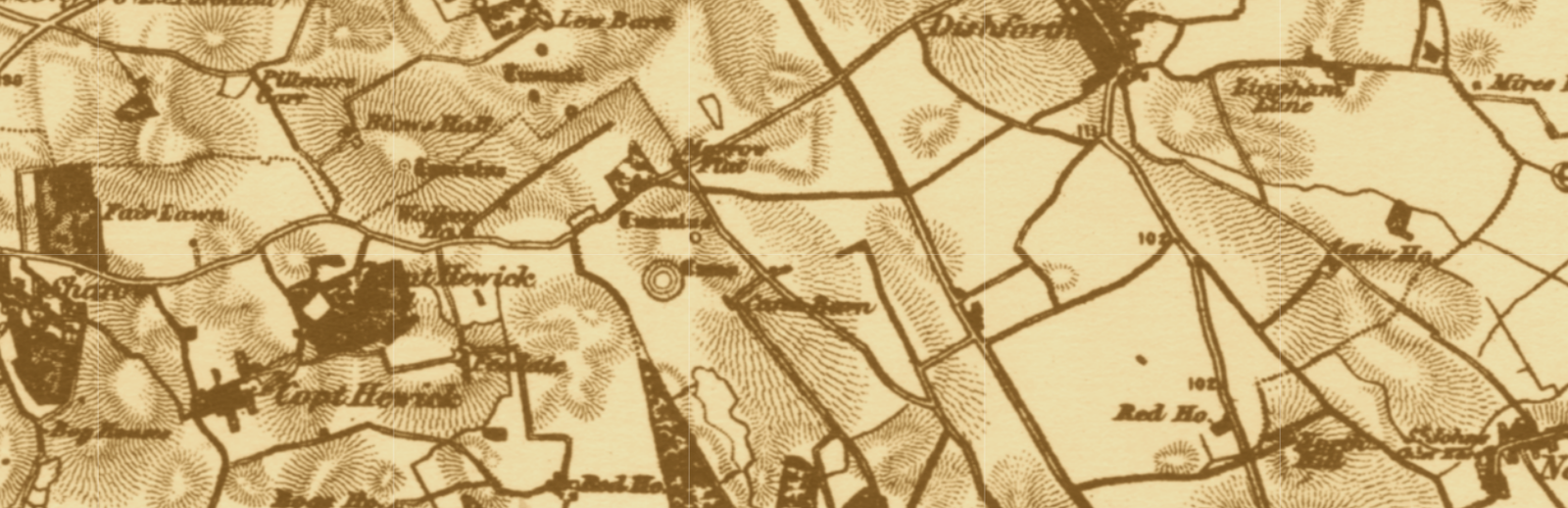
Cana Barn Henge - 1805 OS map
Cana Barn Henge, Copt Hewick, North Yorkshire
Location
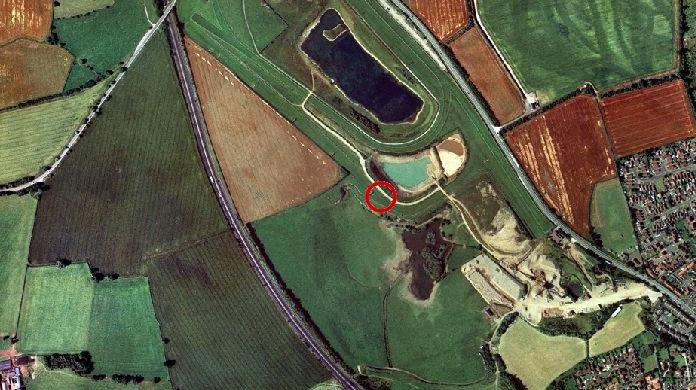
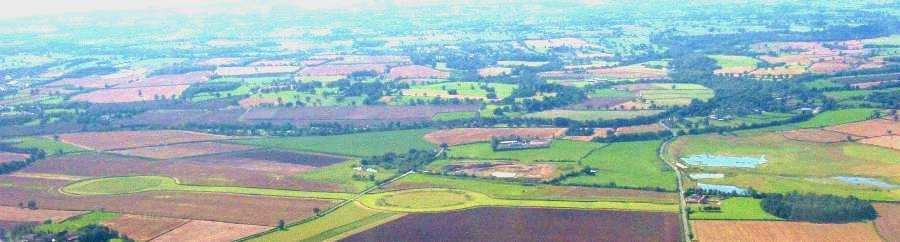
Cana Barn Henge (grid reference SE 3608 7185) lies c. 3 km north‑east of Ripon and 800 m south‑east of the River Ure on gently undulating farmland between the villages of Copt Hewick and Marton‑le‑Moor. The monument sits at ≈ 38 m OD on the fertile Vale of Mowbray, midway along the celebrated alignment of great henges that runs from the Devils’ Arrows at Boroughbridge north‑west to the Thornborough complex.
Cana barn henge - OS Series 1 - National Museum of Scotland
Geological & Topographic Setting
The henge occupies a low gravel terrace formed by Devensian outwash over Permian Magnesian Limestone. Local soils are free‑draining brown earths that favour arable cultivation and would have provided a well‑drained platform overlooking the wide alluvial meadows of the Ure. The river’s palaeochannels, visible on LiDAR, emphasise that Cana Barn commanded a liminal zone between dry ground and wet valley floor—an echo of the water‑edge settings favoured by several other North Yorkshire henges.
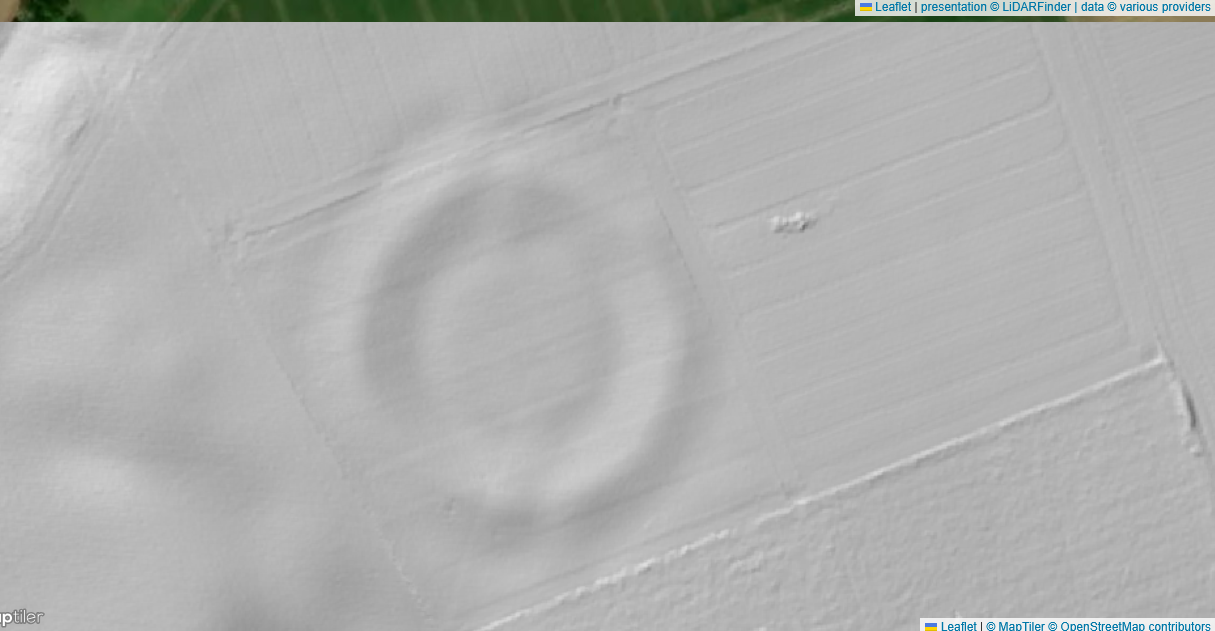
Cana Barn Henge - LiDAR - LiDAR Finder
Form & Dimensions
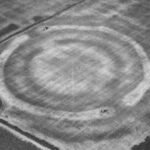
Aerial photography and LiDAR show Cana Barn as a near‑circular enclosure defined by a broad inner ditch (4–10 m wide) and a slight external bank. The outer diameter is c. 174 m, making it one of the larger henges in the Vale. Two opposed causewayed entrances face almost due north and south. Cropmarks reveal:
irregular lengths of ditch suggestive of segmented excavation;
faint pits on the bank line, perhaps stone‑holes for an internal timber setting;
a narrow double‑ditched feature running south‑north through the southern entrance—possibly an avenue or processional way.
Surviving Earthworks today comprise a low, spread bank <0.3 m high and a shallow internal hollow; the southern arc is clipped by a modern field boundary.
Archaeological Evidence
The site was first recognised on RAF vertical air‑photos in 1946 and mapped in detail during the National Mapping Programme. Field‑walking in the 1980s recovered struck flint, including a leaf‑shaped arrowhead and several scrapers, hinting at Late Neolithic activity, but no controlled excavation has been undertaken. Its place within the Ure‑Swale ‘sacred vale’ suggests Cana Barn formed part of a planned monumental landscape conceived around 3000–2500 BC, broadly contemporary with Thornborough.
State of Preservation & Protection
Plough‑levelled for decades, Cana Barn survives primarily as a cropmark; earthworks are slight and best appreciated in low‑angle light or LiDAR imagery. Despite this, the ditch fills and any buried occupation layers remain largely undisturbed beneath cultivation soils. The monument was scheduled in 1994 (NHLE 1009790) and is monitored under agri‑environment agreements that promote minimal‑tillage regimes.
Visiting Advice
The henge lies on private farmland with no on‑site interpretation. It is best viewed from the public footpath that skirts Cana Barn farm (SE 361 717), where the low outer bank is just perceptible in favourable light.
YAA Mapping Site visit notes
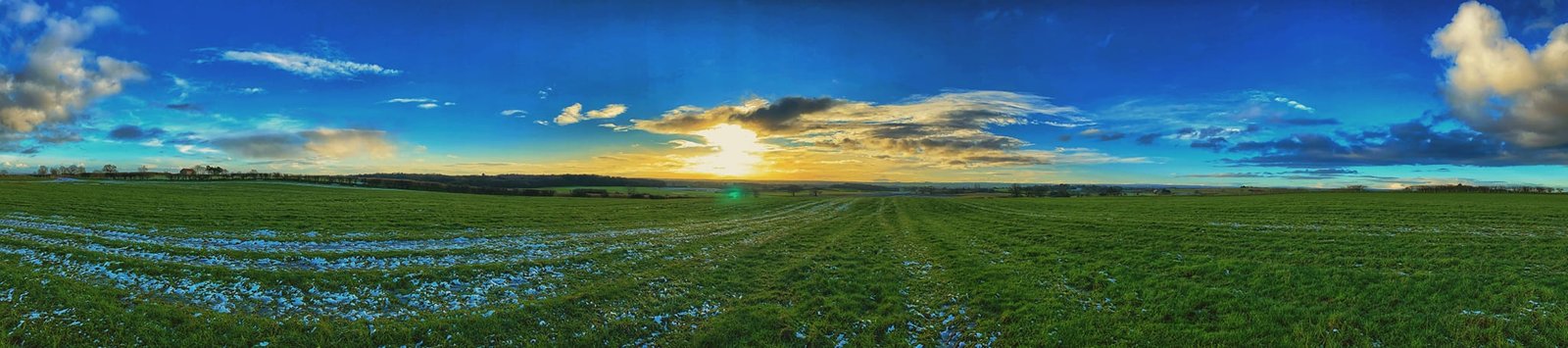
The stats for this Neolithic monument are astounding: 200m across, once a great circle of earthen banks and deep ditches. Today, almost lost: 5,000 years of plough and neglect have flattened the banks and filled the ditches, and Cana Henge is now nothing but a smoothly undulating grassy field on the moor overlooking Ripon.
But notwithstanding the above, todays mission was to see if the new Infrared camera, so successful in extracting lost archaeology elsewhere, could see the henge and the Round Barrow (burial mound) next to it.
The site was open, exposed cold: melted snow made our boots soaked, freezing and uncomfortable and, despite the team, the car, the batteries and the drone all protesting loudly that the weather was unsuitable, the images were collected and, with the aid of the Hunt-Hickie GVC algorithm, processed on return to base.
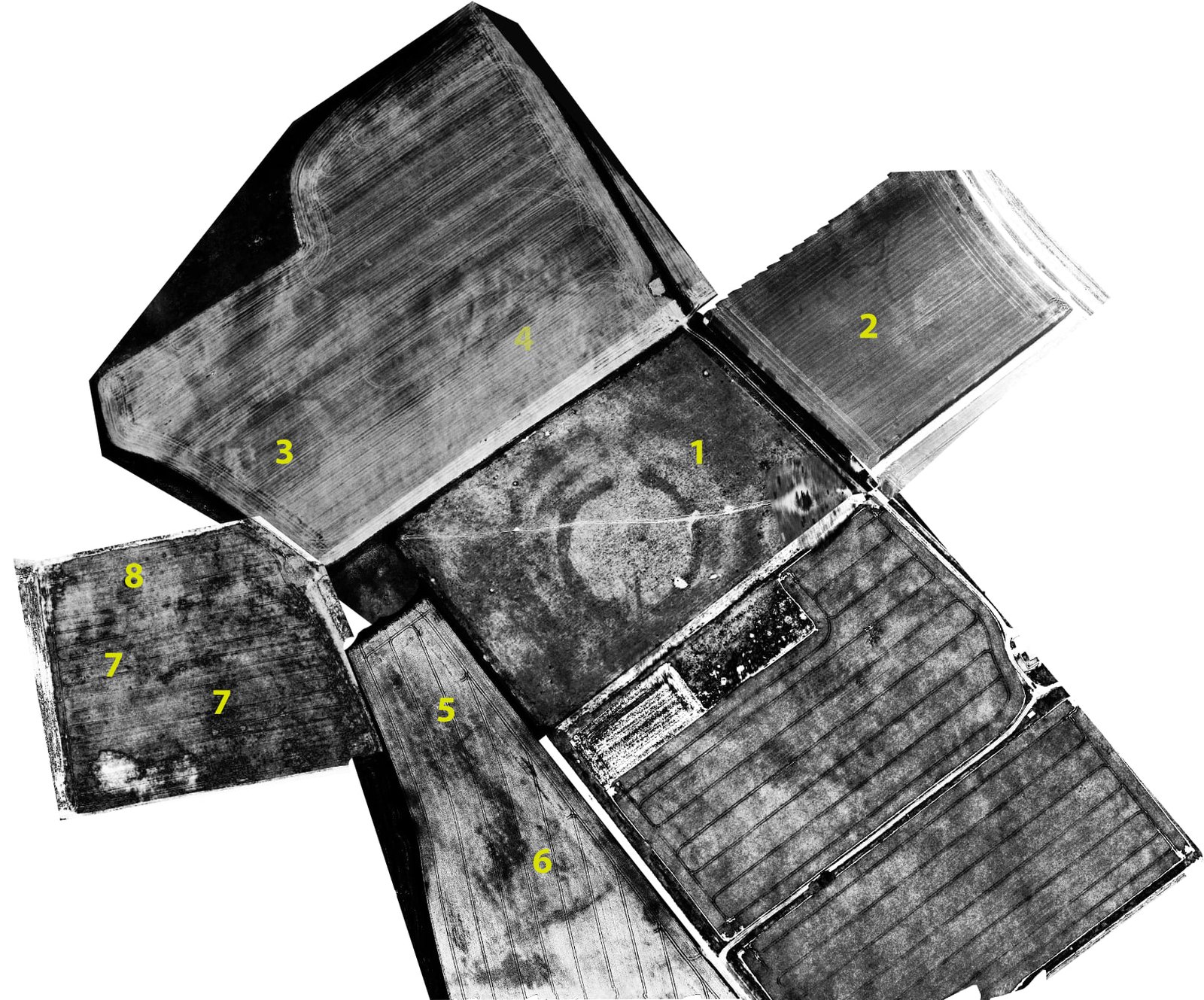
And what images they are: here they are presented as a composite, as each field needed processing with slightly different settings. So, we will leave you to gasp as - we did - as the lost archaeology emerged from the greyscale images
Here is a summary of what we can see:
(1) The henge: magnificent once more, the ditches and banks showing up well, 200m (600ft) across with the causwayed entranceway, a bridge across the now vanished ditches, to the south west.
(2) The burial mound showing as a white area: indicating that the plough spread still affects the plant growth where the mound once stood, this surrounded by snake like convolutions of ditches and enclosures: are these archaeology?
(3) To the west another great circle seems to appear: double ditched, is this an earlier henge unrecorded until today?
(4) To the north a series of enclosures can be seen: possibly concurrent with the henge, possibly later. Next to that, to the North west yet another circle, again huge in scale but simpler in structure.
(5) To the south west a square: possibly a square Barrow? Bu if it is, what is that doing this far north: these are typically East Yorkshire features.
(6) Just to the south of this a huge double ditched rectangular structure, apparently several of them.
(7) Another 2 circles, arcing across the landscape, possibly a ring ditch adjacent? (8)
A busy landscape indeed. All surrounding and possibly giving context to the great henge.
Above Text and images supplied with thanks by https://www.yaamapping.co.uk/cana-barn-henge.html
Liminal Spaces
“Liminal” comes from the Latin limen — “threshold.” Anything liminal sits in‑between clearly defined states, places or identities: neither here nor there, but on the edge of becoming one or the other. The idea shows up in several disciplines, each with its own emphasis:
Field
What “liminal” means
Classic examples
Why it matters
Anthropology (Arnold van Gennep → Victor Turner)
The middle, ambiguous phase of a rite of passage — after separation from the old status, before reincorporation into the new.
In liminality normal rules suspend; participants are “betwixt and between,” open to transformation.
Psychology / Human experience
Moments or spaces where familiar cognitive frames drop away; we feel disoriented, nostalgic, uneasy, or inspired.
Empty airports at 3 a.m., hotel corridors, waiting rooms, a school hallway during summer break.
They highlight how much meaning we normally borrow from context; remove the context and the mind rushes to fill the gap.
Architecture / Urban studies
Transitional physical zones that mediate between public ↔ private, inside ↔ outside, past ↔ future.
Foyers, verandas, bridges, stairwells, plazas under flyovers.
Good design can soften or dramatize transitions, influencing flow, security, even social interaction.
Art & pop‑culture (“liminal space” aesthetics)
Images of eerily vacant, mundane places evoke a shared dreamlike mood (“the Backrooms,” vaporwave malls).
Photos of fluorescent, carpeted office cubicles; childhood play centres; foggy parking lots.
Online communities use them to explore nostalgia, uncanny valley feelings, and collective memory.
Key ideas that run through every use
Ambiguity & potential Liminality isn’t a destination; it’s a state of flux. Rules loosen, identities blur, and creativity (or anxiety) spikes because the usual boundaries are missing.
Threshold effect Crossing a threshold—literal or symbolic—signals that transformation is possible. Mythic gates, initiation huts, or a mundane elevator ride all mark a change of context.
Communitas Turner observed that people sharing a liminal phase often experience a brief sense of egalitarian camaraderie—rank and hierarchy fade while everyone is “in the same boat.”
The uncanny When a space designed for bustle is suddenly empty, or when day‑to‑day objects appear out of context, we feel the uncanny: familiar yet strangely foreign.
Why liminal thinking matters today
Design & placemaking – Architects deliberately craft thresholds (atriums, courtyards) to calm, prepare, or impress users as they shift modes (street → sanctuary, public → domestic).
Work & technology – Remote work erases many physical and temporal thresholds (commute, office lobby). People recreate them with rituals—closing the laptop, going for a walk—to mark “work mode off.”
Mental health – Therapeutic practice often places clients in controlled liminal states (retreats, vision quests, psychedelic sessions) where old narratives can be rewritten.
Cultural analysis – Periods of rapid social change (pandemics, political revolutions) are collective liminal phases. Norms soften, new possibilities open—and anxieties surge.
A quick way to spot a liminal space or moment
Ask: “Is this a place/time where one frame ends and another hasn’t quite begun?” If yes—and especially if it feels strangely charged, empty, or timeless—you’re standing in a liminal zone.
Whether encountered in a deserted shopping centre after closing time, or in the pause between life chapters, liminality reminds us that meaning lives in transitions. Embrace the threshold, and you often find fresh vision on the other side.