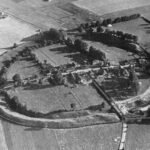
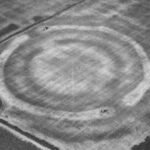
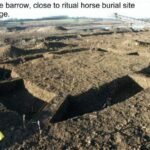
Archaeologists use the word “henge” for later-Neolithic and earliest Bronze-Age earthen rings whose ditch lies inside the bank, creating a deliberately bounded interior. The term itself was coined in 1932 by Kendrick; it was refined in the 1950s by Richard Atkinson, whose system still frames most discussion.
Henge Classifications
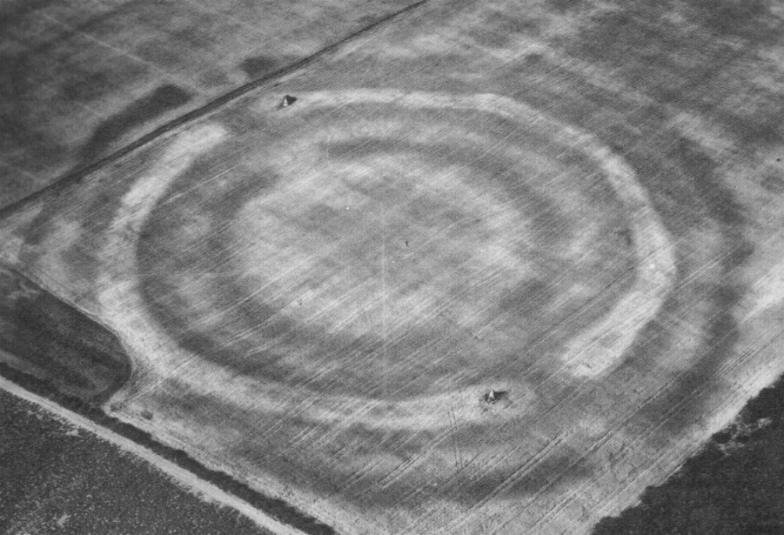
Atkinson divided true henges into three classes according to how many gaps the builders left through the Earthwork. Class I has only a single entrance; Class II has two opposed entrances; Class III has four, facing one another in pairs. Later writers kept the same basis but recognised subgroups when more than one concentric ditch is present, so we now meet labels such as “Class IA” for a single-entrance ring with a double ditch, or “Class IIA” for a two-entrance ring that also has multiple ditches. (en.wikipedia.org, nessofbrodgar.co.uk)
The Term – Hengiform
Because some monuments are either much smaller or vastly larger than the classic examples, further descriptive labels have grown up. Geoff Wainwright introduced “hengiform” in 1969 for diminutive rings only five to twenty metres across; they behave like mini-henge shrines rather than full ceremonial arenas. At the opposite extreme, scholars speak of “henge enclosures” or “super-henges” when the banked circuit exceeds three hundred metres, as at Durrington Walls or Marden. All of these variants keep the inner ditch as their defining feature.
Classifying Factors
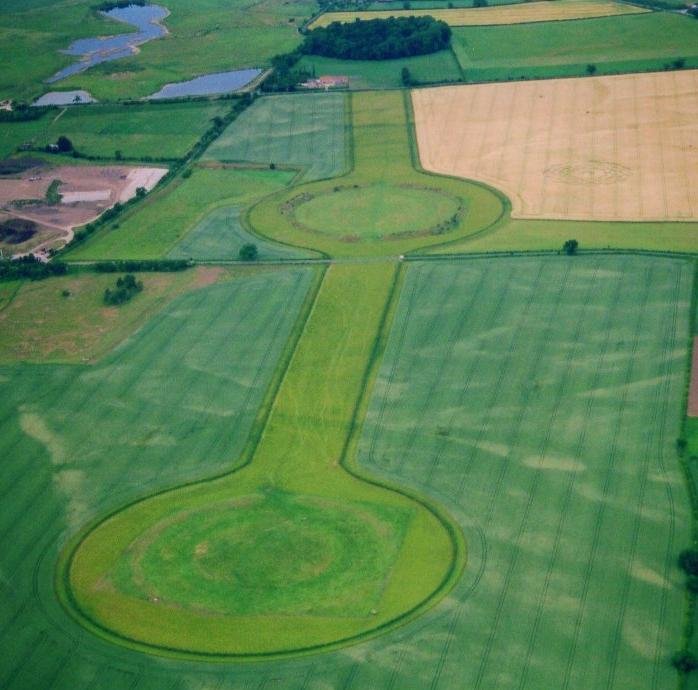
Size and entrance number are not the only traits that vary. Some henges are built entirely of redeposited gravel or cobbles with no ditch at all, as at Mayburgh and Catterick; others combine bank, ditch and a ring of timbers or stones, while some, like Thornborough, sit within wider linear Earthworks. Attempts to force every ring into a rigid class scheme can therefore be misleading, and recent syntheses emphasise that “henge” is a morphological convenience, not a guarantee of shared function. Even so, the entrance-based classes remain a useful shorthand when comparing monuments or mapping their distribution, which is densest in lowland England and southern Scotland but extends from Orkney to Cornwall. (academia.edu)
Classification Index
Below is the scheme most British pre-historians still use, after Richard Atkinson’s 1951 paper. The capital‐letter classes (I, II, III) describe the number and layout of entrances; the lower-case suffixes “a” and “b”, added soon afterwards by Atkinson himself and refined by later writers, flag extra ditch systems that complicate the basic plan.
Class I single formal entrance in the bank
Ia one entrance and two concentric ditches: the familiar inner ditch inside the bank plus a second, slighter ditch outside it. The bank thus sits between the two. Examples include Dorchester‐on-Thames Henge I and Nunwick. (deadseaquake.info)
Ib one entrance, an inner ditch as usual, plus a completely separate outer ditch set further away; often both ditches are picked up only as crop-marks. The unexcavated double-ring at Stapleton’s Field, Letchworth, is the type cited in field manuals. (nortoncommarch.files.wordpress.com)
Class II two diametrically opposed entrances (normally north–south)
IIa two entrances and a second ditch outside the bank, giving a double-ringed outline. Dorchester Henge III and the Knowlton “Church” henge are standard IIa sites. (deadseaquake.info)
IIb two entrances, an inner ditch inside the bank and an additional, separate outer ditch. These are exceptionally rare; a probable IIb crop-mark surrounds the double-ditched ring at Sutton Weaver, Cheshire, but no type-site has yet been excavated and published.
Four opposed entrances, creating quartered segments (Avebury is the textbook case). Very few monuments add more ditches, so the “a/b” subdivision is seldom used here; when it is, the rules follow those above (IIIa = extra outer ditch, IIIb = both inner and outer ditches).
Why the complication?
The entrance count was meant to capture the ceremonial choreography—single-file approach, processional through-route, or cross-movement—while the “a/b” tags alert us to monuments that went beyond the simplest bank-and-ditch recipe, perhaps to stage more elaborate gatherings or to monumentalise earlier Barrow rings. Subtypes are therefore a morphological convenience, not a chronological sequence: Ia, Ib, IIa and IIb rings can be late Neolithic or Early Bronze-Age, depending on region and associated finds.
In practice most catalogues now quote both pieces of information together—“Class IIa henge”, “Class Ib hengiform”, and so on—because the paired code instantly tells the reader (1) how many gateways were built and (2) whether one or more extra ditches complicate the circuit.
Distinguising the Henge from other Monuments
Henges were rarely isolated undertakings. Across Britain many were built into, around, or in deliberate sight-lines with other structures, forming what archaeologists now call “monument complexes” or “ritual landscapes.” Several recurring patterns show how this played out.
Henge plus circle
A first, very common pattern is the “henge-plus-circle” combination: the enclosing bank and internal ditch are laid out first, and then a ring of posts or megaliths is set inside it. Stonehenge, Avebury, the Ring of Brodgar, Stenness and Balfarg all began life as earthwork henges before gaining timber circles, stone uprights, or both. Doing so turned an already bounded arena into an architecturally articulated stage where stone or timber framed whatever ceremonies took place.
Henge with a central mound or cairn
Second is the henge with a central mound or cairn. At Catterick a low Early-Bronze-Age cobble cairn was absorbed into the henge bank; at Marden a huge chalk mound—Hatfield Barrow—rose inside the southern arc; at Mount Pleasant, Dorset, a steep inner bank ringed an earlier barrow. Such insertions let later builders anchor new rites to an older focus, creating nested layers of meaning.
Alignments
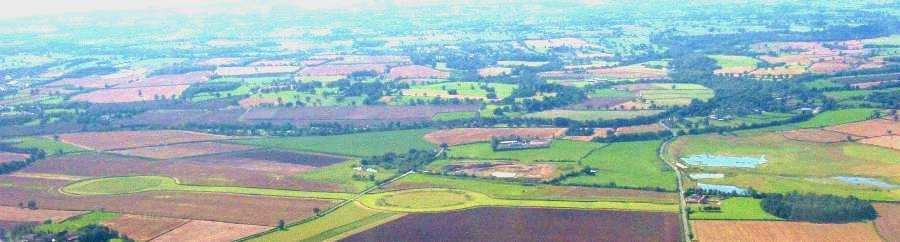
A third theme links separate monuments into longer alignments. The three Thornborough henges, Nunwick and the Devil’s Arrows standing stones fall on an almost straight north–south axis that is echoed again by Catterick and the newly recognised Moulton henge. Similar chains run through the Great Langdale valley and along the Dorset chalk. Each element kept its own ditch-inside-bank form, but the true “monument” is the line itself: people moved between nodes, not just around a single circuit.
Henges also attract later reuse. Roman roads slice through Catterick and King Arthur’s Round Table; early-medieval halls invade the ditch at Broomend of Crichie; Norman mottes cap the bank at Windsor Great Park. These episodes exploit the ready-made platform and the lingering prestige of a place already ancient in the builders’ eyes.
Other Monuments
Finally, many henges sit amid fields of Long Barrows, cursus avenues, pit alignments and pit-circle “post avenue” structures. Modern remote-sensing and big motorway digs—such as those along the A1 near Catterick—show that the henge was usually only the last flourish within a landscape that had been receiving ceremonial investment for centuries.
So, when archaeologists classify a site as a Class I, II or III henge, that label describes only the bank, ditch and entrances. To understand the monument in use we must look outward—to the circles, mounds, avenues, later intrusions and sight-lines that fuse individual earthworks into a much larger choreography of places, movements and memories.
Glossary
Henge — A late-Neolithic or very early Bronze-Age circular earthwork defined above all by a ditch that lies inside a surrounding bank, deliberately separating a formally bounded interior from the wider landscape. Diameters range from thirty to more than four hundred metres, and the enclosed area need not contain stones or timber rings; the defining criterion is the “ditch-inside-bank” arrangement, which distinguishes a henge from a hill-fort or cursus. Most British examples cluster in lowland England and southern Scotland and date—by radiocarbon and artefact association—to about 3100–2000 BC.
Class I Henge — A henge with a single, clearly defined entrance break. The blank circumference forces all movement into one controlled point, giving these monuments an especially theatrical approach. Good examples are King Arthur’s Round Table in Cumbria and North Mains in Strathearn. Class I rings vary widely in diameter, but typically enclose between half a hectare and two hectares.
Class II Henge — The most common type: a circular bank and internal ditch pierced by two opposed entrances, usually aligned close to the north-south axis. Thornborough South, Catterick and Stonehenge’s outer circuit all belong here. Two entrances facilitate processional movement straight through the arena and reinforce the idea that the interior was as much a route as a destination.
Class III Henge — A rarer form distinguished by four roughly equidistant gaps that divide the circuit into quadrants. The best-known instance is Avebury in Wiltshire. The quadruple portals invite cross-movement and may mark links to solstitial sunrise and sunset as well as lunar extremes, suggesting a more elaborate cosmological programme than the single- or double-entrance rings.
Hengiform Monument — A diminutive relation of the true henge, usually five to twenty metres across, with a proportionately slight bank and ditch and a single entrance gap. Because the enclosed area is small—sometimes barely large enough for two or three people—archaeologists treat hengiforms as shrines or mortuary enclosures rather than full ceremonial arenas.
Henge Enclosure (Super-henge) — An exceptionally large example, normally over three hundred metres in diameter, where the scale tips the balance toward being a monumental precinct rather than a simple ring. Durrington Walls (450 m across) and Marden (520 m) fall into this bracket. Their vast interiors contain subsidiary timber circles, pits and buildings, implying gatherings of several hundred people.
Bank-only Henge — A variant built entirely from redeposited gravel, cobbles or chalk without any encircling ditch. Mayburgh (Cumbria) and Catterick (North Yorkshire) illustrate the type. The absence of a ditch challenges neat typologies but the inner-bank idea remains intact, so most authors include these as henge derivatives.
Hengiform Classification System (Atkinson Classes) — Richard Atkinson’s 1950s framework that sorts henges primarily by the number and arrangement of entrances. Although later scholars have added qualifiers—such as “IA” for a single-entrance ring with multiple ditches—the basic three-class scheme still underpins catalogue work and distribution mapping.
A complete silver Scottish twelve shillings coin of James VI of Scotland and I of England, eighth coinage post-dating accession to English throne, dating to 1603-1625, Lys initial mark. Reverse has a shield with arms of [...]
A silver Post-Medieval shilling of Elizabeth I, third issue with ‘A’ initial mark dating to 1583-1585. Mint of London. As North Vol 2, p.136, no.2014. [...]
A lead alloy pipe tamper dating to the 17th century. The plate has moulded decoration to both sides depicting Charles I (facing right) and Henrietta Maria of France (facing left). Both images are contained in [...]
A damaged lead-alloy Medieval pilgrim's ampulla, 50mm in length and 35mm wide, with a round bodied flask with a flaring open top which is partially complete. One side of the flask body has traces of moulded [...]
An incomplete Medieval cast copper alloy buckle plate, dating to c. AD 1100-1400. The plate is missing its buckle and part of its sprues. The buckle plate is sub-rectangular in plan. Projecting from one long edge [...]
A Roman copper-alloy nummus of the House of Valentinian , dating to AD 364-7 (Reece Period 19), GLORIA RO-MANORVM reverse type depicting the emperor with right hand dragging captive right and holding a labarum in left hand. Mint of [...]
A Post-Medieval copper alloy farthing of Charles I (AD 1625-1649), dating to AD 1636-1644. Rose type 2, with sceptres in saltire through single crown. Mint of London. Unclear initial mark. North (1991: 165) no. 2291. [...]
A clipped and heavily worn Roman copper alloy nummus of Gratian (AD 367-383) dating to the period AD 367-378 (Reece period 19). SECURITAS REI PUBLICAE reverse type depicting Victory advancing left, holding a wreath and palm. Unknown mint. [...]
A silver Roman siliqua of Honorius (AD 393-423) dating to the period AD 397-402 (Reece Period 21) minted in Milan VIRTVS ROMANORVM reverse type depicting Roma seated left on cuirass, holding Victory on globe and spear. Hoxne, p. 145, no. [...]
An incomplete Roman composite plate brooch probably dating to AD 100-200. The brooch is missing it's pin and part of the top and bottom circles. The brooch is flat in cross section and probably originally consisted of [...]
Fragment from a probable buckle frame dating to the Post Medieval period (c.AD 1720-1790). The fragment is broadly rectangular in plan and includes a short section of the corner of the buckle frame. The fragment includes the [...]
Fragment from a buckle frame dating to the Post Medieval period (c.AD 1720-1790). The fragment is broadly C shaped in plan and D shaped in profile. It consists of two corners and one side of a sub-rectangular [...]
A complete copper alloy bovine (bull's head) vessel / bucket mount, dating to the Roman period (c. AD 50-200).The cast copper alloy mount is a sub-inverted triangle with a pointed lower tip and slightly waisted sides to form the nose.The [...]
An incomplete copper-alloy early Medieval stirrup strap mount of uncertain or unclassified type, dating to c.AD 1050-1150. The central part of the object survives with parts of the open work broken off on all sides except [...]
A near complete Medieval-Post Medieval cast copper alloy buckle with integrated plate dating to the period c.AD 1250-1500. The buckle is missing its pin.It has a rectangular frame, which has a sub rectangular cross-section. The integral plate has [...]
A very worn copper-alloy Roman radiate or nummus of unclear ruler dating to AD 260-402. Unclear reverse type, unclear mint.The coin is chipped around its circumference. [...]
A very worn Roman copper alloy radiate of uncertain emperor dating to the period AD 260-275 (Reece period 13). Unclear reverse type depicting. Unclear mint. [...]
An incomplete Medieval cast copper-alloy rectangular buckle with integral looped plate, dating to c. AD 1200-1400. The buckle is missing its pin. The buckle comprises a rectangular loop and an integral plate. The plate is made [...]