Category: Empathic Archaeology

Guide: Socratic Thought in Archaeology

An archaeologist standing puzzled in front of a new Oldsmobile car with a confused look on their face

Socratic thought in archaeology is a method of critical inquiry that challenges assumptions, promotes deeper exploration, and encourages rigorous reflection about the past. Based on the questioning techniques of the ancient Greek philosopher Socrates,


Guide – Empathic Archaeology: The Ancestral Honour Thought Exercise

A father and son working together in a field, around 20,000 BC.

Celtic Heads Celtic Head from Witham, 2nd c B.C. (British Museum) “Celtic” carved heads are found throughout the Read more Timeline 60BC – 138AD This timeline is focussed on the British Celtic culture and those cultures which had influence on the British Celts. It Read more Heads at St Michael, Kirklington An analysis of head …

Continue reading

Guide – Critical Thinking: The Simple Assumption

A car in a river and the driver saying it is a car park

We often take for granted the advancements we see in the world today. Many inventions, breakthroughs, and societal changes feel almost mundane to us, simply because we are accustomed to living in an era where they are well-established.

Guide – Empathic Archaeology: Building a Strong Straw Man

An object that appears entirely different depending on the perspective of the observer

Celtic Heads Celtic Head from Witham, 2nd c B.C. (British Museum) “Celtic” carved heads are found throughout the Read more Timeline 60BC – 138AD This timeline is focussed on the British Celtic culture and those cultures which had influence on the British Celts. It Read more Heads at St Michael, Kirklington An analysis of head …

Continue reading

Guide – Empathic Archaeology: The Straw Man

A comic illustration representing the laying out of a 'straw man' in an archaeologist's mind.

At first glance, the idea of psychoanalyzing an “imaginary alien” might sound outlandish, but it perfectly mirrors the approach many archaeologists must take when trying to understand ancient cultures. These cultures are far removed from our own in time, and often in social structure, belief systems, and material culture.

Guide – Empathic Archaeology Introduction

An archaeologist’s mind’s eye, representing the chaos of creation.

Empathic archaeology is the practice of immersing oneself in the worldview of the people being studied, allowing archaeologists and researchers to interpret artifacts, structures, and landscapes through the lens of the individuals who created or used them.

Guide – Critical Thinking: Lack of Evidence Does Not Mean Evidence of Lack

A car broken down on the side of the road.

In archaeology, the phrase “lack of evidence does not mean evidence of lack” is an important reminder that the absence of proof does not necessarily prove something does not exist or did not happen.

Guide – Congruence in Archaeological Interpretation: Holistic Analysis

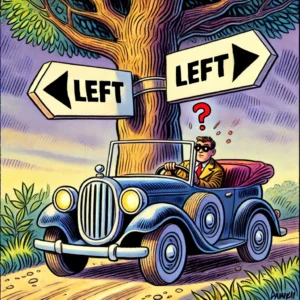
A car approaching a signpost with two arrows pointing in different directions, both leading to the same destination.

In archaeology, congruence refers to the alignment or consistency between various elements of evidence, data, and interpretations. It is the principle that all parts of a research question should fit together seamlessly to offer a coherent and reliable understanding

Guide – Challenging Assumptions with Free Thinking

One of the most powerful tools in archaeology is not just digging deeper into the earth but digging deeper into our own thinking processes. In archaeological research, we often encounter assumptions—either based on prior data, outdated methodologies, or even cultural biases—that shape how we view and interpret the past.

Guide – Introduction to Critical Thinking in Archaeological Research

A car in a river and the driver saying it is a car park

In the world of archaeology, as with all forms of inquiry, the pursuit of truth begins with the ability to think critically and independently. Archaeology is often seen as the science of uncovering the past, but it is equally the art of understanding how we approach and interpret evidence. In the case of the Brigantes Nation, a tribe whose history is riddled with gaps and assumptions, critical thinking is not only useful—it is essential.

Contact Us
close slider