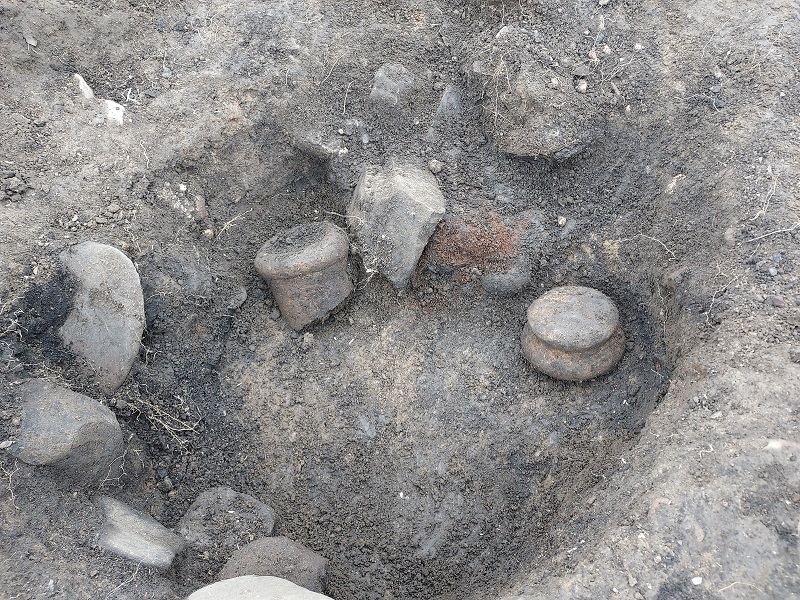
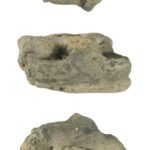
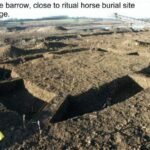
Intact Roman pot (at right) in excavation pit, Drumanagh, Ireland
DRUMANAGH, IRELAND—Last year, Irish archaeologists working at the Iron Age fort on the Drumanagh promontory north of Dublin uncovered a 2,000-year-old charred fig, providing the oldest evidence of the exotic Mediterranean fruit ever found on the island. RTE Ireland has reported that more recently they have made yet another remarkable discovery—an intact Roman pot. the first one to be uncovered on Irish soil, and providing more tantalising clues about ancient Roman-Irish interactions.
Although the Roman Empire they never reached Ireland (except, seemingly, in myth). That does not mean, that Roman influence and goods did enter Ireland, and it means that Drumanagh continues to headline as one of Irelands most tantalising archaeological sites for that same reason – exactly what were the Romans doing in Ireland?
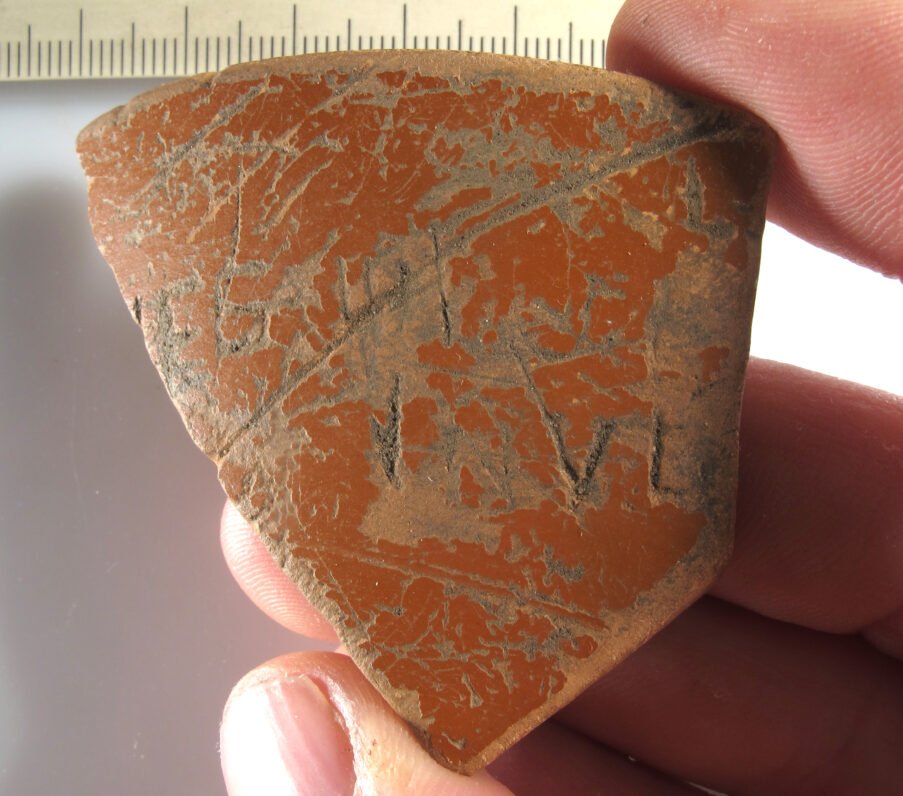
Archaeological work at Drumanagh has shown that although there was not a settlement located there, people with a Roman background or with strong Roman trading contacts frequented the site. Artifacts found include glass beads, gaming pieces, and a bone comb, but the intact Roman vessel seems to crown the collection so far.
Drumanagh Promontory Fort
Drumanagh Promontory Fort, perched on a Limestone headland just north of Loughshinny in County Dublin (OS grid O 239 104), has long fascinated archaeologists as a unique place of Iron-Age fortification and Roman-period exchange. Though the site was never formally colonized by Rome, successive investigations—both rescue digs and chance finds—have revealed a surprisingly rich set of indigenous and imported material.
Site and Setting
The fort encloses roughly 44 acres with three parallel earth banks and accompanying ditches cutting across the peninsula’s neck; sheer sea-cliffs guard the other sides. Geological evidence shows the headland sits on Carboniferous limestone, making it both defensible and a ready source of durable stone for ramparts. Coastal erosion has claimed substantial ground over the centuries, so the original enclosure may once have been even larger (en.wikipedia.org).
Major Past Finds
Amphora Sherds: From the 1950s onward, ploughing and illicit metal-detecting turned up imported tableware’s and broken amphora necks, firmly placing Drumanagh within a network of trade or exchange with Roman Britain (en.wikipedia.org).
Glass Beads, Gaming Pieces and Bone Comb: Systematic fieldwalking in the 1990s catalogued dozens of small finds pointing to repeated Roman-style activity—perhaps seasonal fairs or elite gatherings—rather than permanent settlement (archaeology.org).
Copper and Brass Ingots: Over 40 ingots recovered by detectorists, coupled with evidence of prehistoric copper mines at nearby Loughshinny, imply that Drumanagh was also an Iron-Age metallurgical hub. These ingots (some still unprovenanced) suggest smelting and trade in native metals long before Roman contact (en.wikipedia.org).
2,000-Year-Old Charred Fig: In late 2024, archaeologists unearthed a charred fig seed—Ireland’s earliest exotic fruit—demonstrating direct links in consumables and lifestyle with the Mediterranean world (archaeology.org).
First Intact Roman Pot (May 2025): Christine Baker and her team from the Centre for Irish Cultural Heritage at Maynooth University revealed the first ever complete Roman ceramic vessel in Ireland—a textbook-style pot found upside-down beside an amphora fragment. “We have found five or six different types of Roman artefacts here, including the neck of an amphora, but nobody has ever seen a pot like this before in Ireland,” Baker enthused (heritagedaily.com).
Archaeological Interpretation
No structural remains of a villa or fortification contemporary with Rome have been confirmed beneath these finds, leading to two leading hypotheses:
Trading Colony/Fair Site: Drumanagh may have hosted periodic markets where native elites traded local metals, furs and foods for Roman goods—glass, fine pottery, wine and luxury foods.
Roman Bridgehead: A more contentious theory posits that Rome established a temporary “bridgehead” here (c. AD 82), possibly under Agricola, to probe invasion options—though no direct military artifacts (weapons, fort timber) have been found to date (en.wikipedia.org).
Significance
Drumanagh stands at the crossroads of Iron-Age industry and Roman-period globalization. The intact pot not only enriches our corpus of Roman imports but also underscores how peripheral Ireland was far from isolated.
Hints from the Classical and Mythological Authors
Classic and medieval Welsh traditions hint at contact—diplomatic, military or mercantile—between Roman Britain and Ireland, but always through a veil of legend rather than hard fact.
Tacitus and Juvenal
Tacitus (c. AD 98) records that Agricola, governor of Britain, considered an Irish expedition and even entertained an exiled Irish “regulus” as a potential client ruler for a future invasion. The same historian notes that arms had been carried “beyond the shores of Hibernia” by some of his officers, suggesting at least reconnaissance or raiding rather than full conquest (en.wikipedia.org). Centuries later, the Roman poet Juvenal echoed this idea, implying that Roman forces may have ventured across the Irish Sea, although no archaeological trace of a formal military presence has been found in Ireland (en.wikipedia.org).
Early Medieval Lore
In Ireland’s own Early Medieval lore, the legendary high-king Túathal Techtmar is said to have been exiled as a boy and raised “beyond the seas,” then returned at the head of a foreign army—often interpreted as Roman-sponsored—to reclaim his throne in the first century AD. Though preserved in Irish annals, this tale was also known to Welsh chroniclers, who incorporated Túathal’s story into works like the Historia Brittonum and genealogical tracts, blending historical memory with myth (en.wikipedia.org).
Welsh Prophetic Poetry
Welsh prophetic poetry likewise casts the Irish as allies in a shared future. In the 10th-century poem Armes Prydein (“The Prophecy of Britain”), a unified Brythonic host joins Scots, Irish and Vikings to expel the Saxons—an imaginative reversal of Roman-era dynamics that nonetheless reflects a long-standing sense of kinship between the Britons and the Gaels (en.wikipedia.org). While Armes Prydein post-dates Rome’s withdrawal by half a millennium, its very invocation of Irish-British solidarity hints at enduring cultural memories of earlier contacts.
Place-name Evidence
Finally, place-names and field-names in Wales occasionally preserve echoes of Irish links—Cantref Gwladys “Land of Gladz,” for example, is said in local legend to recall an Irish princess’s dowry lands—but these are folklore, not secure evidence of Roman-era relations. In the absence of direct archaeological proof for Roman bases in Ireland, these myths remain tantalizing reflections of cross-channel awareness rather than concrete testimony.
Together, the classical allusions in Tacitus and Juvenal, the mythic saga of Túathal Techtmar, and the later Welsh prophetic vision in Armes Prydein form a patchwork of sources suggesting that Irish-British contacts during Rome’s tenure in Britain were romantically remembered.
An incomplete cast copper alloy double looped trapezoidal buckle of post medieval date. Only one loop remains. The frame is narrow with bevelled edges and a narrowed strap bar. There is no visible decoration. [...]
An incomplete cast copper alloy Roman bow brooch, of plate headed hinged T-shaped type dating to the 2nd century AD. The arms are narrow and cylindrical, enclosing an axis spindle and with a notch at the centre [...]
A worn and corroded post-Medieval copper-alloy Nuremberg Jetton of anonymous 'ship-penny' type (c. 1490-1550). Obverse has a sailing ship, the reverse has four fleur-de-lis in a lozenge. Illiterate legends. Cf. Mitchiner 1152-1165. [...]
Lead token, tally or boardgame piece. Hammered bifacial disc with one side bearing a pattern or device resembling a stylised tree with stocky fringed trunk and an arcing ‘legend’ of dots between faintly defined circles. [...]
Silver coin fragment. Worn long cross round halfpenny, broken to achieve well under one farthing’s weight, issue of 1280-1327Obverse description: worn smoothReverse description: long cross, three pellets in each angleReverse inscription: CIVI/[TAS]/(----)Diameter: 14.3mm, Weight: 0.23gms [...]
Silver coin. Short cross cut halfpenny of John (1199-1216) or Henry III (1216-1272), London mint. Class 6a1 issue of 1208-1218Obverse description: facing bust with sceptre left, hair left of two oval curls, beard of fine [...]
Copper alloy unidentified object fragment. Cast square-section bar with a stepped and rounded end; other end broken. The rounded tip forbids interpretation as a nail shank, which this object otherwise resembles. Suggested date: possibly Roman, [...]
Copper alloy finger ring. Cast oval bezel and tapered/constricting shoulders of a finger ring; the bezel is filled with blue enamel, sunken in the middle and crazed by recent impact; Guiraud type 1. The rest [...]
Silver coin. Penny of Edward I (1272-1307), class 10cf3 issue of 1307-1309, London mintObverse description: facing bust with broad bifoliate crown cf3 with break in band, drapery of angled wedges, initial cross pattee.Obverse inscription: +EDW [...]
A Medieval silver groat of Edward III (AD 1327-1377). Series E (North 1163) dating to AD 1354-5. London mint. North (1991: 51). Edge on the lower right quarter on the obverse has broken away. Coin measures 28.3mm in diameter. [...]
Silver coin. Voided long cross cut halfpenny of Henry III (1216-1272), probably class 3a issue of 1248-1250Obverse description: facing bust no sceptre, legend starts at 12 O’clock, hair comprises two neat curls and pellets left [...]
Copper alloy brooch fragment. A now-cruciform scrap of a cast plate brooch, possibly Mackreth type British Plate [unspecified], comprising the paired U-shaped lugs from the seat for a hinged pin, with a flat front retaining [...]
Silver coin. Denarius of an indeterminate early Roman emperor, cut with the loss of about one fifth of the flan, probably issue of AD14-138.Obverse description: bust laureate draped right, clean-shaven and jowled, lightly tousled hair.Obverse [...]
A worn and corroded Roman copper alloy nummus of the House of Constantine dating to AD 330-340 (Reece period 17). VRBS ROMA type with a reverse depicting Romulus and Remus suckling a wolf, with three stars above. Mint of Trier. Cf. LRBC Vol [...]
Lead and iron possible steelyard weight, as kindly suggested by the finder. An irregular plano-convex lump of cast lead retaining relicts of a heavy iron suspension loop with recent breakage evident; the lead is slightly [...]
A Roman copper alloy nummus of Constantine II (AD 317 - 340) dating to AD 327 (Reece period 16). PROVIDENTIAE CAESS reverse depicting a camp-gate of two towers with a star above. Mint of Arelatum / Arles. [...]
A post medieval, lead human figurine probably dating from the late 18th- 19th century.The figurine is in the form of a standing figure, possibly female holding a baby. Possibly depicting Mary with child. The reverse is flat [...]
A medieval cast copper alloy single looped oval buckle, complete with plate and pin. The frame has a rounded front edge and a recessed strap bar with lobes at either end. The plate is sub triangular [...]