Tag: Roman

The hero archetype and Lugh

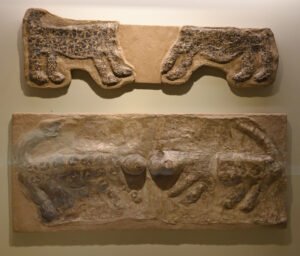
Museum of Anatolian Civilizations Çatalhöyük Leopard reliefs all in 2019 01

At its core the “hero” is the figure who steps out of ordinary society, confronts chaos or a monster, and returns (or dies) having secured order for the group. In Jungian and comparative-myth terms it sits in the “warrior-champion” slot of the collective story-board; evolutionists would say it crystallises the survival value of decisive coalition leadership in small bands.
Gnaeus Julius Agricola

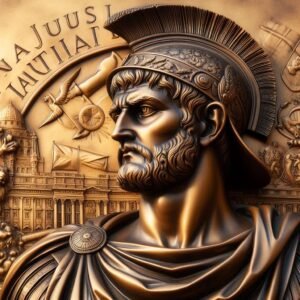
In a series of annual military campaigns Agricola put down revolts in north Wales, subdued the Brigantes tribe in the north, extended Roman control over the Scottish lowlands, where he established a string of forts between the Forth and the Clyde, sent troops into Galloway, and made inroads into the eastern Highlands. During the latter campaign his vessels were the first to circumnavigate the islands.

Guide: Spoil Heaps

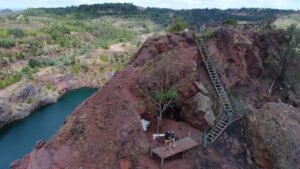
Ochre mine in the Lion Cavern in Eswatini southern Africa - Credit - Jörg Linstädter

These are artificial hills made from the unwanted rock, shale and tailings that come up with coal, metal ore, stone or clay when it is being mined or quarried. Because extractive industry is both deep and long-lived, single collieries or pits can generate tens of millions of cubic metres of spoil; pushed out by locomotive, conveyor or tippler wagon and dumped in successive layers, the piles quickly become a distinctive landform.

Guide: Barrows

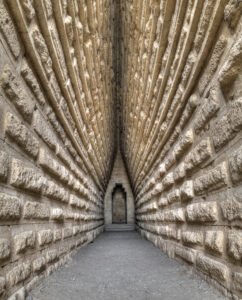
royal kurgans barrow, interior

A barrow is a mound of earth and/or stones raised over a grave or group of graves. Used from the Neolithic through to the Iron Age (roughly 4000 BCE to 500 CE), barrows were often constructed to honour elite individuals, such as tribal leaders, warriors, or chieftains. They are frequently found singly or in cemeteries known as barrow fields.

Brigantes Tribe

Thornborough Henges c.2004

The name Brigantia represents three separate concepts: a goddess, a people, and a tribal federation. By the Roman period, the name represented a tribal federation compromising all of what would become the Roman province of Britannia Secunda, except for the Parisi territory, east of the River Derwent.

The Legend of Caer Caradoc

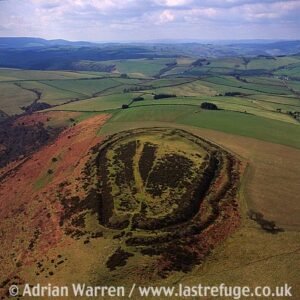
Caer Caradoc

Caer Caradoc is often linked to Caradoc (or Caradog), a prominent figure in Welsh mythology and Arthurian legend. Caradoc is considered one of the knights of the Round Table in Arthurian lore, and he is sometimes referred to as Caradoc of the Battle or Caradoc the Brave. He was known for his bravery and his loyalty to King Arthur.

Briefing – Roman Interaction with Galicia and the Iberian Peninsula

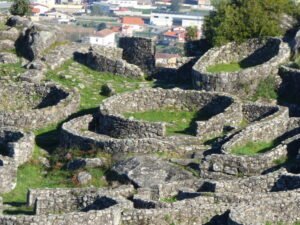
Hut circles at Castro de Santa Trega

Roman Invasion of Hispania: The Romans’ first significant incursions into the Iberian Peninsula began in 218 BCE during the Second Punic War, when Hannibal Barca, the Carthaginian general, crossed the Alps and threatened Rome. This prompted Roman intervention to ensure control of their western Mediterranean territories.

Guide – The Roman Period in the British Isles

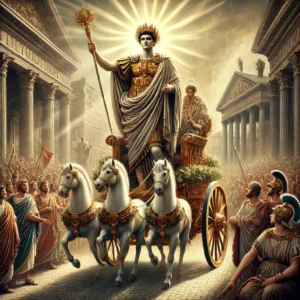
Emperor Augustus dressed as a deity, parading through ancient Rome

Julius Caesar made the first significant Roman attempt to conquer Britannia in 55 BCE during his campaign in Gaul. He landed on the shores of south-eastern Britain, but his invasions were brief and mostly for reconnaissance. Despite some skirmishes, there was no lasting conquest at this stage.

Rome: The Emperors Claim to Divinity

Emperor Augustus dressed as a deity, parading through ancient Rome

Celtic Heads Celtic Head from Witham, 2nd c B.C. (British Museum) “Celtic” carved heads are found throughout the Read more Timeline 60BC – 138AD This timeline is focussed on the British Celtic culture and those cultures which had influence on the British Celts. It Read more Heads at St Michael, Kirklington An analysis of head …

Continue reading

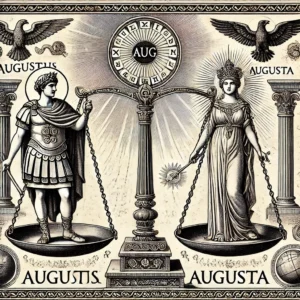
Latin Translation – Choosing the meaning of AUG

A symbolic illustration representing the process of determining the meaning of 'AUG' in Roman inscriptions

The term AUG could mean either Augustus, or Augusta. Given that we have inscriptions that give the Goddess Brigantia an appellation of Augusta, how do translators choose between those two options?

Contact Us
close slider