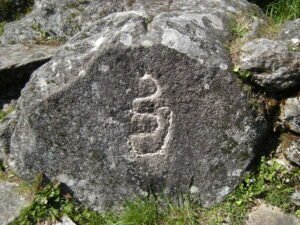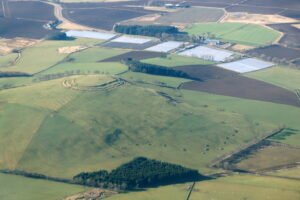
Boltby is a very important ancient site IMO. A gold “hair braid”, was found there, linking it to the Amesbury Archer, buried with two similar hair braids. This also provides a link to the founding of Stonehenge, which helps set a potential scene for a possible “zeitgeist”, of the day.
Category: Fort
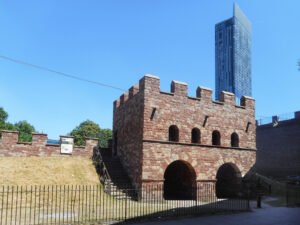
Mamucium Roman Fort, Manchester
Mamucium occupies a low sandstone promontory at the junction of the Rivers Medlock and Irwell. The bedrock is the Triassic Sherwood Sandstone Group, a firm, well‑drained red sandstone that gave Roman engineers a stable platform for earthworks and timber palisades, while nearby river gravels supplied road‑making aggregate.
Castro de Trona fort – Pontevedra, Spain
Castro de Trona is an oval enclosure with significant terracing to the west and a large ditch to the east. This castro (a hillfort settlement) has an accepted date of around 600 BCE. Like many others in Galicia, this castro reached its peak during the 1st and 2nd centuries CE. It measures approximately 200 metres east to west by 150 metres north to south.
Doncaster Roman Fort (Danum)
← South Yorkshire Roman Rig Defensive Works The Roman Rig is a defensive dyke built to defend against attack from the south. It runs from Sheffield, past Read more Templeborough Roman Fort – Rotherham Templeborough Roman Fort occupies a commanding position on the north bank of the River Don at Rotherham (OS grid SK Read …
Templeborough Roman Fort – Rotherham
Templeborough Roman Fort occupies a commanding position on the north bank of the River Don at Rotherham (OS grid SK 410 916), where the Magnesian Limestone ridge drops into the floodplain. Originally constructed in timber and earth in the mid–1st century AD, it was later rebuilt in stone and occupied—possibly intermittently—until the withdrawal of Roman authority in the early 5th century AD
Drumanagh Promontory Fort – First Ever Intact Roman Pot Found in Ireland
RTE Ireland has reported that more recently they have made yet another remarkable discovery—an intact Roman pot. the first one to be uncovered on Irish soil, and providing more tantalising clues about ancient Roman-Irish interactions.
Although the Roman Empire they never reached Ireland (except, seemingly, in myth). That does not mean, that Roman influence and goods did enter Ireland, and it means that Drumanagh continues to headline as one of Irelands most tantalising archaeological sites for that same reason – exactly what were the Romans doing in Ireland?
- 1
- 2