These are raised platforms created first and foremost for cult, procession, assembly or conversion—not for fortification or routine boundary-making. They tend to be much more significant and monumental than other mounds and raised platforms. Some are the largest structures known of their type. In Britain, possibly the best known example is Silbury Hill in Wiltshire.
Category: Georgian
Jun 11
Guide: Ritual/Ceremonial Mounds
- Filed under Anglo-saxon, Bronze Age, Ceremonial Mount, Dark Ages, Early Christian, Early Medieval, Georgian, Guide, Landscape feature, Medieval, Neolithic, New Sites, Norman
Intach Ford: Upstream of Nathwaite Bridge, Coverdale
- Filed under Brigantia England, Ford, Georgian, Jacobite, Medieval, Medieval Brigantia, Norman, Stuart, Tudor
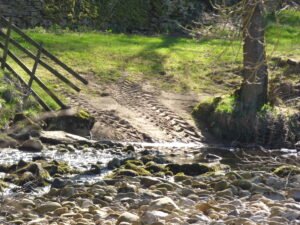
In the field of Bridge Barn, close to Nathwaite Bridge, there are two fords marked on the OS Series 1 map. This site page holds the details of our investigation into the fording point we think may be called Intach Ford.
May 20
Guide: Fortified Barns in Yorkshire – A historical overview
- Filed under Brigantia England, Enclosure, Fortified Barn, Georgian, Guide, Jacobite, Landscape feature, Medieval, Medieval Brigantia, Stuart, Tudor
Even in a rural community of mainly farmers, there are often reasons to wish to build or create a structure that is for, at least in part, for defensive purposes. Thus, some barns in Yorkshire and other places can be seen to have “arrow slits”, and later, square “gun ports”. This article provides a brief overview of what these structures are, why they were built and how they were used.
- Abbey, Barn, Bastle, Bastle-barn, Bolton Abbey, Bolton Priory Tithe Barn, Bowlees, Byre, Coverdale, Dentdale, Easby, Estate Barn, Fountains Abbey, Friar's Head Grange Barn, gun-loop, Holwick, Jervaulx, Keld, Langstrothdale, Loophole, Monastic, Mount Grace, Muker, Musket-loop, Nidderdale, North Riding, priory, Put-log hole, Rievaulx, Scar House Coal Barn, Stang-side Bustle, Swaledale, Thornton Stewart, Thwaite, Town Head Farm Barn, Upper Teasdale, Wensleydale, Yorkshire, Yorkshire Dales
- Leave comment
May 20
The Coal Barns of Coverdale
- Filed under Anthracite - Coal, Barn, Brigantia England, Georgian
“Coal Barns”, are, in the case of Coverdale, and smaller coal producer, often, simply ordinary barns, which have been used, and perhaps partially converted for use as coal storage.
Nathwaite Bridge – Coverdale
- Filed under Bridge, Georgian, Regional Surveys
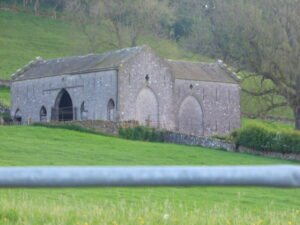
Nathwaite bridge over the River Cover is a strategically placed river crossing, for centuries it has been the only crossing point over the river Cover, and with a fortified barn right next door to it, this is an enigmatic site worthy of closer attention.
Jul 05
The Lawson-Tancred family
- Filed under Brigantia England, Georgian, Leaders, Medieval, Norman
The Lawson-Tancred family, with its roots deeply embedded in English history, boasts several notable figures who have made significant contributions to their fields and society. The lineage of the family can be traced back to the Norman Conquest, with Richard Tankard, who owned lands at Boroughbridge in Yorkshire shortly after this pivotal event in English history.
Aldborough Hall, North Yorkshire
- Filed under Brigantia England, Georgian, Hall
Aldborough Hall, nestled in the picturesque village of Aldborough in North Yorkshire, England, is a testament to architectural evolution and historical significance. The origins of the hall can be traced back to the early 17th century
World Heritage
- Filed under Anglo-saxon, Bronze Age, Dark Ages, Dark Ages Brigantia, Early Christian, Early Medieval, Georgian, Iron Age, Jacobite, Medieval, Medieval Brigantia, Mesolithic, Neolithic, Norman, Palaeolithic, Roman, Saxon, Stuart, Tudor
This is our master collection page for all of our heritage articles and sites. It is the root of our tree of sites covered within Brigantes Nation. Both within and without Brigantia. It is everything that has been of interest, so far.
Articles
- Bronze Age
- Iron Age
- Roman
- Dark Ages
- Early Christian
- Viking
- Saxon
- Medieval
- Vitrified Fort
- Archaeology Guide
- Guide – Introduction to Critical Thinking in Archaeological Research
- Guide – Challenging Assumptions with Free Thinking
- Guide – Congruence in Archaeological Interpretation: Holistic Analysis
- Guide – Critical Thinking: Lack of Evidence Does Not Mean Evidence of Lack
- Guide – Critical Thinking: The Simple Assumption
- Guide – Applying critical thinking to historic and archaeological research
- Guide – Empathic Archaeology Introduction
- Guide – Landscape Archaeology Introduction
- Guide – What is Landscape Archaeology?
- Guide – Introduction to Glacial Archaeology
- Guide – The Flora and Fauna of Prehistoric Britain
- Guide – Landscape Archaeology: Post-Ice Age Landscape of Thornborough
- Guide – Archaeological Periods in Western Europe
- Guide – Visible Remains
- Guide – Hidden Remains
- Guide – Getting Started
- Guide – Landscape Features
- Guide – Agricultural practices through time
- Guide – Introduction to Glacial Archaeology
- Guide: In Depth – Church Doors and Windows
- Guide – Mining
- Guide – Archaeological Terms
- Guide – Glossary
- Latin Translation – Choosing the meaning of AUG
- Reports
- An introduction to Brigantian Druidry
- Brigantia during the Dark Ages
- Celtic Heads
- Finding Bardon – An Arthurian Quest
- Early Christian syncretism and how the old ones hid amongst the new religion
- Rome: The Emperors Claim to Divinity
- Syncretism through the ages
- The Border Reivers
- The Gallus Frontier – Brigantia against the Romans
- The growth of Christianity 50AD – 1100AD
- The Kingdom of Venutius
- The use of the word Lady in relation to water related structures
- The walled gardens of Brigantia
- Yorkshire’s “Sacred Vale” – The Dawn of Brigantia
- Brigantia Espania
- Iberian Peninsular
- Galicia
- Biefing – The Myth of Breogán and the Tower of Heracles
- Briefing – Galicia’s Political History and Separatist Sentiment
- Briefing – Geography and Geology of Galicia
- Briefing – Design of Galician Hillforts
- Briefing – Roman Interaction with Galicia and the Iberian Peninsula
- Church of Santa María de Cambre, Cambre near A Coruña
Categories
- Agriculture (6)
- Field Systems (1)
- ploughing (2)
- Angle (2)
- Archaeological Periods (312)
- Anglo-saxon (6)
- Bronze Age (52)
- Late Bronze Age (1)
- Dark Ages (24)
- Dark Ages Brigantia (9)
- Early Christian (37)
- Early Medieval (8)
- Georgian (9)
- Gothic (3)
- Ice Age (1)
- Iron Age (133)
- Late Iron Age (5)
- Jacobite (7)
- Medieval (61)
- Medieval Brigantia (9)
- Mesolithic (11)
- Neolithic (45)
- Early Neolithic (5)
- Norman (40)
- Palaeolithic (6)
- Roman (94)
- Saxon (9)
- Stuart (6)
- Suspect (1)
- Tudor (10)
- Undated (7)
- Viking (4)
- Archaeology (93)
- Archaeobotanical (1)
- Empathic Archaeology (11)
- Free Thinking (7)
- Battle (1)
- Brigantia (147)
- Brigantia England (134)
- Brigantia Espania (11)
- Civil Structure (6)
- Defensive Structures (45)
- Castle (5)
- Defensive Dike (2)
- Defensive Walls (1)
- Fort (20)
- Fortified Barn (1)
- Marching Camp (5)
- Motte and Bailey (6)
- Ring Work (1)
- Class A (1)
- Dialects (1)
- Earthworks (51)
- Dike (8)
- Field Systems (26)
- Enclosure (12)
- Enclosure Acts (1)
- Europe (51)
- Festivals (2)
- Finds (42)
- Altar (10)
- Amphora (1)
- Animal Remains (4)
- Auroch (1)
- Hoof marks (1)
- Antler Pick (2)
- Arrowhead (1)
- Leaf-shaped (1)
- Axe (1)
- Bone Comb (1)
- Celtic Head (8)
- Celtic Head (2)
- Clock (1)
- Curse Tablet (1)
- Flint Scatters (4)
- Gaming Pieces (1)
- Hair Braid – Ring (4)
- Human Remains (2)
- Adult (1)
- Couched Burial (1)
- Juvinile (1)
- Mace Head (1)
- S-curved (1)
- Mosaic (1)
- Polished Stone Adze (1)
- Pottery (8)
- Funerary Urns (2)
- Grooved ware (1)
- Peterborough ware (1)
- Mortlake ware (1)
- Planig‑Friedberg ware (1)
- Samian ware (2)
- Vasi a Bocca Quadrata ware (1)
- Quern Stones (1)
- Statue (1)
- Geography (16)
- Maps (7)
- Geology (13)
- Anthracite – Coal (2)
- Geomorphology (2)
- Gods (9)
- Guide (72)
- Critical Thinking (8)
- Socratic Thought (1)
- Glossary (1)
- Hidden Remains (8)
- Geophysics (5)
- LiDAR (1)
- Radiocarbon Dating (1)
- Remote Sensing and Analysis (1)
- Regional Surveys (13)
- Research Tools (4)
- Visible Remains (12)
- Air Mapping (2)
- Air Photography (2)
- Fieldwalking (2)
- Lithics (1)
- Photography (6)
- Critical Thinking (8)
- Henge (18)
- Hill Fort (61)
- Castro Hillfort (3)
- Contour/Plateau Fort (1)
- Multivallete Hillfort (1)
- Oppidum (1)
- Oppidum (1)
- Promontory fort (4)
- Slavic Gord (1)
- Univallet Hillfort (4)
- Vitrified Fort (27)
- Historic Buildings (20)
- Amphitheatre (1)
- Barn (2)
- Beacon (1)
- Broch (1)
- Coaching Inn/Hostelry (1)
- Folly (4)
- Hall (2)
- Hospital (1)
- House (1)
- Tower (7)
- Walled Garden (1)
- Industrial Heritage (9)
- Chimney (1)
- Mining (9)
- Spoil Heap (1)
- Smelting (2)
- Iron-Age (1)
- Landscape Archaeology (38)
- Glacial Archaeology (2)
- Landscape Legislation (1)
- Mining Landscape (1)
- Ritual Landscape (6)
- Landscape feature (49)
- Barrow (18)
- Bell Barrow (2)
- Bowl Barrow (1)
- Cairn (2)
- Disc Barrow (1)
- Long Barrow (5)
- Ring Barrow (1)
- Ring Cairn (1)
- Round Barrow (1)
- Square Barrow (1)
- Steppe Kurgan (1)
- Boundary Marker (2)
- Burial Mound (9)
- Ceremonial Mount (1)
- Cursus (2)
- Hill Figure (5)
- Linear Earthworks (2)
- Mound (6)
- Passage Tomb (1)
- Ring Cairn (2)
- Snake Mound (1)
- Terraces (3)
- Barrow (18)
- Leaders (33)
- Agricola (2)
- Arthur (1)
- Augustus Caesar (2)
- Breogans (3)
- Caratacus (1)
- Cnut (1)
- Julius Caesar (1)
- Petilius Cerialis (1)
- Liminal Spaces (1)
- Market (1)
- Megalithic (10)
- Rock Art (3)
- Stone alignment (1)
- Stone Circle (7)
- stone circles (1)
- Stone Row (2)
- Myth and Legend (5)
- New Sites (23)
- Publications (21)
- Biographies (2)
- Henge Capital of Britain (10)
- News (4)
- Stories of Brigantia (4)
- Walking Guides (1)
- Rabbit Warren (1)
- Religious Structures (31)
- Abbey (3)
- Church (24)
- Crosses (1)
- Memorial Planting (1)
- Priory (2)
- Religious Orders (3)
- Ritual walkway/pilrimage path (1)
- Reports (148)
- Roman Culture (11)
- Roman army (8)
- Roman baths (1)
- Roman City (1)
- Roman Gods (1)
- Mercury (1)
- Roman navy (1)
- Roman pottery (3)
- Samian ware (2)
- Roman Road (1)
- Roman Roads (2)
- Roman Villa (2)
- The Celtic World (35)
- Celtic Gods (1)
- Lugh (1)
- Celtic Industry (1)
- Celtic Life (9)
- Celtic Trade (1)
- Celtic Tribes (27)
- Celtic Gods (1)
- Trade (4)
- Minting (3)
- Coins (1)
- Spoil Heaps (2)
- Minting (3)
- Translation (7)
- Inscription (4)
- Latin (5)
- Uncategorized (24)
- Water Works (13)
Research Links
Heritage Gateway
Announcing: The Brigantian News!
- Roman Road to the West uncovered under Manchester Street 16 July 2025
- What might Stonehenge Mean? Dartmoor and Carnac add to the Picture 3 July 2025
- Megalithic Stone Monuments in France May Be Europe’s Oldest 1 July 2025
- Drumanagh Promontory Fort – First Ever Intact Roman Pot Found in Ireland 5 June 2025
Portable Antiquities News
An incomplete Medieval to Post Medieval bone or ivory parchment-pricker dating to the 13th-16th century. The shaft has a circular cross-section and tapers towards the tip, it is broken approximately half way along its length. At [...]
A Post Medieval lead alloy cloth seal dating from the 16th – 17th century. This is a two part cloth seal with both faces having similar imagery. One side has three letters 'C L C' [...]
A Late Medieval copper-alloy eyed book clasp / composite 'double rectangular' book fitting of Howsam's type A.7 dating to c.1350-1450.Comprising of two rectangular plates joined together with four separate securing rivets, one at each corner, with all [...]
A worn late medieval silver halfgroat of Henry VII (1485 - 1509), Class IIIc dating to c.AD 1490 - 1500. Tun initial mark to obverse, tun or pansy to reverse. Mint of Canterbury, struck jointly [...]
An incomplete Irish silver Shilling of James I (AD 1603-1626). Second coinage. Crowned harp reverse. Dublin mint. AD 1604-1607.Diameter: 25.95mm, Thickness: 0.72mm, Weight: 3.31gThe coin is missing portions of its outer flan due to clipping, and [...]
A complete silver Groat of Edward III (AD 1327-1377). Fourth coinage, Pre-Treaty series C/D/E. Fourth coinage, Pre-Treaty Period, Series C. Long cross reverse, dividing double legend, with three pellets in each quadrant. As London mint. AD [...]
An incomplete silver Penny of Elizabeth I (AD 1558-1603). Third coinage. Long cross fourchée reverse over squared reverse shield. One initial mark. London mint. AD 1601-1602.Diameter: 14.01mm, Thickness: 0.54mm, Weight: 0.61gThe coin is missing minor portions its [...]
A complete silver denarius of Trajan (AD 98-117) dating to AD 98-99 (Reece Period 5). PM TRP COS III PP reverse type, depicting Victory seated left with palm and patera. Mint of Rome.Diameter: 19.77mm, Weight: 2.86g RIC Vol. II, p. 245, [...]
A complete silver Groat of Edward III (AD 1327-1377). Fourth, pre-Treaty coinage, series E. Long cross reverse with three pellets in each quadrant, legend in two fields. London mint. AD 1354-1355. Diameter: 27.09mm, Thickness: 1.03mm, [...]
A complete silver Ring of Post-Medieval to Modern date (AD 1650-1950). Small ring composed of plaited silver wire. The object is constructed of multiple strand silver plaited wire, which is circular in section, in groups of nine, [...]
An incomplete Swivel Fob Seal of Post-Medieval date (AD 1700-1800). The object is composed of a rectangular section ovate swivelling seal face which is detached from the handle but retained. The Axis bar is broken [...]
An incomplete silver cut Halfpenny of Henry II (AD 1154-1189). Cross-and-Crosslets type. Bust C. Unclear moneyer and mint. AD 1161-1165.Diameter: 20.75mm, Thickness: 0.81mm, Weight: 1.44gThe coin is missing minor portions of its outer flan.North Vol [...]
An incomplete silver Halfgroat of James I (1603-1625). Second coinage. Small crowned thistle reverse. Escallop initial mark. London mint. AD 1606-1607.Diameter: 15.89mm, Thickness: 0.42mm, Weight: 0.77gThe coin is missing minor portions of its outer flan.North Vol II, [...]
An incomplete copper alloy Brooch of Roman date (AD 43-360). The object is a Colchester derivative, Harlow type brooch with a spring mechanism. The head is composed of hollow and semi-circular wings. From the back of the head [...]
A Roman copper alloy radiate or nummus dating to AD 260-402.. Unclear reverse type. Unclear mint. [...]
A Post Medieval copper-alloy Rose farthing of Charles I (1625-1649) dating to AD1636-1644. Not further defined. [...]
A Roman copper alloy nummus dating to AD 300-400. Unclear reverse type. Unclear mint. [...]
A copper alloy Roman radiate of Claudius II (AD268-270) dating to AD270-271 (Reece period13). CONSECRATIO reverse type depicting an eagle. Unclear mint. [...]
An incomplete copper alloy Roman nummus of an unclear ruler dating to AD300-400. Unclear reverse type. Unclear mint. [...]
A Roman copper alloy nummus of the House of Constantine (307-361) dating to AD 318-324 (Reece period 16). VICTORIAE LAETAE PRINC PERP reverse type depicting two victories holding a wreath or shield over an altar. [...]
Recent Articles and Site Pages
- The Story of Boltby Scar
- Swaledale
- Guide: Parliamentary-walls and the Northern Enclosures
- County Durham
- The hero archetype and Lugh
- Head One – St Michaels Church, Kirklington
- Long Meg and her Daughters standing stone and stone circle
- Cana Barn Henge
- Anciens Arsenaux Neolithic Settlement, Sion – Switzerland
- Gnaeus Julius Agricola
- Snake Iconography in the British Isles
- Wiltshire
- Liverpool Street Roman Road, Manchester
- South Street Long Barrow, Avebury
- Mamucium Roman Fort, Manchester
Locations
- Czechia (1)
- England (198)
- Bedfordshire (1)
- Cumbria (13)
- Dorset (2)
- Durham (9)
- East Yorkshire (1)
- Lancashire (7)
- North Derbyshire (8)
- North Yorkshire (118)
- Yorkshire Dales (4)
- Yorkshire Moors (1)
- Northumberland (9)
- Oxfordshire (2)
- Somerset (2)
- South Yorkshire (10)
- Staffordshire (3)
- West Yorkshire (7)
- Wiltshire (4)
- Europe (8)
- France (3)
- Germany (2)
- Global (3)
- Ireland (4)
- County Dublin (1)
- Scotland (21)
- Dumphries and Galloway (3)
- Grampian (4)
- Highlands (8)
- Perthshire (4)
- Tayside (3)
- Spain (4)
- Switzerland (1)
- Wales (4)