
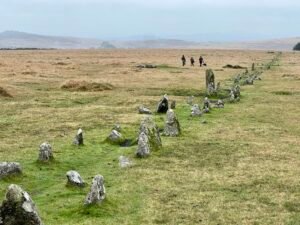
Stonehenge has always been enigmatic, due to its use of those definitive morticed trilithons, all of which where squared of, more like the structures of the Maltese temples and other stone structures closer to Africa, as opposed to those of the rest of Britain and most of the wider North-west European ritual landscape.
Category: Bell Barrow
What might Stonehenge Mean? Dartmoor and Carnac add to the Picture
- Filed under Barrow, Bell Barrow, Britain, Bronze Age, France, Funerary Urns, Hair Braid - Ring, Landscape feature, Megalithic, Mining, Neolithic, News, Radiocarbon Dating, Smelting, Stone alignment, Stone Circle, Stone Row, Wales
- amesbury, Anglesey, archer, boltby, Boltby Scar, britain, Bronze Age, Carnac, Dartmoor, France, Gold Tresses, Great Orme, Hill Fort, Kirkhaugh, Llanymynech, Nabta Playa, nenthead, Neolithic, North Yorkshire, Parys Mountain, Powys, Rouslton Moor, Shropshire, Stonehenge, Tabular Hills, wales, Yorkshire Moors
- 4 comments
Jun 10
Guide: Barrows
- Filed under Archaeobotanical, Barrow, Bell Barrow, Bowl Barrow, Bronze Age, Dark Ages, Disc Barrow, Europe, Guide, Iron Age, Landscape Archaeology, Landscape feature, Long Barrow, Neolithic, Ring Barrow, Ritual Landscape, Roman, Round Barrow, Square Barrow, Steppe Kurgan
A barrow is a mound of earth and/or stones raised over a grave or group of graves. Used from the Neolithic through to the Iron Age (roughly 4000 BCE to 500 CE), barrows were often constructed to honour elite individuals, such as tribal leaders, warriors, or chieftains. They are frequently found singly or in cemeteries known as barrow fields.
- AngloViking, Arras Culture, barrow, Barrow Timeline, Bell Barrow, Bowl Barrow, britain, Bronze Age, Burial Mound, Disc Barrow, Eastern Europe, Hallstatt, Iberian Peninsular, ireland, Iron Age, la tene, Long Barrow, Neolithc, Nordic Bronze Age, Ring Barrow, Roman, Round Barrow, ScandinaviaUkraineCentral Europe, Square Barrow, Steppe Kurgan, timeline
- Leave comment
Articles
- Bronze Age
- Iron Age
- Roman
- Dark Ages
- Early Christian
- Viking
- Saxon
- Medieval
- Vitrified Fort
- Archaeology Guide
- Guide – Introduction to Critical Thinking in Archaeological Research
- Guide – Challenging Assumptions with Free Thinking
- Guide – Congruence in Archaeological Interpretation: Holistic Analysis
- Guide – Critical Thinking: Lack of Evidence Does Not Mean Evidence of Lack
- Guide – Critical Thinking: The Simple Assumption
- Guide – Applying critical thinking to historic and archaeological research
- Guide – Empathic Archaeology Introduction
- Guide – Landscape Archaeology Introduction
- Guide – What is Landscape Archaeology?
- Guide – Introduction to Glacial Archaeology
- Guide – The Flora and Fauna of Prehistoric Britain
- Guide – Landscape Archaeology: Post-Ice Age Landscape of Thornborough
- Guide – Archaeological Periods in Western Europe
- Guide – Visible Remains
- Guide – Hidden Remains
- Guide – Getting Started
- Guide – Landscape Features
- Guide – Agricultural practices through time
- Guide – Introduction to Glacial Archaeology
- Guide: In Depth – Church Doors and Windows
- Guide – Mining
- Guide – Archaeological Terms
- Guide – Glossary
- Latin Translation – Choosing the meaning of AUG
- Reports
- An introduction to Brigantian Druidry
- Brigantia during the Dark Ages
- Celtic Heads
- Finding Bardon – An Arthurian Quest
- Early Christian syncretism and how the old ones hid amongst the new religion
- Rome: The Emperors Claim to Divinity
- Syncretism through the ages
- The Border Reivers
- The Gallus Frontier – Brigantia against the Romans
- The growth of Christianity 50AD – 1100AD
- The Kingdom of Venutius
- The use of the word Lady in relation to water related structures
- The walled gardens of Brigantia
- Yorkshire’s “Sacred Vale” – The Dawn of Brigantia
- Brigantia Espania
- Iberian Peninsular
- Galicia
- Biefing – The Myth of Breogán and the Tower of Heracles
- Briefing – Galicia’s Political History and Separatist Sentiment
- Briefing – Geography and Geology of Galicia
- Briefing – Design of Galician Hillforts
- Briefing – Roman Interaction with Galicia and the Iberian Peninsula
- Church of Santa María de Cambre, Cambre near A Coruña
Categories
- Agriculture (6)
- Field Systems (1)
- ploughing (2)
- Angle (2)
- Archaeological Periods (312)
- Anglo-saxon (6)
- Bronze Age (52)
- Late Bronze Age (1)
- Dark Ages (24)
- Dark Ages Brigantia (9)
- Early Christian (37)
- Early Medieval (8)
- Georgian (9)
- Gothic (3)
- Ice Age (1)
- Iron Age (133)
- Late Iron Age (5)
- Jacobite (7)
- Medieval (61)
- Medieval Brigantia (9)
- Mesolithic (11)
- Neolithic (45)
- Early Neolithic (5)
- Norman (40)
- Palaeolithic (6)
- Roman (94)
- Saxon (9)
- Stuart (6)
- Suspect (1)
- Tudor (10)
- Undated (7)
- Viking (4)
- Archaeology (93)
- Archaeobotanical (1)
- Empathic Archaeology (11)
- Free Thinking (7)
- Battle (1)
- Brigantia (147)
- Brigantia England (134)
- Brigantia Espania (11)
- Civil Structure (6)
- Defensive Structures (45)
- Castle (5)
- Defensive Dike (2)
- Defensive Walls (1)
- Fort (20)
- Fortified Barn (1)
- Marching Camp (5)
- Motte and Bailey (6)
- Ring Work (1)
- Class A (1)
- Dialects (1)
- Earthworks (51)
- Dike (8)
- Field Systems (26)
- Enclosure (12)
- Enclosure Acts (1)
- Europe (51)
- Festivals (2)
- Finds (42)
- Altar (10)
- Amphora (1)
- Animal Remains (4)
- Auroch (1)
- Hoof marks (1)
- Antler Pick (2)
- Arrowhead (1)
- Leaf-shaped (1)
- Axe (1)
- Bone Comb (1)
- Celtic Head (8)
- Celtic Head (2)
- Clock (1)
- Curse Tablet (1)
- Flint Scatters (4)
- Gaming Pieces (1)
- Hair Braid – Ring (4)
- Human Remains (2)
- Adult (1)
- Couched Burial (1)
- Juvinile (1)
- Mace Head (1)
- S-curved (1)
- Mosaic (1)
- Polished Stone Adze (1)
- Pottery (8)
- Funerary Urns (2)
- Grooved ware (1)
- Peterborough ware (1)
- Mortlake ware (1)
- Planig‑Friedberg ware (1)
- Samian ware (2)
- Vasi a Bocca Quadrata ware (1)
- Quern Stones (1)
- Statue (1)
- Geography (16)
- Maps (7)
- Geology (13)
- Anthracite – Coal (2)
- Geomorphology (2)
- Gods (9)
- Guide (72)
- Critical Thinking (8)
- Socratic Thought (1)
- Glossary (1)
- Hidden Remains (8)
- Geophysics (5)
- LiDAR (1)
- Radiocarbon Dating (1)
- Remote Sensing and Analysis (1)
- Regional Surveys (13)
- Research Tools (4)
- Visible Remains (12)
- Air Mapping (2)
- Air Photography (2)
- Fieldwalking (2)
- Lithics (1)
- Photography (6)
- Critical Thinking (8)
- Henge (18)
- Hill Fort (61)
- Castro Hillfort (3)
- Contour/Plateau Fort (1)
- Multivallete Hillfort (1)
- Oppidum (1)
- Oppidum (1)
- Promontory fort (4)
- Slavic Gord (1)
- Univallet Hillfort (4)
- Vitrified Fort (27)
- Historic Buildings (20)
- Amphitheatre (1)
- Barn (2)
- Beacon (1)
- Broch (1)
- Coaching Inn/Hostelry (1)
- Folly (4)
- Hall (2)
- Hospital (1)
- House (1)
- Tower (7)
- Walled Garden (1)
- Industrial Heritage (9)
- Chimney (1)
- Mining (9)
- Spoil Heap (1)
- Smelting (2)
- Iron-Age (1)
- Landscape Archaeology (38)
- Glacial Archaeology (2)
- Landscape Legislation (1)
- Mining Landscape (1)
- Ritual Landscape (6)
- Landscape feature (49)
- Barrow (18)
- Bell Barrow (2)
- Bowl Barrow (1)
- Cairn (2)
- Disc Barrow (1)
- Long Barrow (5)
- Ring Barrow (1)
- Ring Cairn (1)
- Round Barrow (1)
- Square Barrow (1)
- Steppe Kurgan (1)
- Boundary Marker (2)
- Burial Mound (9)
- Ceremonial Mount (1)
- Cursus (2)
- Hill Figure (5)
- Linear Earthworks (2)
- Mound (6)
- Passage Tomb (1)
- Ring Cairn (2)
- Snake Mound (1)
- Terraces (3)
- Barrow (18)
- Leaders (33)
- Agricola (2)
- Arthur (1)
- Augustus Caesar (2)
- Breogans (3)
- Caratacus (1)
- Cnut (1)
- Julius Caesar (1)
- Petilius Cerialis (1)
- Liminal Spaces (1)
- Market (1)
- Megalithic (10)
- Rock Art (3)
- Stone alignment (1)
- Stone Circle (7)
- stone circles (1)
- Stone Row (2)
- Myth and Legend (5)
- New Sites (23)
- Publications (21)
- Biographies (2)
- Henge Capital of Britain (10)
- News (4)
- Stories of Brigantia (4)
- Walking Guides (1)
- Rabbit Warren (1)
- Religious Structures (31)
- Abbey (3)
- Church (24)
- Crosses (1)
- Memorial Planting (1)
- Priory (2)
- Religious Orders (3)
- Ritual walkway/pilrimage path (1)
- Reports (148)
- Roman Culture (11)
- Roman army (8)
- Roman baths (1)
- Roman City (1)
- Roman Gods (1)
- Mercury (1)
- Roman navy (1)
- Roman pottery (3)
- Samian ware (2)
- Roman Road (1)
- Roman Roads (2)
- Roman Villa (2)
- The Celtic World (35)
- Celtic Gods (1)
- Lugh (1)
- Celtic Industry (1)
- Celtic Life (9)
- Celtic Trade (1)
- Celtic Tribes (27)
- Celtic Gods (1)
- Trade (4)
- Minting (3)
- Coins (1)
- Spoil Heaps (2)
- Minting (3)
- Translation (7)
- Inscription (4)
- Latin (5)
- Uncategorized (24)
- Water Works (13)
Research Links
Heritage Gateway
Announcing: The Brigantian News!
- Roman Road to the West uncovered under Manchester Street 16 July 2025
- What might Stonehenge Mean? Dartmoor and Carnac add to the Picture 3 July 2025
- Megalithic Stone Monuments in France May Be Europe’s Oldest 1 July 2025
- Drumanagh Promontory Fort – First Ever Intact Roman Pot Found in Ireland 5 June 2025
Portable Antiquities News
A worn and pierced silver penny of Charles I (AD 1625-1649) probably dating to 1625. The penny has roses on either face, one side with a wire inner lines, the other made up of pellets. [...]
A partially worn silver voided long cross penny of Henry III (AD 1216-1272) dating to AD 1248-1250. Struck by the moneyer Adam in Newcastle. Class 3bc (with neck lines). North 987/1 [...]
A silver post Medieval threepence of Elizabeth I, dated 1580 on the coin. Unclear initial mark, but probably a long cross. London Tower mint. As North 1998. [...]
A very worn copper-alloy Roman nummus (AE3) of an uncertain ruler, dating to the fourth century AD. The obverse has a bust facing right, and the reverse has an unclear standing figure. [...]
A worn and corroding copper-alloy Roman radiate of an uncertain emperor, dating to the period AD 260-275. Reece Period 13. Reverse may have a figure standing, but it is hard to discern. [...]
A near-complete cast copper alloy Williams (1997) Class A Type 10a stirrup mount of Early Medieval date (c.AD 1000-1100). The mount is sub-triangular or teardrop-shaped in plan with a loop at the apex, convex on [...]
Copper alloy button. Cast discoid button front with a small central spread-eagle motif stamped into the concave front, which is surrounded by a milled tyre-like rim. The back bears a series of tiny stamps in [...]
A complete lead-alloy bifacial token of post-medieval date. One side has an anchor design (Powell Type 5) and the other either a plume of feathers or a stylised fleur-de-lys (Powell Type 4). Lead tokens had a [...]
Copper alloy dress hook, as kindly identified by the finder. Cast circular slightly concavo-convex plate surmounted by a trapezoid loop and with an uncollared short sharp back-ward-pointing hook below. The plate bears a moulded pattern [...]
Lead stylus, as kindly identified by the finder. A cast lead rod of diameter 4.2mm, knife -sharpened in the manner of a pencil at one end, flat at the other; heavily patinated overall and bent [...]
Opaque pale grey - appears buff under transmitted light - flint with cortex spot, biconvex or plano-convex knife. A sub-oval flake of lentoid section with invasive angled scalar retouch across its dorsal side, and with [...]
Copper alloy and iron brooch. Cast hinged Colchester derivative brooch, Mackreth type CD H1.d. Cast tubular wings clenched behind retain an iron axis bar whose rusting has extruded to retain a hinged pin [lost]. The [...]
A base-silver Roman denarius of Elagabalus (AD 218-222) dating to the period AD 220-222 (Reece Period 10). INVICTVS SACERDOS AVG reverse type depicting the Emperor sacrificing over an altar with a bull behind, holding a [...]
Flint scraper. Discoid scraper with four broad flakes struck from its dorsal side and two adjacent flakes struck from a probably smooth bulbar ventral surface, the angle of working differing by 90 degrees on the [...]
An incomplete cast socketed and pegged, copper-alloy decorated spearhead dating to the Late Bronze Age (c. 1100-800 BC). The spearhead is a small example measuring 75.5mm in length. The open, circular socket has an internal [...]
Copper alloy brooch. Cast headstud brooch, Mackreth type Headstud X1. Rectangular flat-faced wings mask a concave gutter behind with solder traces to retain a separate spring [lost] and are surmounted by what appears to be [...]
Two reject sections of hard hammer struck blades from gunflint manufacture. Both of trapezoidal cross section, one much larger than the other, sub-rectangular in plan. Black/dark brown flint of good quality and matt surface with [...]
Incomplete and worn copper alloy coin, possibly an Byzantine Follis, of uncertain date. On the obverse a bust facing, possibly the head of Christ.The reverse is worn and it is unclear what is depicted and therefore what [...]
An incomplete Medieval to Post-Medieval copper-alloy Scabbard chape, dating to c.AD 1450 - 1600. The object is an openwork sword scabbard chape which is sub-triangular in plan with tapering and rounded sides and a knop at the [...]
An incomplete late Early Medieval copper-alloy harness link or bit link, dating to AD 1000 - 1100. The object consists of a triple knobbed loop with projecting collar, it terminates in an old worn break.Williams, D., (2007) Anglo-Scandinavian Horse Harness Fittings [...]
Recent Articles and Site Pages
- The Story of Boltby Scar
- Swaledale
- Guide: Parliamentary-walls and the Northern Enclosures
- County Durham
- The hero archetype and Lugh
- Head One – St Michaels Church, Kirklington
- Long Meg and her Daughters standing stone and stone circle
- Cana Barn Henge
- Anciens Arsenaux Neolithic Settlement, Sion – Switzerland
- Gnaeus Julius Agricola
- Snake Iconography in the British Isles
- Wiltshire
- Liverpool Street Roman Road, Manchester
- South Street Long Barrow, Avebury
- Mamucium Roman Fort, Manchester
Locations
- Czechia (1)
- England (198)
- Bedfordshire (1)
- Cumbria (13)
- Dorset (2)
- Durham (9)
- East Yorkshire (1)
- Lancashire (7)
- North Derbyshire (8)
- North Yorkshire (118)
- Yorkshire Dales (4)
- Yorkshire Moors (1)
- Northumberland (9)
- Oxfordshire (2)
- Somerset (2)
- South Yorkshire (10)
- Staffordshire (3)
- West Yorkshire (7)
- Wiltshire (4)
- Europe (8)
- France (3)
- Germany (2)
- Global (3)
- Ireland (4)
- County Dublin (1)
- Scotland (21)
- Dumphries and Galloway (3)
- Grampian (4)
- Highlands (8)
- Perthshire (4)
- Tayside (3)
- Spain (4)
- Switzerland (1)
- Wales (4)

