Category: Ford

Coverdale: Nathwaite Bridge river crossing points

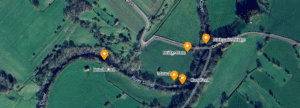
Fords and River crossings at Nathwaite Bridge Coverdale - Google satellite - Thanks to National Library of Scotland

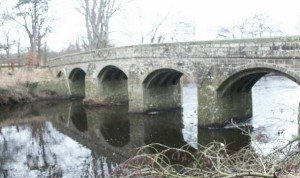
Nathwaite Bridge, over the river Cover in Coverdale, is just about the only way any heavy traffic can easily cross between the key villages of Carlton and West Scrafton.  The importance of the location is perhaps underlined as the last place down the river Cover where it remains reasonably ford-able, and therefore crossable in past times when no closer bridge existed.

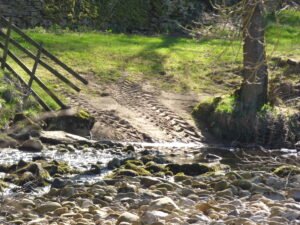
Cow Ford close to Nathwaite Bridge

Fords and River crossings at Nathwaite Bridge Coverdale - OS Series 1 - Thanks to National Library of Scotland

In the field of Bridge Barn, close to Nathwaite Bridge, there are two fords marked on the OS Series 1 map. This site page holds the details of our investigation into the fording point we think may be called Cow Ford.

Intach Ford: Upstream of Nathwaite Bridge, Coverdale

Ford close to Nathwaite Bridge

In the field of Bridge Barn, close to Nathwaite Bridge, there are two fords marked on the OS Series 1 map. This site page holds the details of our investigation into the fording point we think may be called Intach Ford.

Roman Ford – Barnard Castle

The Roman Ford at Barnard Castle, located on the River Tees, is a fascinating historical site. It is believed to have been part of a Roman road connecting Bowes (Lavatrae) and Binchester (Vinovium), indicating the area’s significance during the Roman era.

Mickley Riverworks

Mickley Weird

Anglers and canoeists still talk of “Roman Ford” on the Swinton fishing beat immediately upstream of Mickley (turn4search0) and the name appears in estate fish-catch returns from the 1920s. The idea is that a paved crossing pre-dated the weir and was later buried beneath it. No Roman finds have been reported to PAS or the Historic Environment Record.

Kilgram Bridge Ford

Kilgram bridge itself is of known ancient construction, and is believed to date from the early 12th century – probably built around 1145 AD by the Cistercian Monks who founded Jervaulx Abbey nearby. Local myth tells how the bridge was built by the Devil after a pact made with the local population. Kilgram Bridge is first mentioned in literature in 1301, however Kevin Cale, in his assessment of the bridge suggests an early 12th century date to be appropriate (4).

Contact Us
close slider