Audrey Blanchard of Archeodonum and Jean Noel Guyodo of the University of Nantes during the excavation of Le Plasker.
Are the Stones of Carnac Europe’s Oldest?
Hot News of Carnac’s claim for “Oldest”
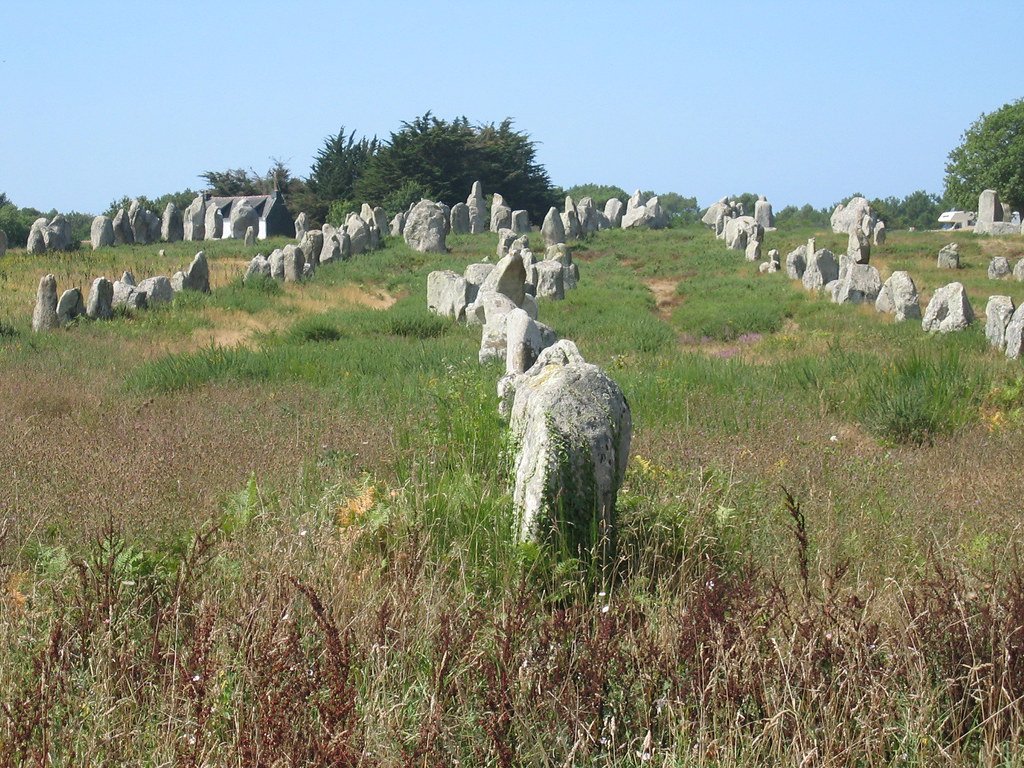
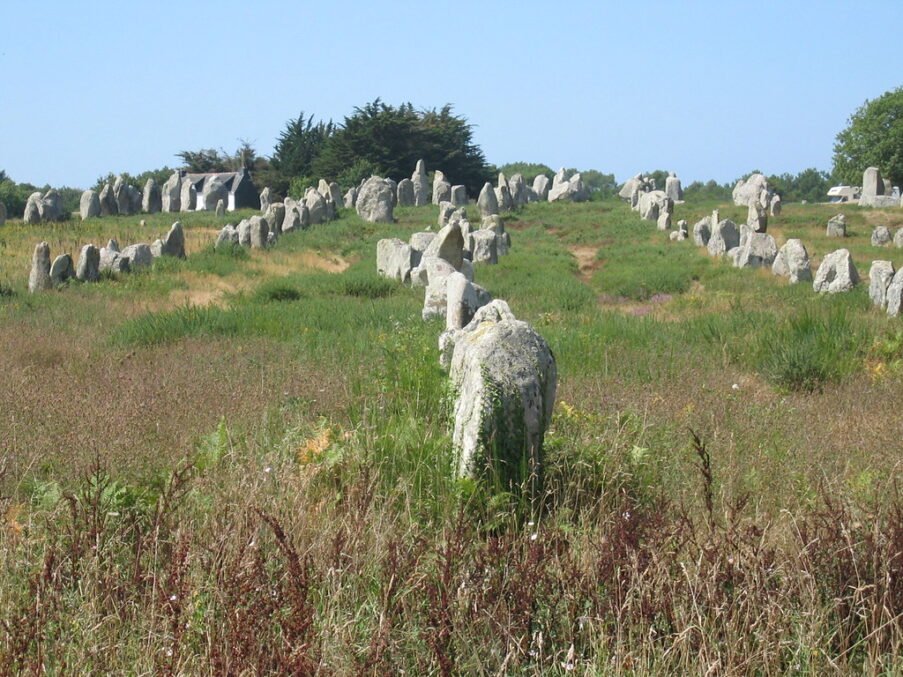
CARNAC, FRANCE—The southern coast of the French region of Brittany is home to one of Europe’s highest concentrations of mysterious megalithic standing stones. More than 10,000 are strewn around a six-mile stretch in the Carnac region, from La Trinité-sur-Mer to Erdeven. Unlike other megalithic monuments, such as Stonehenge, these do not typically form a circle, but are linear or curvilinear in nature. In the past, it has been difficult for archaeologists to accurately ascertain their age. According to a statement released by the University of Gothenburg, new research suggests that that not only are they even older than expected, but they might be the first such stone alignments ever built. A French-Swedish collaboration recently carried out excavations at the new site of Le Plasker in Plouharnel, on the Bay of Morbihan. They uncovered a series of fire-related pits that were associated with the construction of the stone monument. Radiocarbon dating of charcoal samples indicated that the megaliths were erected between 4600 and 4300 b.c. “The alignments in the Carnac region now appear to be among the earliest megalithic monuments in Europe,” said archaeologist Bettina Schulz Paulsson of the University of Gothenburg. “We have also confirmed the Bay of Morbihan as the earliest megalithic region in Europe.”
The recent University of Gothenburg–led excavations at Le Plasker, and their startling radiocarbon dates of 4600–4300 BC for the Carnac alignments, deserve both applause for methodological rigor and a measured dose of critical scrutiny before we rewrite Neolithic Europe’s storybook.
At the heart of this new claim lies a series of purpose-dug, fire-related pits beneath the megaliths, whose charcoal fragments were dated in a well-established laboratory setting. Publication in the peer-reviewed journal Antiquity lends weight to the work—and the multidisciplinary French-Swedish team appears to have taken care in associating the pits directly with stone erection rather than later activity. Nonetheless, we should remember that charcoal, even when stratigraphically sealed, can in theory derive from earlier hearths, root‐charcoal migration or residual vegetation burning.
A handful of dates from one site is powerful, but far from conclusive for an entire six-mile alignment system. Replication—through multiple trenches, independent labs and comparison with Optically Stimulated Luminescence or other dating methods—will be essential to cement the Bay of Morbihan’s claim as Europe’s cradle of megalithism.
What may be the impact?
From a British viewpoint, the repercussions are potentially profound. For generations, Stonehenge (c. 3000–2400 BC) and its circle cousins have held pride of place as our earliest and grandest Neolithic monuments. If Carnac truly predates them by more than a millennium, then the British Isles may need to recast ourselves not as pioneering megalith builders but rather as participants in a broader Atlantic façade tradition, whose epicentre lay in Brittany’s tidal estuaries. Such a shift would invite fresh investigations into cross-channel exchange: were seafarers carrying not only cattle and cereals but architectural know-how? How did maritime networks shape ritual landscapes from Cornwall to Normandy?
More cross-border research needed?
At the policy level, this research underscores the value of collaborative, cross-border archaeology. We ought to encourage similar trench-and-lab programs in western Britain—Cornwall, Wales, the Isle of Man and southwest Ireland—to see whether truly comparable fire pits lie beneath our earliest standing stones. In practical terms, funding bodies like Historic England, Cadw and the Heritage Lottery Fund might sensibly earmark resources for synchronized dating campaigns along the Atlantic margin.
Cross-border archaeology often seems behind that which is focussed within a single country. Much of this seems to be down to the lack of data standards, which should include agreed translation text for terms used etc., but also, funding, especially in the post-Brexit world we find ourselves in, has become another complexity to add to the mix of obstacles.
Test your assumptions!
This Carnac finding reminds us that what we see on the surface—stone lines, circles, chambered tombs—is only the tip of a buried iceberg. The careful recovery and dating of sub-megalithic features (pits, post-holes, deposit lenses) often yields the clearest window on monument construction. As British archaeologists reflect on this Brittany breakthrough, our community should re-examine excavations at Aberdeenshire’s recumbent circles, the Cotswolds’ Long Barrows and the Orkney stone rows for similarly “hidden” construction contexts. Here in North Yorkshire, we might also remember that a Mesolithicdata for the commencement of pit alignments at Thornborough has fallen between the gaps and will probably be lost to posterity.
More dates are needed
The Le Plasker dates challenge entrenched chronologies and beckon us to widen our field of vision—both geographically and methodologically. If the Bay of Morbihan was indeed the crucible of European megalithism, our own prehistoric monuments gain new layers of meaning as part of a dynamic, pan-Atlantic phenomenon rather than isolated island marvels. But before rewriting the textbooks, British researchers must replicate, extend and critically test these findings on their home turf. Only then can we be confident that Carnac, not Stonehenge, deserves the badge of “earliest.”
Carnac
What the heck is Carnac?
A Beginner’s Deep Dive into Carnac—and How It Compares with Avebury
Setting the Scene
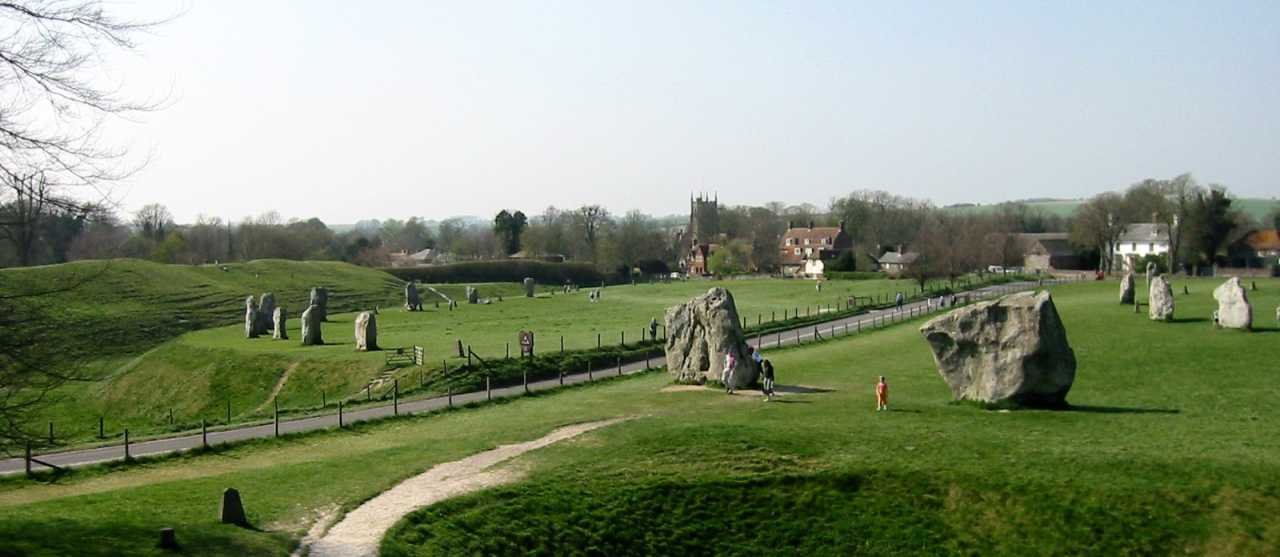
Carnac’s famous alignments lie along the southern coast of Brittany, France, between the towns of La Trinité-sur-Mer and Erdeven. Over more than six miles of gently sloping coastal plain, you’ll find over 10,000 individual standing stones—menhirs—arranged in long, curving rows, isolated single pillars, and small stone groups. By contrast, Avebury in Wiltshire occupies a broad chalk downland plateau: here the spectacle is a giant Henge—an earth-banked circular enclosure—within which stand Britain’s largest stone circle, accompanied by two smaller satellite circles and an avenue of paired stones leading off toward the nearby Sanctuary.
Alignments: The hallmark of Carnac, these straight or gently bowed lines of menhirs can run for hundreds of metres. There are three principal alignments—Ménec, Kermario and Kerlescan—each containing several hundred to over a thousand stones laid out in parallel rows.
Dolmens & Tumuli: Scattered tomb-chambers and earthen burial mounds lie interspersed among the rows, hinting at a close relationship between ritual pathways and funerary rites.
Avebury
Henge & ditch: A massive circular Earthwork nearly 420 m across, with an exterior ditch dug from the central bank—unusual, since most Henges have their ditch inside the bank.
Inner stone circles: Within that bank stand some 100 huge sarsen stones, arranged in a great circle (up to 30 stones), plus two smaller rings to the north and south.
Stone avenues: The Beckhampton and West Kennet Avenues extend from the henge’s circumference, marking processional routes.
Chronology
Carnac:
Early date: Radiocarbon dates from recently excavated pits at Le Plasker now suggest that the alignments began around 4600 BC, making them among Europe’s earliest megalithic constructions.
Long-lived site: Carnac’s rows and tombs continued to see activity—recutting, re-erection and new burials—throughout the Late Neolithic and into the Early Bronze Age (c. 4300–2000 BC).
Avebury:
Middle Neolithic: Built roughly between 2850 and 2200 BC—some 1,500 years after the earliest Breton alignments.
Phased construction: Avenue stones date to about 2500 BC, while the smaller northern and southern circles may have been added later, reflecting evolving ritual practices over centuries.
Construction & Techniques
Carnac menhirs are typically quarried locally from Glomel sandstone or schist. Some weigh several tonnes and were hauled into place using rollers or sledges, then levered upright into pit foundations. The linear layout suggests surveying techniques—lines of sight, pegged ropes or cordons—carefully repeated over long distances.
Avebury’s sarsen blocks (up to 40 t) were sourced from the Marlborough Downs, dragged 20 km by teams of workers using sledges and lubricated timbers, then set into the henge’s chalk substrate. The encompassing bank and ditch required the removal of thousands of cubic metres of turf and chalk—likely by a community mobilized seasonally.
Purpose & Cultural Context
Carnac: The sheer scale of the alignments—hundreds of parallel rows marching across the plain—has led to interpretations as ritual processional ways, defender lines against unseen forces, or even astronomical devices marking solar and lunar movements. Their intimate association with Barrows suggests a landscape woven from life-death-afterlife pathways.
Avebury: The enclosing bank creates a defined “holy space,” separating the interior from the outside world. The stone circles and avenues read as stages for communal gatherings or ceremonies, perhaps linked to ancestor veneration, seasonal feasting or territorial rites. Its later Roman-era reuse of the site testifies to the enduring power of these monuments.
Archaeological Investigations
Carnac: For centuries, antiquarians sketched and poked at the stones, but only in the last few decades have systematic excavations—stratigraphic trenching at Le Plasker, geophysical surveys along the rows and 3D LiDAR mapping—begun to reveal construction pits, buried chips of stone dressing and buried soil surfaces that preserve ancient footprints.
Avebury: Excavations since the 1920s (notably by Alexander Keiller in the 1930s) have revealed post-holes beneath fallen stones, charcoal from hearths, flint tool scatters and fragments of Grooved Ware pottery. More recently, ground-penetrating radar and pollen cores have helped refine our understanding of the henge’s environmental setting and use.
What Beginner Visitors Should Know
Visiting Carnac: The alignments are best appreciated on foot. Start at Ménec, where interpretation panels explain how the rows once stretched farther (many stones were removed in later centuries). As you stroll beside monolithic sentinels, imagine Neolithic people tracing those lines in ritual passage for generations.
Visiting Avebury: You can walk inside and around the henge bank—one of the few sites where the public can roam freely among the stones. The village of Avebury nestles within the circuit, offering a unique sense of living heritage. Nearby, the Alexander Keiller Museum displays artefacts uncovered on site.
Contrasting the Two
Scale & layout: Carnac’s drama lies in its vast, ground-hugging carpet of rows; Avebury’s power comes from its monumental circular “room” of stones, a built-in auditorium for communal spectacle.
Chronological primacy: Carnac likely pre-dates Avebury by over a millennium, reframing the Atlantic seaboard as an early epicentre of megalith-building. Avebury, in contrast, represents a mature phase of Neolithic monumentality in Britain.
Function & experience: Walking the Carnac alignments emphasizes linear movement—ritual journeying through space. At Avebury, the circular plan evokes gathering, enclosure and focus on a shared centre.
Carnac and Avebury are windows into two grand experiments in Neolithic monumentality. Carnac’s monuments teach us about vast ritual landscapes drawn out in lines; Avebury shows how communities could enclose and animate circular arenas of stone. Together, they reveal the astonishing diversity of prehistoric human expression along Europe’s Atlantic fringe.
Read the original scholarly article about this research in Antiquity. To read about another megalithic site in central France, go to “Megalithic Mystery.”
Fragment of a copper alloy drilled buckle frame with a separate spindle, which is now missing, c. 1760-1790AD.Measurements: Length: 44.2mm; Width: 10.7mm; Thickness: 6.0mm; Weight: 3.64g [...]
A probable copper alloy Roman stylus dating to c.AD 43-410.The object comprises a shaft which is circular in cross section. At one end the shaft narrows to a pointed terminal. At the other, the shaft [...]
Everted and thickned rim sherd of a medieval to post-medieval cast copper alloy cooking vessel in quite fresh condition but with old breaks. There are slight traces of sooting on the exterior. The diameter is [...]
Five small fragments of fired clay, reduced with oxidised margins and surfaces, profuse chalk inclusions, and on two larger pieces withy impressions on smoothed surfaces. Weight 56g. Daub from stud walling or from a hearth or kiln [...]
A fragmentary and incomplete Roman silver Radiate of Gallienus, dating to c. AD 258-259 (Reece period 13). GERMANICVS MAX V reverse or similar depicting a trophy between two captives. Possibly mint of Lugdunum. Cf. RIC V Gallienus [...]
An extremely corroded Roman copper alloy Sestertius of uncertain 1st or 2nd century ruler. Uncertain reverse type depicting a standing figure. Probably mint of Rome. [...]
An incomplete uninscribed Iron Age silver unit of the Southern Region, probably of the East Wiltshire group and dating to c. 50-20 BC. Obverse: unclear, possibly a moon head, right. Reverse: Annulate horse, left. [...]
Thirteen sherds of medieval to post-medieval Late Medieval and Transitional pottery (Jennings 1981, 61-2), all body apart from 2 pancheon rim and 2 basal, weight 128g, mid 15th - 16th century. [...]
Two hundred and eighteen sherds of medieval pottery, body unless otherwise stated, weight 1.212kg, 12th - 15th century:- 216 unglazed including sixteen everted jar rim (cf. Jennings 1981 fig. 14 nos. 285-92), twenty-one bowl and [...]
A small oval tertiary flake of pale brown flint, probably of Neolithic date. The left lateral side has been refined with semi abrupt retouch struck from the dorsal side and there is a small amount [...]
A copper alloy fragment, probably from one end of a purse bar of late Medieval to early post Medieval date (cf. Williams Class C). The arm has a rounded cross section, 4.8mm in diameter and ends [...]
An incomplete medieval cast copper alloy oval buckle, with an expanded and thickened front edge. Any decoration has been lost to corrosion. The strap bar has small lobes at either end, but has broken away [...]
A complete copper alloy seal matrix of Medieval date (c. AD 1250-1300).The matrix is flat and pointed-oval or vesica-shaped. On the reverse is a central rib with a perforated lug at the top of the seal. The front [...]
Copper alloy jetton. Hammered French jetton, Late Medieval issue of 1350-1400Obverse description: box-like structure of bars ending on annulets – probably Chatel Tournois.Obverse inscription: [---]*E[-]I[-]SVReverse description: long cross, with short bars at ends of arms [...]
An Iron Age gold quarter stater of the East Wiltshire region, dating to c. 50-35 BC. Savernake Wheel type. Obverse: wreath, crescents below, pelleted spike. Reverse: horse, wheel below, solar spiral above. As ABC p.107, no.2101; BMC 546. [...]
An incomplete copper-alloy imitation of a Roman radiate, probably of Tetricus I (AD 271-274) or Tetricus II (AD 272-274) dating to the period c.AD 275-285 (Reece Period 14). Probably PIETAS AVGG / AVGVSTOR reverse type depicting sacrificial instruments. Unclear [...]
An incomplete silver Penny of James I (AD 1603-1625). First Coinage. Squared shield. Thistle or Lis initial mark. AD 1603-1605.Diameter: 13.44mm, Thickness: 0.38mm, Weight: 0.28gThe coin is missing minor portions of its outer flan.North Vol II, P 144, [...]
An incomplete silver Threepence of Elizabeth I (AD 1558-1603). Second coinage. Long cross fourchée over squared shield reverse, with date above. Sword initial mark. AD 1582.Diameter: 18.64mm, Thickness: 0.68mm, Weight: 1.41gThe coin is missing portions of its outer [...]
An incomplete copper alloy nummus of the House of Constantine dating to the period AD 354-361. Reece period 18. Probably SPES REIPVBLICE reverse type depicting the emperor standing left, holding globe and spear. Unclear mint.Diameter: 13.62mm, Weight: [...]

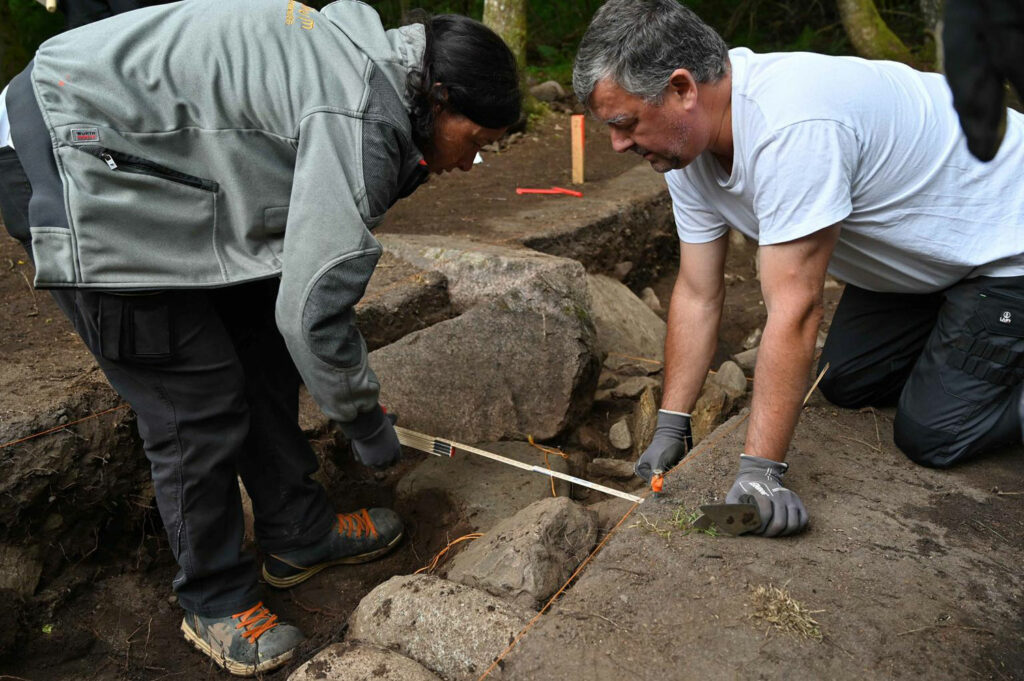 Audrey Blanchard of Archeodonum and Jean Noel Guyodo of the University of Nantes during the excavation of Le Plasker.