

This mound is 22ft. in diam. and about 3ft high. It has been built upon a natural knoll which makes the barrow look larger than it is. Excavation showed that the mound has an earthy core with a rubble capping.
This mound is 22ft. in diam. and about 3ft high. It has been built upon a natural knoll which makes the barrow look larger than it is. Excavation showed that the mound has an earthy core with a rubble capping.
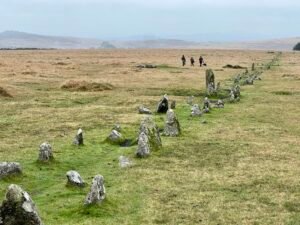
Stonehenge has always been enigmatic, due to its use of those definitive morticed trilithons, all of which where squared of, more like the structures of the Maltese temples and other stone structures closer to Africa, as opposed to those of the rest of Britain and most of the wider North-west European ritual landscape.
Jun 15
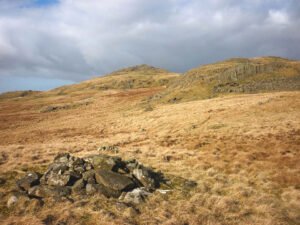
On every late-Victorian and early-20th-century OS sheet the surveyors marked any conspicuous heap of stones they could not instantly classify as a tumulus, beacon, trig-point or boundary stone with the catch-all term “Pile of Stones.”
Jun 11
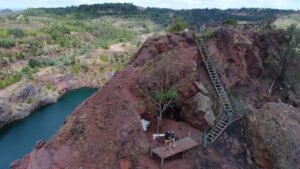
These are artificial hills made from the unwanted rock, shale and tailings that come up with coal, metal ore, stone or clay when it is being mined or quarried. Because extractive industry is both deep and long-lived, single collieries or pits can generate tens of millions of cubic metres of spoil; pushed out by locomotive, conveyor or tippler wagon and dumped in successive layers, the piles quickly become a distinctive landform.
May 20
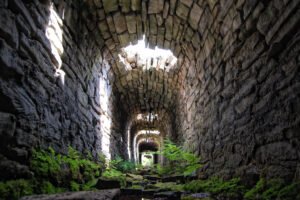
Coverdale never possessed the thick, profitable seams that powered the great Yorkshire coalfield; instead it sat on the very feather-edge of the Yoredale Series where thin coal bands (18 – 50 cm) lie between the well-known limestone, sandstone and shale rhythms.

The tall chimney on the moor near Redmire is connected to the Cobscar Smelting Mill, which was part of the lead mining industry that once thrived in the area. The chimney served a crucial role in the smelting process by exhausting poisonous lead gases away from the mill.
Sep 25

Celtic Heads Celtic Head from Witham, 2nd c B.C. (British Museum) “Celtic” carved heads are found throughout the Read more Timeline 60BC – 138AD This timeline is focussed on the British Celtic culture and those cultures which had influence on the British Celts. It Read more Heads at St Michael, Kirklington An analysis of head …
Sep 25
Celtic Heads Celtic Head from Witham, 2nd c B.C. (British Museum) “Celtic” carved heads are found throughout the Read more Timeline 60BC – 138AD This timeline is focussed on the British Celtic culture and those cultures which had influence on the British Celts. It Read more Heads at St Michael, Kirklington An analysis of head …
Sep 25
This section illustrates the history of mining and aims to give sufficient information for a researcher to be able to recognise mining features and to be able to identify the periods of working on a site. Mine works are an extensive subject, complicated by the use of different terms for similar features, depending on the type of mine and the region under review.
 NLS Map Explorer
 Google Earth
 Google Maps
 Lidar Finder
 TMA
TMA
 Megalithic Portal
 Yorkshire Arch. Air Mapping
 ADS
ADS
 Brigantian Adventure FB Group
Stone Bothering FB Group
Stone Faces FB Group
Brigantian Adventure FB Group
Stone Bothering FB Group
Stone Faces FB Group
 Heritage Gateway
 ARCHI® MAPS: UK
 Atlas of Hillforts
 Portable Antiquities
 British History Online
Brigantes Nation FB Group
British History Online
Brigantes Nation FB Group

