
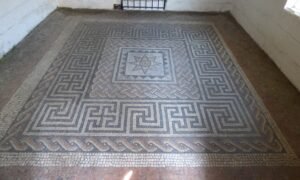
Aldborough, or Isurium Brigantia as it was known in Roman times was the capital of Brigantia, at least from some point during Cartimandua’s acceptance as client Queen, governed by Rome. As such, it is a key site in our search for Brigantia
Aldborough, or Isurium Brigantia as it was known in Roman times was the capital of Brigantia, at least from some point during Cartimandua’s acceptance as client Queen, governed by Rome. As such, it is a key site in our search for Brigantia

Despite is unusually high position, this fort contains traces of a number of huts, and on investigation these have yielded plentiful pottery, as well as charcoal giving a surprisingly early radio carbon date

Summary and supplemental information in relation to the publication: Early‐Middle Bronze-Age Agricultural Terraces in North-East England: Morphology, Dating & Cultural Implications.

Flats Hill mound is approximately 30 meters in diameter and stands about 3.6 meters high. It has never been excavated, although a dry stone wall seems to have been started, and then stopped, partly over its top. It has been suggested as, and is listed as a probable barrow, with a presumably wide date, likely to be in the Bronze Age or Iron Age date range.
Mar 25
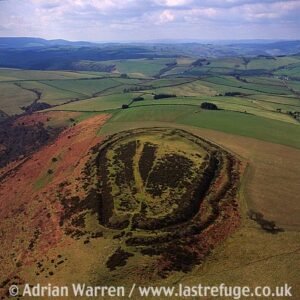
Caer Caradoc is often linked to Caradoc (or Caradog), a prominent figure in Welsh mythology and Arthurian legend. Caradoc is considered one of the knights of the Round Table in Arthurian lore, and he is sometimes referred to as Caradoc of the Battle or Caradoc the Brave. He was known for his bravery and his loyalty to King Arthur.
Mar 25

An oppidum is the name given to a large population centre, with varying levels of fortification. So far, this concept of Iron-Age cities has not really been applied to the British Iron-Age, though many individual hillforts have been suggested.
Feb 11
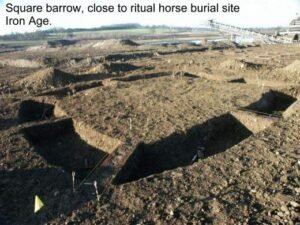
The Nosterfield Quarry excavation sits at the heart of one of Britain’s most enigmatic prehistoric landscapes—the Thornborough Henges Complex.
Feb 07
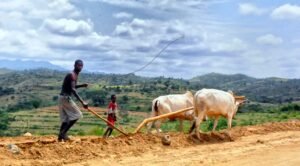
The ard, also known as a scratch plough, represents one of the earliest forms of agricultural technology used by the people of ancient Brigantia.
Jan 24

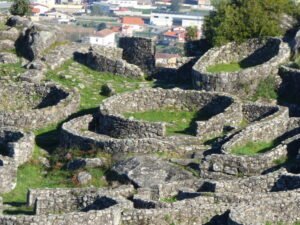
Hillforts, or castros, are some of the most iconic archaeological features of Galicia and provide valuable insights into the region’s Celtic past. These ancient settlements, typically constructed on hilltops or elevated locations, were used for defensive and residential purposes by the Gallaeci and other Celtic groups in northwest Spain.
Jan 24
Roman Invasion of Hispania: The Romans’ first significant incursions into the Iberian Peninsula began in 218 BCE during the Second Punic War, when Hannibal Barca, the Carthaginian general, crossed the Alps and threatened Rome. This prompted Roman intervention to ensure control of their western Mediterranean territories.
 NLS Map Explorer
 Google Earth
 Google Maps
 Lidar Finder
 TMA
TMA
 Megalithic Portal
 Yorkshire Arch. Air Mapping
 ADS
ADS
 Brigantian Adventure FB Group
Stone Bothering FB Group
Stone Faces FB Group
Brigantian Adventure FB Group
Stone Bothering FB Group
Stone Faces FB Group
 Heritage Gateway
 ARCHI® MAPS: UK
 Atlas of Hillforts
 Portable Antiquities
 British History Online
Brigantes Nation FB Group
British History Online
Brigantes Nation FB Group

