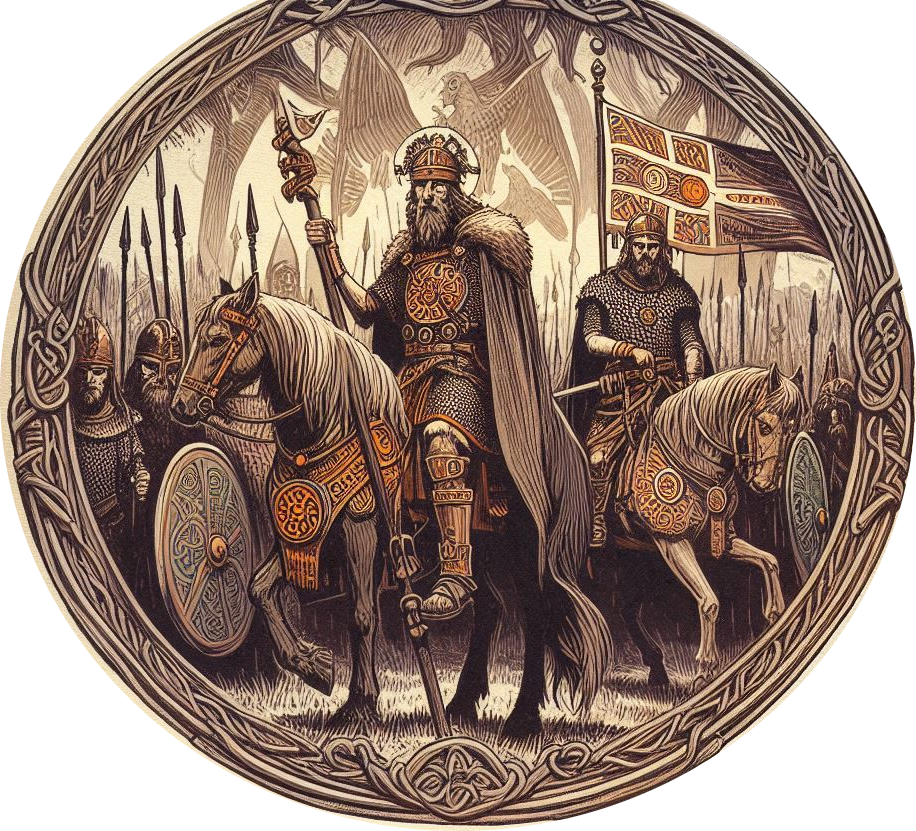
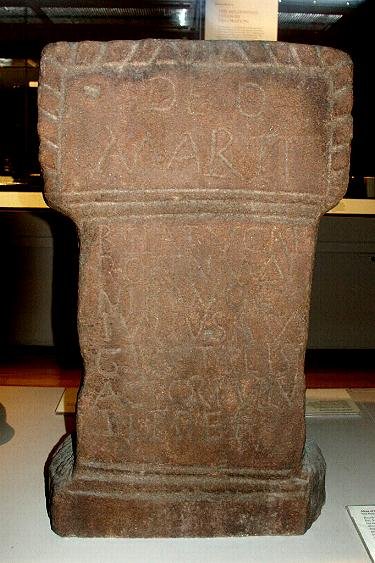
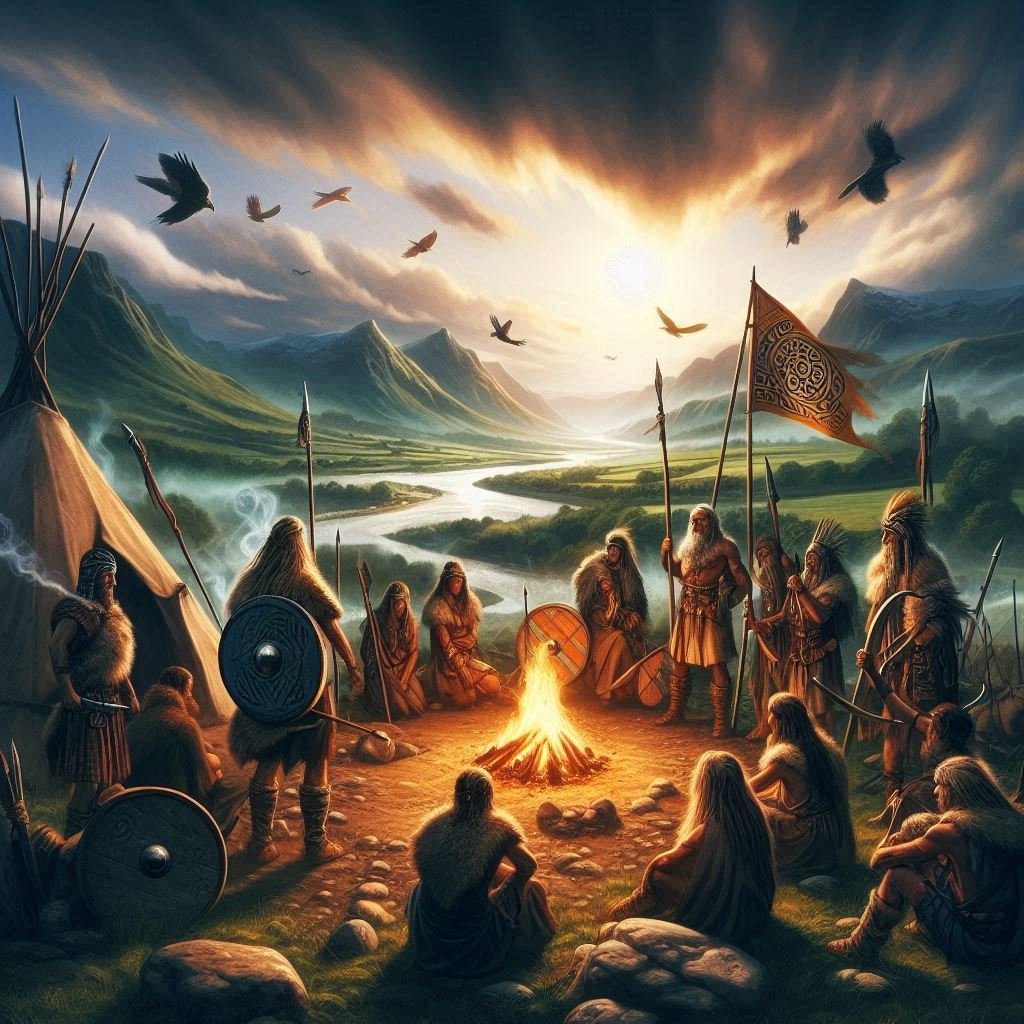
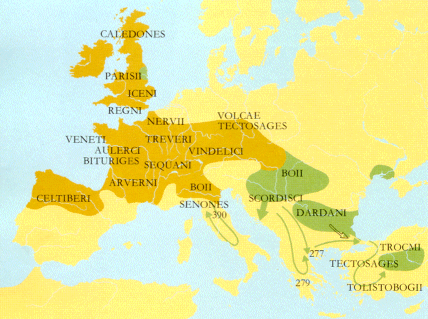
Brigantia, Cartimandua and Gwenhwyfar by Michelle Ziegler, Belleville, Illinois The name Brigantia represents three separate concepts: a goddess, a people, Read more
Incipient vitrification – The earliest, lightest degree of firing in a fort wall: only a skin of glass coats scattered stones, and the original drystone fabric remains recognisable.
Patchy / partial vitrification – Intermediate stage where continuous strings or lenses of fused rock appear in some stretches of rampart, but unmelted rubble still dominates elsewhere.
Thorough / total vitrification – Extreme state in which most of the wall’s length and thickness have coalesced into a single glassy or slag-like mass, leaving little sign of the original masonry.
Melt fraction (melt percentage) – The volumetric proportion of the wall that has turned to glass; quantified in thin-section or image analysis and used as an objective scale of vitrification.
Petrographic criterion – A microscopic standard (e.g., <10 %, 10–50 %, >50 % melt) applied to rock thin-sections to decide which vitrification class a sample belongs to.
Archaeomagnetic dating – Technique that dates the last heating of a wall by matching the direction of its locked-in magnetic field to regional records of Earth’s past field changes.
Thermoluminescence (TL) dating – Method that dates the last firing event by measuring the stored radiation energy released as light when samples are reheated in the laboratory.
Timber-laced core – Rampart construction in which horizontal and vertical timbers are woven through a rubble interior; when burned, the vanished wood leaves glassy tunnels or strings.
Timber-reveted front – Wall built as a timber-framed box faced externally with wood and filled with stone; vitrification mainly affects the outer façade where the timbers stood.
Stone-only wall – Rampart built without timber reinforcement; any vitrification results from heat applied externally (e.g., bonfires) rather than from internal fuel.
Destructive vitrification – Melting produced by an intentional attack or clearance fire after occupation, evidenced by thick destruction debris sealed beneath the glassy layer.
Creative vitrification – Hypothesised practice of purposefully fusing walls during construction to strengthen them; now considered rare and structurally dubious for quartz-rich rocks.
Incidental vitrification – Localised glass formation caused by accidental natural fires or lightning strikes rather than deliberate human action.
Glass connectivity – Measure of how well individual melt patches join up to form a continuous network, controlling both wall strength and archaeomagnetic reliability.
Micro-computed tomography (micro-CT) – High-resolution X-ray scanning that reveals the three-dimensional distribution of melt versus unmelted grains inside vitrified stone.
Slag – A dense, amorphous, glass-rich residue resembling industrial furnace waste; in forts, it forms when wall materials reach temperatures above roughly 1000 °C.
Rubble core – The interior packing of small stones and soil inside many ramparts; its composition and moisture content strongly influence how (and whether) vitrification proceeds.
Façade slabs – Dressed or roughly coursed outer facing stones that give a rampart its finished look; they often show the clearest evidence of surface fusion.
Hillfort rampart – The defensive embankment encircling an Iron-Age hilltop settlement; when partly or wholly vitrified, it becomes the key feature for classification studies.
Secular-variation (SV) curve – A time-series showing how the direction and strength of Earth’s magnetic field have drifted in a given region. By matching a wall’s frozen magnetic vector to the appropriate segment of the curve, archaeomagnetists can convert that vector into a calendar firing date.
Thermoremanent magnetisation (TRM) – The stable magnetic signal a rock or slag acquires when it cools from above its Curie temperature in Earth’s field. TRM is what archaeomagnetic dating actually measures in vitrified ramparts.
Palaeointensity (archaeomagnetic intensity) – The absolute strength of Earth’s field recorded in a TRM. Determining palaeointensity from oriented wall chips can date a firing event even when directional data are distorted.
Optically Stimulated Luminescence (OSL) dating – A method that estimates the last time quartz or feldspar grains were exposed to light. Experimental work applies it to the glassy skins of vitrified stones, where TL dosimetry is problematic.
Radiocarbon (^14C) dating – Age determination based on the radioactive decay of ^14C in short-lived organic remains (e.g., charcoal) sealed by the vitrification event. Provides an independent check on archaeomagnetic or TL results.
Dendrochronology – Tree-ring dating that assigns calendar years to timbers by matching growth-ring patterns to master chronologies. Rare in vitrified forts because the firing usually destroys the wood, but invaluable when preserved.
Bayesian SV model – A statistical framework that combines many dated magnetic records (kiln, lava, fort, etc.) to build a more precise regional SV curve and to re-evaluate legacy archaeomagnetic datasets.
Internal dosimetry (dose rate) – The calculation of ionising-radiation dose that a sample has absorbed since its last heating or light exposure; critical for converting TL or OSL signal intensities into absolute ages.
Micromorphology – Thin-section analysis of soils and burned deposits at the microscopic scale. In vitrified forts it helps confirm whether charcoal, ash, and glass belong to a single high-temperature episode.
Calibrated firing date – A calendar age obtained after correcting a raw laboratory result (e.g., radiocarbon years BP or TL equivalent dose) with appropriate calibration curves or dose-rate data, producing the best-estimate “real-world” date of wall vitrification.
Neutron tomography – A 3-D imaging method that uses neutrons (rather than X-rays) to penetrate dense silicates while highlighting light elements such as charcoal and water. It exposes hidden timber voids and moisture pathways in vitrified blocks without cutting them, refining draught and fracture models.
Laser-ablation ICP-MS (LA-ICP-MS) – A microanalytical technique in which a laser drills 10–100 µm pits whose vapour is fed to an inductively coupled plasma mass-spectrometer. It maps trace-element fingerprints across glass skins or stone faces, proving quarry source or imported “flux” blocks at ppm resolution.
MC-ICP-MS – Multi-collector ICP-MS that measures isotope ratios (e.g., ⁸⁷Sr/⁸⁶Sr, ¹⁴³Nd/¹⁴⁴Nd) on 5–10 mg chips. It ties wall fragments or metallic droplets to specific bedrock areas or ore fields, testing long-distance transport hypotheses without large destructive samples.
Distributed fibre-optic sensing (DTS) – A single optical fibre laid through the wall acts as thousands of thermocouples, returning temperature every metre, every second. It captures full rampart thermal histories for calibrating CFD heat-budget models.
Acoustic-emission (AE) monitoring – Piezo sensors record high-frequency crack sounds during firing. Sudden AE bursts flag spalling or impending collapse, allowing safe shutdowns and giving real-time data on when the wall gains or loses structural integrity.
Micro-indentation – A pointed probe presses into the stone or glass during and after firing; force vs. displacement yields hardness and modulus. It tracks strength gain continuously, directly testing the “structural-strengthening” hypothesis.
Coupled CFD–DEM modelling – High-performance simulations that join Computational Fluid Dynamics (air, flames, gases) with Discrete Element Models (individual blocks). They predict temperature fields, block movement and collapse before lighting the real wall, optimising sensor layout and safety.
Bayesian hierarchical modelling – A statistical framework that fuses radiocarbon, OSL and archaeomagnetic dates while respecting stratigraphy and phase priors. It shrinks dating uncertainty to decades and allows explicit tests of “inner wall burned before outer” scenarios.
Spatial hotspot statistics (Getis–Ord Gi, Moran’s I)* – Quantitative measures of whether forts, hoards or quarries cluster more than random chance. They convert qualitative “clusters” into significance levels that can be compared with geology or migration routes.
Least-cost-path and network modelling – GIS algorithms that compute the easiest routes for hauling timber or stone and inter-visibility networks between forts. They quantify logistical feasibility and warning-line effectiveness in refuge or attack scenarios.
Agent-based simulation (ABM) – Virtual populations that follow behavioural rules (e.g., flee, fortify, burn) in a landscape. Repeated runs generate testable predictions about how often vitrification should occur under different threat levels and resource constraints.
Explainable AI (XAI) classifiers – Machine-learning models (e.g., gradient-boosted trees with SHAP values) that sort stones or glass samples by provenance while revealing which elements drive each decision. They provide courtroom-level sourcing proof without the “black box” problem.
Linked-Open-Data & FAIR repositories – Publishing raw sensor logs, 3-D models and code in formats that are Findable, Accessible, Interoperable and Reusable. LOD/FAIR pipelines let other teams re-analyse or merge datasets instantly, accelerating cross-site synthesis.
Interactive visual-analytics dashboards (Kepler.gl, Plotly Dash) – Browser tools that fuse LiDAR terrain, live temperature feeds and melt-fraction rasters with time sliders. They offer real-time situational awareness during burns and intuitive post-mortem exploration for all stakeholders.
Unconfined Compressive Strength (UCS) – The maximum axial load a material withstands before failure without lateral support. Measuring UCS before and after firing quantifies any true strengthening gained from vitrification, a critical test of the “structural-enhancement” hypothesis.
Archaeomagnetic dating – A chronometric technique that compares the orientation and intensity of magnetic minerals locked in burnt features (such as vitrified ramparts or hearths) with master curves of the Earth’s past magnetic field. Once a wall has cooled below its Curie point, the signal is fixed, giving a destruction-by-fire date that can be as precise as ±50 years for the last 2 ½ millennia.
Optically Stimulated Luminescence (OSL) – Method for dating the last time quartz or feldspar grains were exposed to sunlight. Useful for earthen ramparts or buried wall-cores: a small sample is light-stimulated in the lab; the emitted photons reveal how long the grains have been shielded, yielding construction or infill ages up to 200 kyr.
Micro-CT (micro–computed tomography) – High-resolution X-ray scanning that builds a 3-D model of internal structures in stone, slag or bone. For vitrified forts it visualises timber voids, melt zones and gas bubbles without destroying specimens, refining fire-temperature estimates and construction models.
Ring-headed pin – An Iron-Age dress fastener whose shank ends in a basal ring rather than a solid head. Dunagoil finds defined the “Dunagoil series”, dating to c. 300–50 BC and acting as a cultural tracer across Atlantic Scotland and Ireland.
La Tène brooch – Spring-bow brooches inspired by continental La Tène art (late Iron Age Switzerland–France). Scottish examples, like the Dunagoil piece, mark high-status contacts c. 250–100 BC and help peg fort occupations to the wider European timeline.
Lime-burp (mortar) dating – Radiocarbon technique that measures CO₂ re-absorbed by lime mortar as it cures. Applied to medieval tower houses built atop Iron-Age forts, it can separate masonry phases decades apart when no charred timber is available.
Slag vesicle analysis – Study of bubble size and distribution within vitrified wall-glass. Bubble geometry reflects cooling rate and wood-fuel load, offering clues to whether walls were fired quickly in warfare or slowly in controlled “bake-out” rituals.
Gateless oblong fort – A regional class of NE-Scottish hillforts (e.g., Dunnideer) with straight-sided, elongated plans and no visible doorway breaks in their timber-laced, vitrified walls—suggesting entries were via removable ladders or timber galleries.
Terrace-house platform – Sub-rectangular cut or build-up against a slope that provides a level stance for timber roundhouses. On forts like Dunnideer these platforms, now grassed-over shelves, hint at dense garrison-style interior occupation.
Charcoal lens – A discrete, often centimetres-thick layer of burnt wood trapped within rampart debris. These lenses, once dated or analysed for species, pinpoint the conflagration event and reveal the types of woodland harvested to fuel fort-burning.
An incomplete cast copper alloy double looped trapezoidal buckle of post medieval date. Only one loop remains. The frame is narrow with bevelled edges and a narrowed strap bar. There is no visible decoration. [...]
An incomplete cast copper alloy Roman bow brooch, of plate headed hinged T-shaped type dating to the 2nd century AD. The arms are narrow and cylindrical, enclosing an axis spindle and with a notch at the centre [...]
A worn and corroded post-Medieval copper-alloy Nuremberg Jetton of anonymous 'ship-penny' type (c. 1490-1550). Obverse has a sailing ship, the reverse has four fleur-de-lis in a lozenge. Illiterate legends. Cf. Mitchiner 1152-1165. [...]
Lead token, tally or boardgame piece. Hammered bifacial disc with one side bearing a pattern or device resembling a stylised tree with stocky fringed trunk and an arcing ‘legend’ of dots between faintly defined circles. [...]
Silver coin fragment. Worn long cross round halfpenny, broken to achieve well under one farthing’s weight, issue of 1280-1327Obverse description: worn smoothReverse description: long cross, three pellets in each angleReverse inscription: CIVI/[TAS]/(----)Diameter: 14.3mm, Weight: 0.23gms [...]
Silver coin. Short cross cut halfpenny of John (1199-1216) or Henry III (1216-1272), London mint. Class 6a1 issue of 1208-1218Obverse description: facing bust with sceptre left, hair left of two oval curls, beard of fine [...]
Copper alloy unidentified object fragment. Cast square-section bar with a stepped and rounded end; other end broken. The rounded tip forbids interpretation as a nail shank, which this object otherwise resembles. Suggested date: possibly Roman, [...]
Copper alloy finger ring. Cast oval bezel and tapered/constricting shoulders of a finger ring; the bezel is filled with blue enamel, sunken in the middle and crazed by recent impact; Guiraud type 1. The rest [...]
Silver coin. Penny of Edward I (1272-1307), class 10cf3 issue of 1307-1309, London mintObverse description: facing bust with broad bifoliate crown cf3 with break in band, drapery of angled wedges, initial cross pattee.Obverse inscription: +EDW [...]
A Medieval silver groat of Edward III (AD 1327-1377). Series E (North 1163) dating to AD 1354-5. London mint. North (1991: 51). Edge on the lower right quarter on the obverse has broken away. Coin measures 28.3mm in diameter. [...]
Silver coin. Voided long cross cut halfpenny of Henry III (1216-1272), probably class 3a issue of 1248-1250Obverse description: facing bust no sceptre, legend starts at 12 O’clock, hair comprises two neat curls and pellets left [...]
Copper alloy brooch fragment. A now-cruciform scrap of a cast plate brooch, possibly Mackreth type British Plate [unspecified], comprising the paired U-shaped lugs from the seat for a hinged pin, with a flat front retaining [...]
Silver coin. Denarius of an indeterminate early Roman emperor, cut with the loss of about one fifth of the flan, probably issue of AD14-138.Obverse description: bust laureate draped right, clean-shaven and jowled, lightly tousled hair.Obverse [...]
A worn and corroded Roman copper alloy nummus of the House of Constantine dating to AD 330-340 (Reece period 17). VRBS ROMA type with a reverse depicting Romulus and Remus suckling a wolf, with three stars above. Mint of Trier. Cf. LRBC Vol [...]
Lead and iron possible steelyard weight, as kindly suggested by the finder. An irregular plano-convex lump of cast lead retaining relicts of a heavy iron suspension loop with recent breakage evident; the lead is slightly [...]
A Roman copper alloy nummus of Constantine II (AD 317 - 340) dating to AD 327 (Reece period 16). PROVIDENTIAE CAESS reverse depicting a camp-gate of two towers with a star above. Mint of Arelatum / Arles. [...]
A post medieval, lead human figurine probably dating from the late 18th- 19th century.The figurine is in the form of a standing figure, possibly female holding a baby. Possibly depicting Mary with child. The reverse is flat [...]
A medieval cast copper alloy single looped oval buckle, complete with plate and pin. The frame has a rounded front edge and a recessed strap bar with lobes at either end. The plate is sub triangular [...]