Period: Medieval

Moulton Henge

Moulton Henge - 1m Lidar

Archaeologists now recognise a true Neolithic henge lying immediately south-west of Moulton village, roughly midway between the Swale and Dere Street. The monument is almost 200 m across, with a low earthen bank encircling an inner ditch and a central platform about 110 m wide; the ditch lies inside the bank—the classic “Class II” henge arrangement.
Vitrified Fort Sites

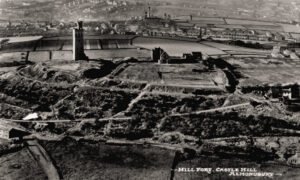
1930s photograph of Castle Hill

This page is a master placeholder for all vitrified fort sites in the Vitrified Forts section of Brigantes Nation.

Mote of Mark Hill Fort

Mote of Mark from sea shore path

The Mote of Mark is a defended hilltop overlooking the Urr estuary. It was the court or citadel of a powerful Dark Age chieftain, possibly one of the princes of Rheged. The site was occupied during the 6th century and appears to have been destroyed by fire in the 7th century.

How Hill Hillfort, Swaledale

How Hill Downholme LIDAR

How Hill, near Downholme in North Yorkshire, is the site of a large univallate hillfort.

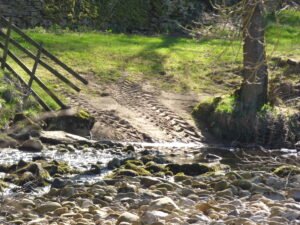
Cow Ford close to Nathwaite Bridge

Fords and River crossings at Nathwaite Bridge Coverdale - OS Series 1 - Thanks to National Library of Scotland

In the field of Bridge Barn, close to Nathwaite Bridge, there are two fords marked on the OS Series 1 map. This site page holds the details of our investigation into the fording point we think may be called Cow Ford.

Intach Ford: Upstream of Nathwaite Bridge, Coverdale

Ford close to Nathwaite Bridge

In the field of Bridge Barn, close to Nathwaite Bridge, there are two fords marked on the OS Series 1 map. This site page holds the details of our investigation into the fording point we think may be called Intach Ford.

Guide: Fortified Barns in Yorkshire – A historical overview

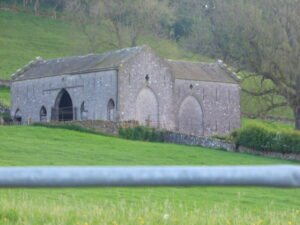
Monastic Fortified tythe barn in Wenseydale

Even in a rural community of mainly farmers, there are often reasons to wish to build or create a structure that is for, at least in part, for defensive purposes. Thus, some barns in Yorkshire and other places can be seen to have “arrow slits”, and later, square “gun ports”. This article provides a brief overview of what these structures are, why they were built and how they were used.

Flats Hill – Carlton in Coverdale

Flats Hill Mound - Carlton-in-Coverdale - view from road

Flats Hill mound is approximately 30 meters in diameter and stands about 3.6 meters high. It has never been excavated, although a dry stone wall seems to have been started, and then stopped, partly over its top. It has been suggested as, and is listed as a probable barrow, with a presumably wide date, likely to be in the Bronze Age or Iron Age date range.

Round Hill Motte at Carlton-in-Coverdale

Motte_at_Carlton_in_Coverdale_-_geograph.org.uk_-_Gordon_Hatton

Carlton Castle, or Round Hill Motte, at Carlton-in-Coverdale is an intriguing historical site that offers a glimpse into the medieval past of the Yorkshire Dales. The structure seems related to an extensive set of linear earthworks that have been interpreted as agricultural, however, their existence asks a question: if these are not older than this medieval interpretation. 

Guide: The Ard – Early Ploughing in English Brigantia

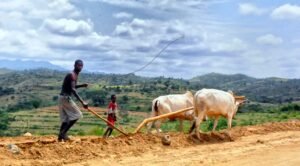
Single Tyne Plough, Arba Minch

The ard, also known as a scratch plough, represents one of the earliest forms of agricultural technology used by the people of ancient Brigantia.

Contact Us
close slider