Period: Any Period

Swaledale

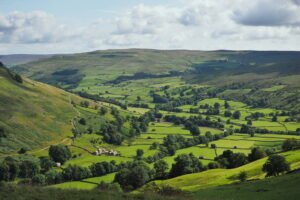
2015 Swaledale from Kisdon Hill

Swaledale occupies the long, sinuous valley carved by the River Swale on its 45-kilometre descent from Nine Standards Rigg (662 m) on the Pennine watershed to Richmond in lower Teesdale. The dale narrows between rough gritstone scarps near Keld, broadens to a patchwork of hay-meadows around Muker and Gunnerside, then opens into a tree-fringed flood-plain west of Reeth before the river cuts through the Carboniferous escarpment to meet the Vale of Mowbray.
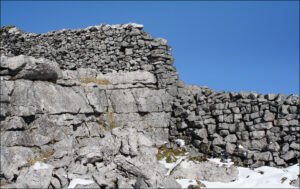
Guide: Parliamentary-walls and the Northern Enclosures

Ingleton Visit 3/13 (il16)

Between the mid-18th and late-19th centuries the British Parliament passed almost 5,000 local “Inclosure Acts.” Each Act authorised a team of appointed commissioners to survey one specific township or parish, divide its open-field strips, common pastures, and “wastes” into new, privately owned parcels, and lay out straight roads and boundary walls or hedges. The commissioners issued a legal award map and schedule that became the new title deeds.

County Durham

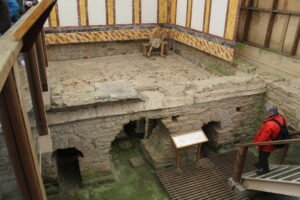
Binchester Roman baths, March 2017 warm room

County Durham’s landscape is often described as a “three-belt county.” To the west rise the high, windswept Pennines; in the middle lies a sheltered coal-bearing vale that funnels every main road and railway; and to the east stands the pale Magnesian-Limestone escarpment ending in low cliffs above the North Sea.

Wiltshire

Silbury Hill, Wiltshire

Lying across the spine of southern England, Wiltshire offers a textbook cross‑section of chalk downland, greensand vales and clay lowlands. Its long archaeological record – from 10 000‑year‑old spring‑side camps to modern military landscapes – is inseparable from that underlying geology and from the climatic swing that ended the last Ice Age.

Prehistoric mounds, cairns and boundary earthworks in Coverdale

Cairn atop Little Whernside

A gazetteer of probable prehistoric mounds, cairns and boundary earthworks in Coverdale. It is not complete and is still being researched.

Bishopdale

Bishopdale lies within the northern limb of the Askrigg Block, its underlying bedrock dominated by Carboniferous limestones with intermittent shales and sandstones of the Yoredale Series. The Great Scar Limestone, a thick, massive unit formed around 330 million years ago in a shallow tropical sea, underpins the dale’s steeper scarps and cliff lines, while the thinner-bedded limestones and intervening mudstones of the Yoredale Group create the characteristic terraced flanks on which many of Bishopdale’s field systems are laid out

Guide: SAR Doppler Tomography

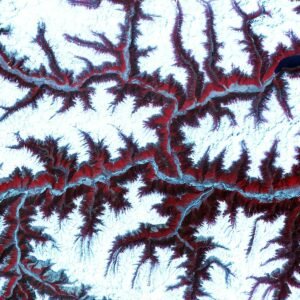
a close up of a red and white pattern on a white background

Synthetic-aperture radar (SAR) already relies on Doppler shifts: echoes from scatterers in a side-looking radar beam have slightly different frequencies as the platform flies past, and focusing those micro-shifts yields a two-dimensional image.

Vitrified Fort Sites

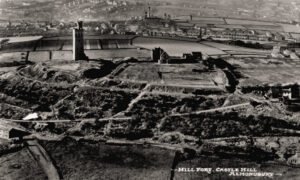
1930s photograph of Castle Hill

This page is a master placeholder for all vitrified fort sites in the Vitrified Forts section of Brigantes Nation.

Knockfarrel Fort

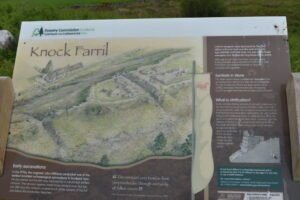
Knock Farril

This had substantial ramparts made of stones with a timber frame, enclosing a large area and making good use of the natural defences of the hill-top.

Guide – Exploring the Past with LIDAR

A scene showing a Roman archaeologist in the field, holding a tablet displaying LIDAR data.

Imagine being able to see the landscape around you in a completely new way—an invisible layer revealing the hidden structures of the past, right beneath the surface.

Contact Us
close slider