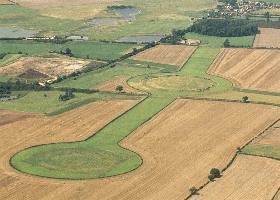
The Story of Boltby Scar

The Story of Boltby Scar

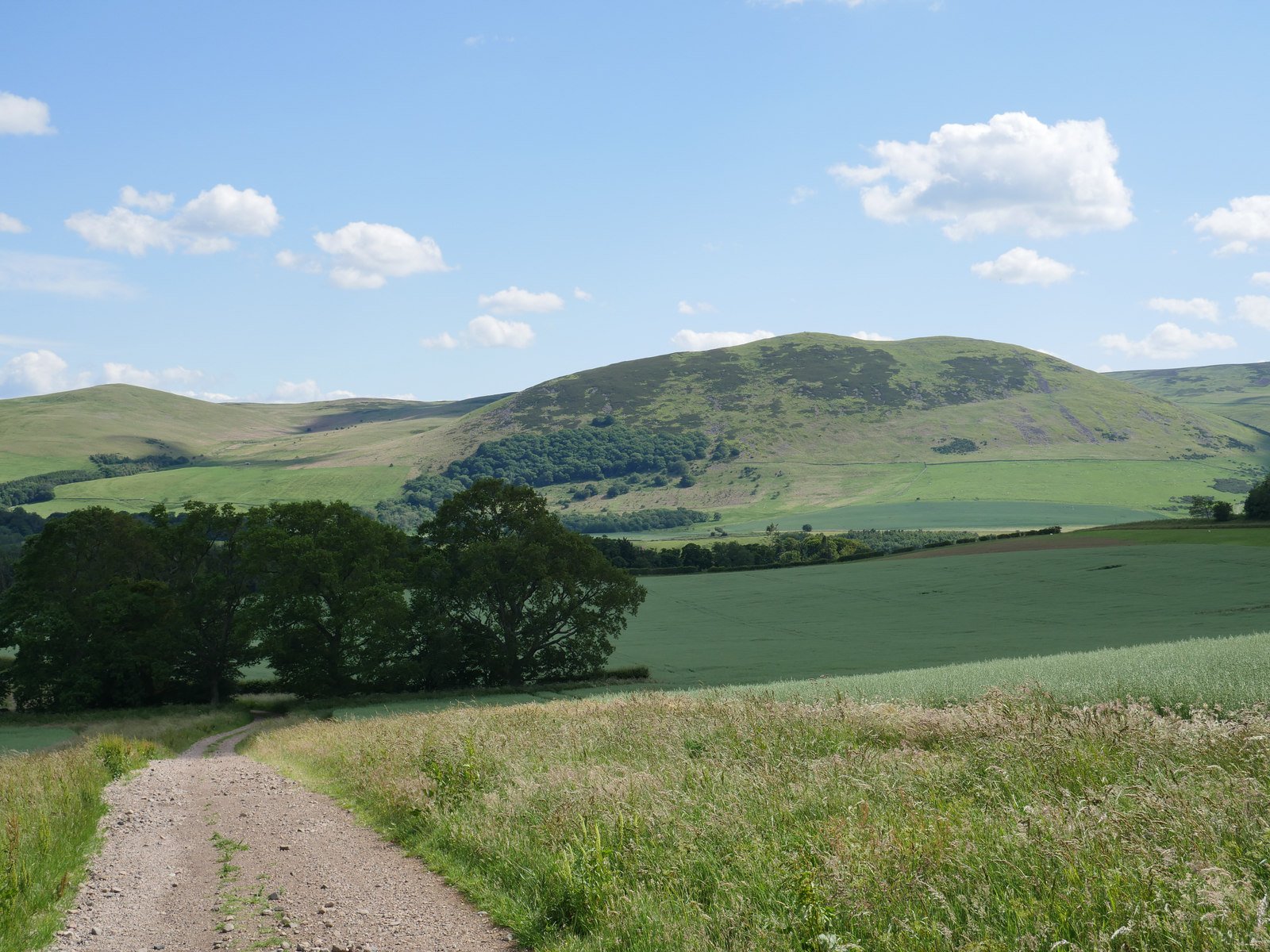
The “Hair Braid” of Boltby

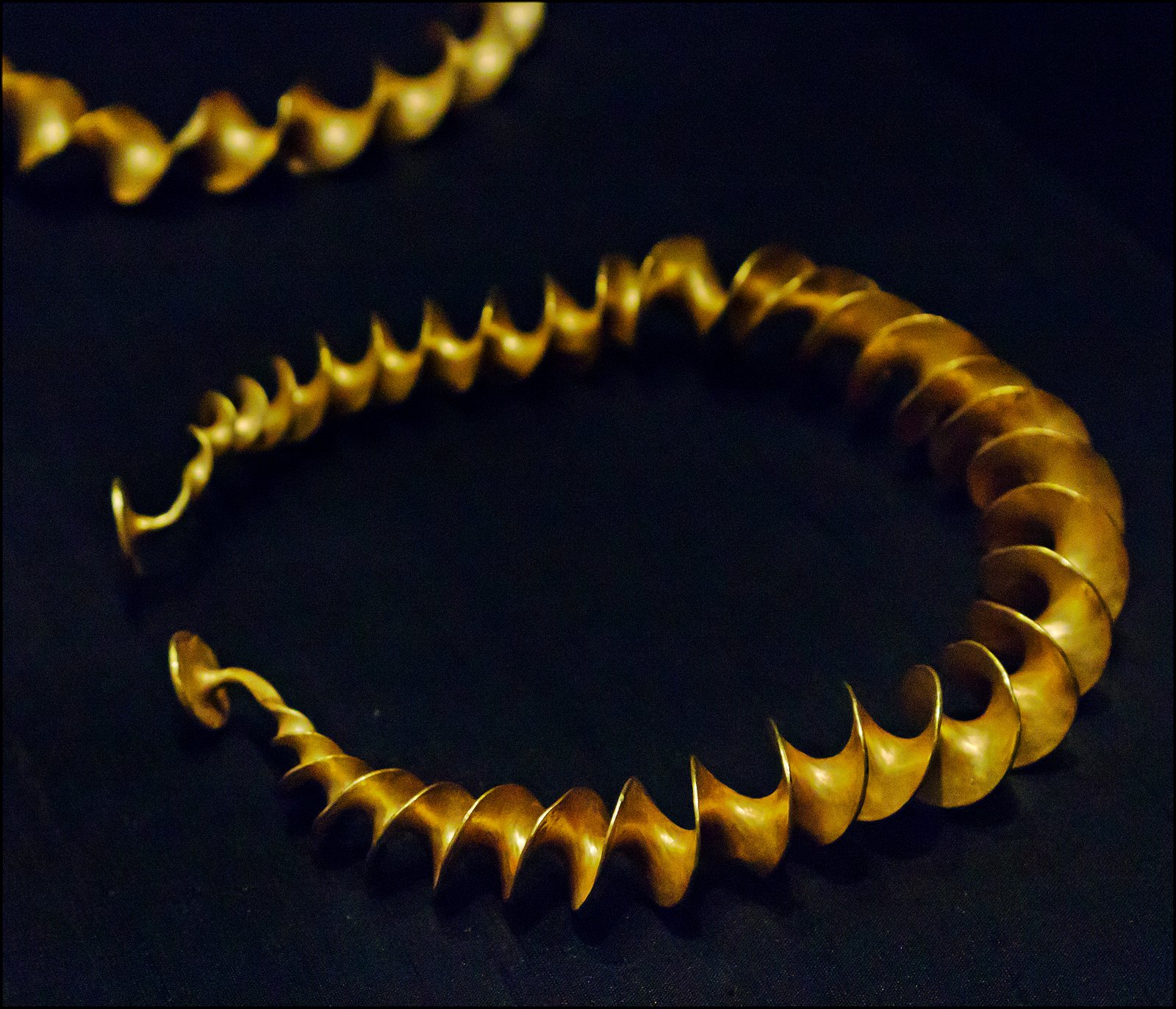
Boltby is a very important ancient site IMO. A gold “hair braid”, was found there, linking it to the Amesbury Archer, buried with two similar hair braids. This also provides a link to the founding of Stonehenge, which helps set a potential scene for a possible “zeitgeist”, of the day.

This hair braid of Boltby, perhaps has a “sister”, though, perhaps, seems may be more of a myth. A tale has been told of it being found over to the west, at a henge close to Ripon, one of the 6 big ones found between Ripon and Thornborough. Fabled to be in Ripon Cathedral now. I need to take a look.

The Amesbury Archer

The Amesbury Archer, is thought to be one of the very first metal workers in Britain. The hair braids have been suggested as being a symbol of that status; as a person who could prospect, mine, refine and work with metals.

This probably also meant he was a spiritual person, and that his mission was the spread of a kind of ritualised belief in an archetype that helped him find his metal.

Only four of those braids have been found. Plus the unconfirmed one at Ripon Cathedral. The other was up at Alston.

Metal Extraction

All three northern hair braids are in metal extraction zones, if you make my own mighty leap and suggest the Ripon braid was sited in the Yorkshire Dales region.

That gold at Boltby, it is the oldest gold in Yorkshire.

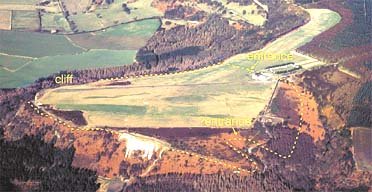
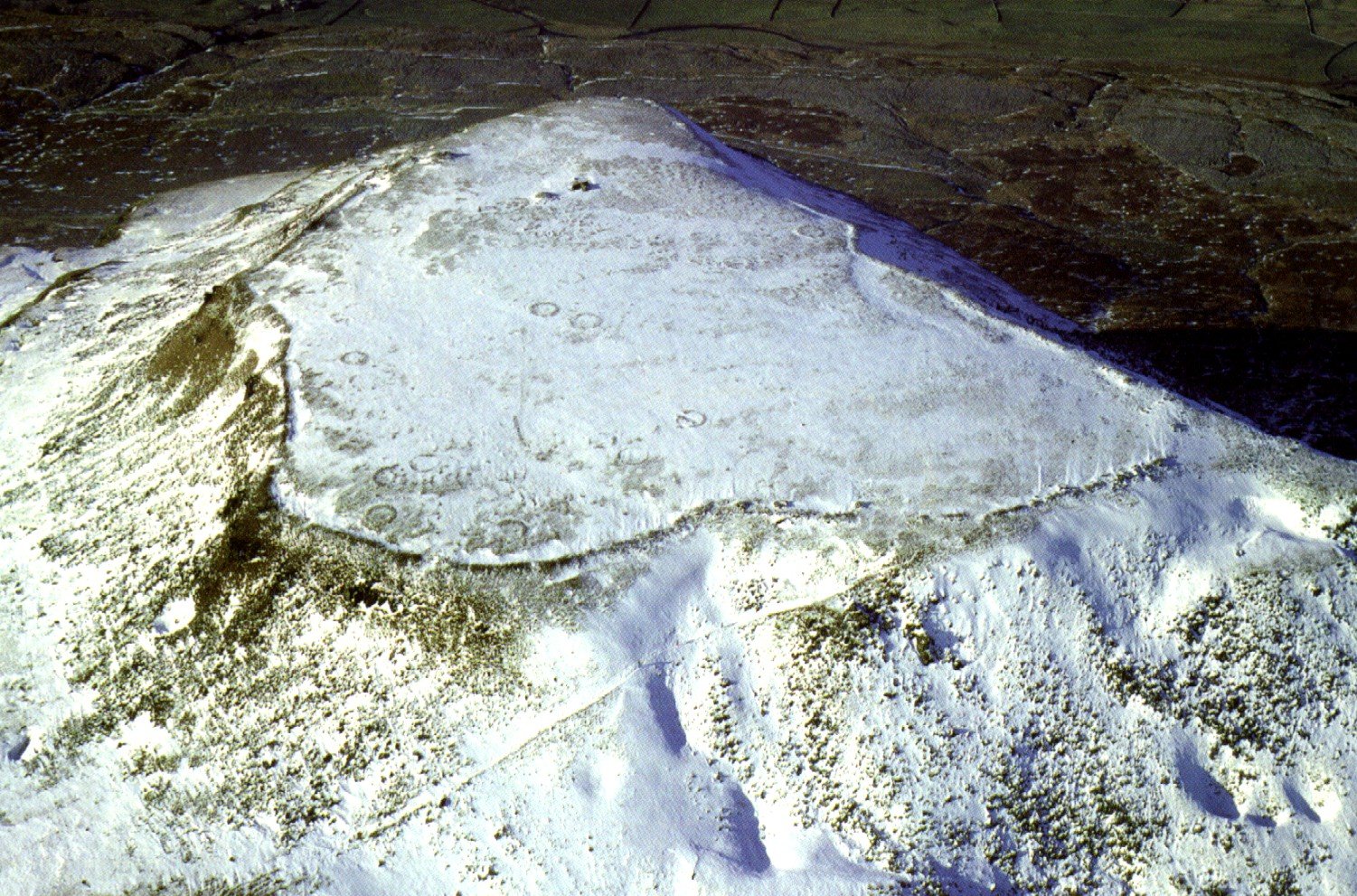
Boltby is an Iron Age hillfort, whose foundations included this oldest gold, which signified the start of the Bronze Age. It is therefore a site which integrated and embodied key stages of the development of our people, on the greatest stage of its day.

Boltby must have signalled a direction of change into the future, one that involved embodying the deepest past.

The Story of Boltby

Now that I have set out the background. Please indulge me a little more, and I can tell you an imaginative story, that may help us understand what was going on.

The “big difference”, between the Iron-age and the Bronze-age, has typically been exemplified, by hill forts and defences. Typically, we see few defensive structures in the bronze-age, and many, in the Iron-age. Let me suggest, therefore, that, here at Boltby, we have a memory of a change in society in general, which has echoes to this day.

Let us say, that, at some point, prior to the Bronze-age, the need for land ownership and control was “less”. People were transitioning from a semi-nomadic lifestyle, to one where they depended upon key resources being available.

But then, we have the discovery of mining, and with this loose legal framework. Those that “got here first”, found themselves being beaten to the metal harvest of the day, by newcomers, who got there “quicker today”.

We can therefore conject, that given this societal pressure, that increasingly, people in the area would start to try to exclude, or make it otherwise clear, that this land/mining prospecting area, was theirs, and private. That these people were starting to form more cohesive tribal units, and that Boltby may well be the place where the first major tribe of the area, actually obtained some kind of identity. From neighbour to kin, it was here, that the transition began.

Put  in this context, then perhaps what we are seeing at Boltby, and the Yorkshire Moors in particular, in terms of the dykes, ditches and other boundary marking arrangements was a very early societal experiment in how best to organise land use between those that the control group allowed, and were “in” that tribal organisation, and those that were not?

We have the largest defended hillfort area in Britain, via Roulston Scar, and then all of the various dykes and other alignments that cover large parts of the Moors.

Given that in Boltby, we have this very clear entry point to the northern Bronze-Age, and the clear evidence of enclosures of differing types, spreading across this area of specific mining interest. Then perhaps we have an experiment that the rest of the region watched, and perhaps chose to adopt, once the basics had been worked out here?

Guide: Parliamentary-walls and the Northern Enclosures

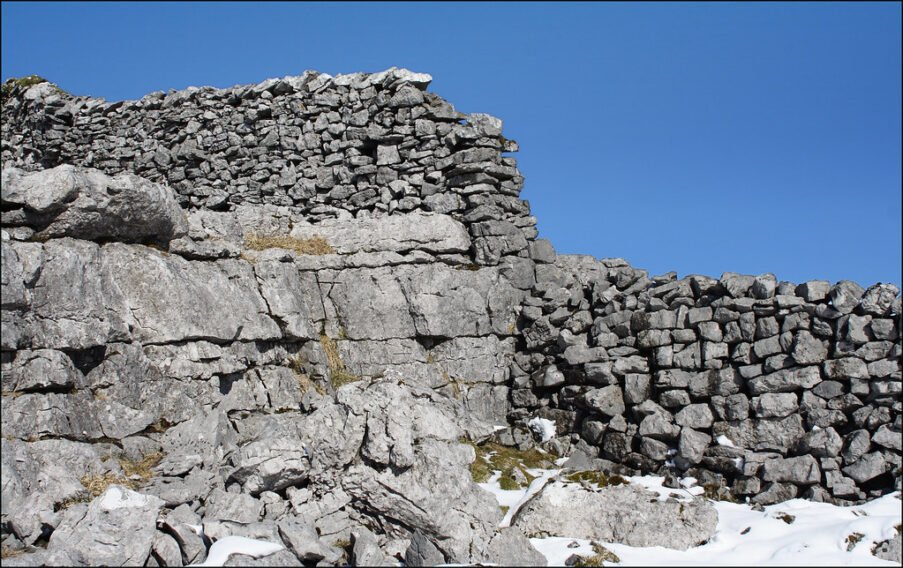
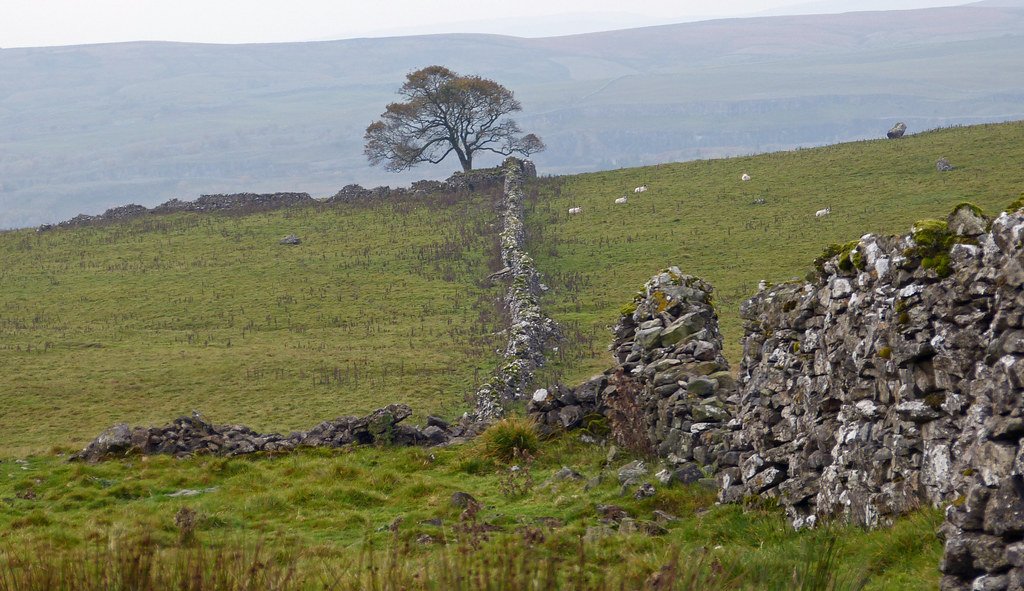
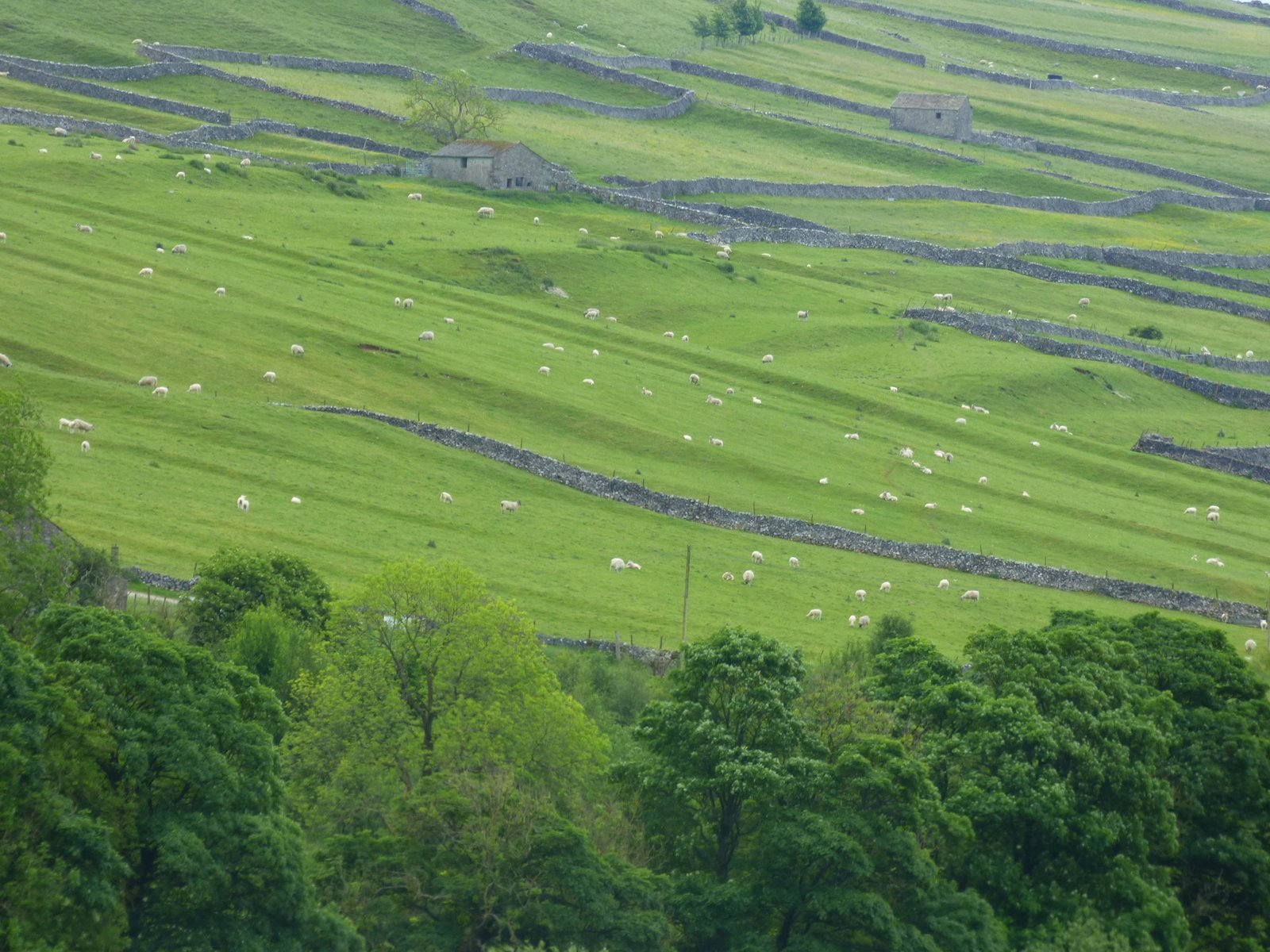
Dales Wall

Dales Wall” by ARG_Flickr is licensed under CC BY 2.0

The Parliamentary-wall

The Enclosure Acts of the late 17th and early 18th centuries introduced the term “parliamentary wall”, and I thought it interesting to look at how this phrase carried forth into modern literature.

Milestone text Exact wording Relevance
Enclosure award schedules (c. 1760-1840) “A good and sufficient stone wall 5 ft 3 in high and 2 ft 4 in broad at the base…” The Acts never coined a special name; they merely prescribed height, breadth and stone type.
W. G. Hoskins, The Making of the English Landscape (1955) “…mile after mile of the long straight walls and hedges laid out by the Parliamentary enclosure commissioners.” Hoskins links the walls to enclosure, but still does not create a fixed term.
David Garner, “Dry-stone walling on the Mendips” Proc. Somerset Arch. Soc. 127 (1984) “The later Parliamentary walls were built to tighter specifications and in straighter lines.” First specialist paper to treat the phrase as a wall-type. (learning.mendiphillsaonb.org.uk)
County‐level landscape guides (e.g. Durham 2009) “Later parliamentary enclosure walls are typically built from regular thinly-bedded quarry stone … 2 ft 4 in at the base, 5 ft 3 in high.” (durhamlandscape.info) Standard dimensions are now codified for conservation practice.
Ian Whyte, “The Parliamentary Enclosure of Upland Commons” in Cultural Severance and the Environment (2013) Caption to fig. 23.5: “Well-built parliamentary enclosure wall with three lines of through-stones…” (SpringerLink) Academic synthesis: fixes the phrase in upland landscape history.
Pendle Hill Landscape Action Plan (2017) “These parliamentary walls are the longest, straightest walls you see, often running up the side of the hill …” (forestofbowland.com) Shows the term now embedded in public‐facing heritage documents.

Key points in that evolution

18th–19th c. reality: enclosure commissioners ordered walls to uniform metrics; the walls themselves are historic but not yet named “parliamentary”.

Mid-20th c. scholarship: Hoskins popularises the idea that the straight, regimented field boundaries are the visual signature of the Acts.

1980s–2000s field studies: walling historians (Garner, CHERT Surveys) begin to speak of “Parliamentary walls” as a typological class, contrasting them with earlier “intake” or “clearance” walls.

Current conservation usage: county guidelines and AONB reports treat “Parliamentary wall” as standard jargon for straight, survey-set dry-stone walls erected under an Enclosure Award, usually 1.3–1.6 m high, with two through-courses and a neat copestone.

Typical identifying features (drawn from field manuals)

Straight, ruler-like alignment across moor or fell, often ignoring micro-relief.

Regular thin-bedded quarry stone rather than random field-cleared boulders.

Specification walls: about 0.7 m wide at base, tapering to 0.4 m; two courses of through-stones; single or saddle coping (Durham spec sheet). (durhamlandscape.info)

Sometimes accompanied by an “occupation road” set out in the same Award.

Earliest printed occurrences

The phrase “parliamentary wall” itself is hard to trace before the 1980s—award clerks simply spoke of “stone walls” and early historians (e.g. J. R. Ward 1954) used “enclosure walls”. Garner’s 1984 article is the first to treat it as a fixed compound; by the 1990s the term appears in county HERs and by 2010 it is routine in management plans and academic monographs (Whyte 2013; Rotherham 2013) (Ethernet University).

Why the phrase matters now

Dating guide: in upland northern and western England, a long, straight dry-stone wall marching up-slope almost always signals an 18th–19th-century Act.

Conservation trigger: repair grants and SSSI guidance often distinguish “Parliamentary walls” from earlier vernacular boundaries because their tidy appearance is vulnerable to partial collapse or modern rebuilding in a different style.

Social history: the walls are the physical trace of enclosure’s legal and social revolution—the line that privatised former stints and commons.

What the Enclosure Acts were

Between the mid-18th and late-19th centuries the British Parliament passed almost 5,000 local “Inclosure Acts.” Each Act authorised a team of appointed commissioners to survey one specific township or parish, divide its open-field strips, common pastures, and “wastes” into new, privately owned parcels, and lay out straight roads and boundary walls or hedges. The commissioners issued a legal award map and schedule that became the new title deeds.

Earlier enclosures (14th-17th c.) had been done piecemeal by manor court agreement or lordly edict, but the Parliamentary Acts provided a uniform, litigable procedure and—critically—over-rode any local dissent once the Bill was passed.

Why enclosure was pursued—shared justifications at the time

Stated aim Problem with the old system How enclosure claimed to solve it
Increase food production Open-field strips and communal grazing made it hard to try crop rotations, drainage, or new grasses; grazing animals wandered and over-browsed. A landowner who held a compact, hedged farm could invest in four-course rotations (turnips, clover), selective breeding, liming and manuring—all said to raise yields 50–100 %.
End common-field disputes Rights to stint (graze) or cut turf were vague; trespass cases clogged manor courts. Single-owner parcels and straight “parliamentary walls” abolished overlapping rights and the need for constant adjudication.
Encourage investment & drainage No tenant would sink capital into drainage channels or marl-pits on land he might lose next year through open-field reallocations. Freehold or long leases on enclosed land secured returns on drainage, fencing, and new buildings.
Support a growing population & army Britain’s population doubled 1700-1800; wars with France demanded grain self-sufficiency. Larger, more efficient farms were expected to feed cities and keep bread prices stable.

Less-voiced but real motivations

Landlord profits: rising grain prices after 1750 made enclosure attractive; rents on newly enclosed Wolds or Midland arable sometimes doubled within a decade.

Rational tax base: compact holdings were easier to rate for the Poor Law and land tax than scattered strips and commons.

Control of labour: concentrated holdings reduced the number of small independent graziers, creating a wage-dependent workforce for both agriculture and emerging industries.

Were the Acts “needed”? (Historians’ verdict)

Agronomic necessity: modern scholarship shows that many innovations (turnips, clover, Norfolk rotation) could happen inside common-field frameworks given cooperative governance; yet enclosure accelerated their universal adoption.

Legal clarity: in areas with tangled manorial rights (upland commons, forest wastes) Parliamentary authority did supply a clear, once-for-all settlement.

Social cost: enclosure delivered efficiency for owners but often at the expense of cottagers who lost grazing and fuel rights; pauperism initially rose in several districts. Whether that price was “necessary” remains debated.

The Enclosure Acts were local laws that converted shared medieval landscapes into modern, hedged and walled farms. Reformers hailed them as essential for higher yields and legal order; critics then and now point out that they chiefly served landowners, dismantled village commons, and set the stage for the rural depopulation that fed Britain’s industrial cities.

What happened to Swaledale’s people when the commons were “walled in”?

When Parliament authorised the division of Swaledale’s stinted pastures (the main awards came in 1814 – 1825 for Grinton-Reeth and 1824 – 1843 for Muker/Gunnerside) the dale acquired the ruler-straight dry-stone “parliamentary walls” we still see today. But the physical neatness masked a radical social shift.

Land ownership and control

Before enclosure most dale households—yeomen, copy-holding miners, and cottagers—held tiny rights to graze a handful of beasts on the township commons; these were protected by the custom of “stints”.

After the award the surveyors allotted the lion’s share of former common to a few dozen larger farmers and to outside investors (notably lead-mine partnerships who wanted moorland for water-capture reservoirs). Cottagers and tenant miners received token plots—often steep, rushy ground that was impossible to wall without spending more than the land was worth. (eprints.lancs.ac.uk)

Within a generation many smallholders had sold their allotments or slipped into pure wage labour, consolidating fields into today’s 10- to 30-hectare livestock units.

Population movement

Parochial censuses show a brief spike during the 1820s–1840s as men were hired to wall and drain the new allotments, followed by steady decline once lead prices slumped and small graziers lost common grazing: Muker township fell from c. 1250 people in 1851 to 720 in 1901. Many families followed the ore-smelters to Teesside or took mill work in Darlington and Leeds. (Academia)

Every-day impact on livelihood

What changed Practical effect on ordinary families
Loss of free turf & bracken Cottagers now had to buy peat-cutting rights or coal for fuel; bracken for bedding became a rented commodity.
hay-meadow obligation Each new in-bye parcel had to be fenced, limed and mown: hired labour or cash rent replaced communal “meadow days”.
Higher rents & rates Landlords passed enclosure survey costs onto tenants; Swaledale vestry minutes record a 40 % rise in poor-rate calls in the 1830s.

Resistance and negotiation

Unlike some lowland counties, Swaledale saw no enclosure riots; but township minutes note repeated petitions asking commissioners to set back head-dykes so that poorer graziers could still reach summer turbary plots. A few concessions were granted—narrow “occupation lanes” that today appear as un-walled green tracks threading to the moor.

What the landscape still tells us

The dense lattice of field barns and hay-meadows between Muker and Thwaite is the fossil of the allotment grid laid down by the 1824 award—each barn stands in the very centre of its original two “ing” strips.

Parliamentary walls run arrow-straight over blind summits (e.g., Birkdale Common) where practical farmers would once have followed slope contours; that rigidity is the surveyor’s signature. (Parliament News)

Deserted miner-cottages on the new allotments (e.g., Bracken Rigg) mark the failure of small allotments to sustain dual mining–farming households after ore prices collapsed in the 1870s.

Documentation Notes

Parish vestry books, enclosure maps, the 1841 tithe returns, and estate rentals—makes Swaledale one of the better-recorded Dales for studying how parliamentary paperwork translated into everyday winners, losers, and a field pattern that still frames the view from every fell-side today. (Lumen Learning, eprints.lancs.ac.uk)

The hero archetype and Lugh

Contents

The hero archetype

At its core the “hero” is the figure who steps out of ordinary society, confronts chaos or a monster, and returns (or dies) having secured order for the group. In Jungian and comparative-myth terms it sits in the “warrior-champion” slot of the collective story-board; evolutionists would say it crystallises the survival value of decisive coalition leadership in small bands.

Earliest visual hints of a heroic idea

Scholars and archaeologists have noticed that from very early dates, hunting scenes can often show attention to heroic acts, and the have suggested that such scenes may well be an origination point for a later, more well defined hero archetype.

Date (BP) Object / scene Why scholars read it as “proto-heroic” Source
40 000–35 000 Lion-Man of Hohlenstein-Stadel – mammoth-ivory figure, human body + cave-lion head, 31 cm high Combines human agency with the apex predator; plausibly a master-of-beasts or shaman-hero rather than a fertility idol. (Wikipedia)
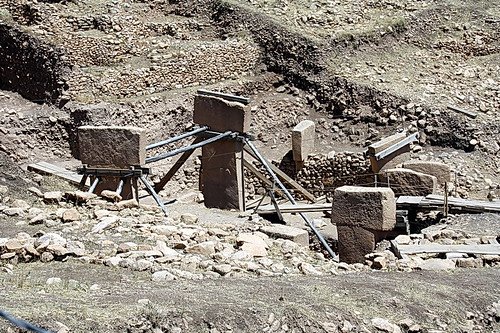
11 600–11 000 Göbekli Tepe, Pillar 43 – relief shows a decapitated man amid dangerous beasts One of the first narrative carvings of a human confronting lethal animals; interpreters (e.g., Notroff 2016) see a mythic “headless hero” motif. (dainst.blog)
c. 5100 T-shaped “anthropomorphic” pillars at Göbekli Tepe Carved belts and arms confirm they represent larger-than-life humans presiding over the rings – guardians or super-ancestors.
c. 3100 BC Narmer Palette (Egypt) – king smites a defeated enemy, wears regalia Earliest named individual shown defeating chaos; establishes visual code later used for pharaohs and Near-Eastern hero-kings. (Wikipedia)

The oldest effigy we can link to heroic power is Upper-Palaeolithic (Lion-Man). Narrative hero scenes proliferate when large farming communities emerge in the 4th millennium BC.

From symbols to fully fledged heroes

Over time, we can see how this heroic archetype figure may have evolved:

Palaeolithic therianthropes

The 30–40 Ka Löwenmensch (lion-man) of Hohlenstein-Stadel and the “Sorcerer” engraving in Les Trois Frères cave mix human limbs with the heads or pelts of apex predators. Because predators belong squarely in the untamed realm, a figure that fuses with them signals an ability to cross the boundary between human order and wild chaos. Many pre-industrial shamans do exactly that in trance, “borrowing” animal bodies to hunt or fight on behalf of the clan, so archaeologists read these statuettes as early visual shorthand for a boundary-breaking, protector-hunter—the seed of the later hero idea.

Neolithic master-figures

At Göbekli Tepe (11 ka) the T-pillars show stylised human torsos wearing belts and loin-cloths, flanked by carved scorpions, lions and snakes. The animals cling to, but do not threaten, the pillar-men—suggesting the human counts as their master. Similarly, wall reliefs at Çatalhöyük (Turkey, 9 ka) show a reclining human grasping leopards by the tails. In both cases the message is “the hero-ancestor tames the dangerous world,” turning the Palaeolithic hunter’s one-off feat into a permanent, protective presence at the core of a settled farming community.
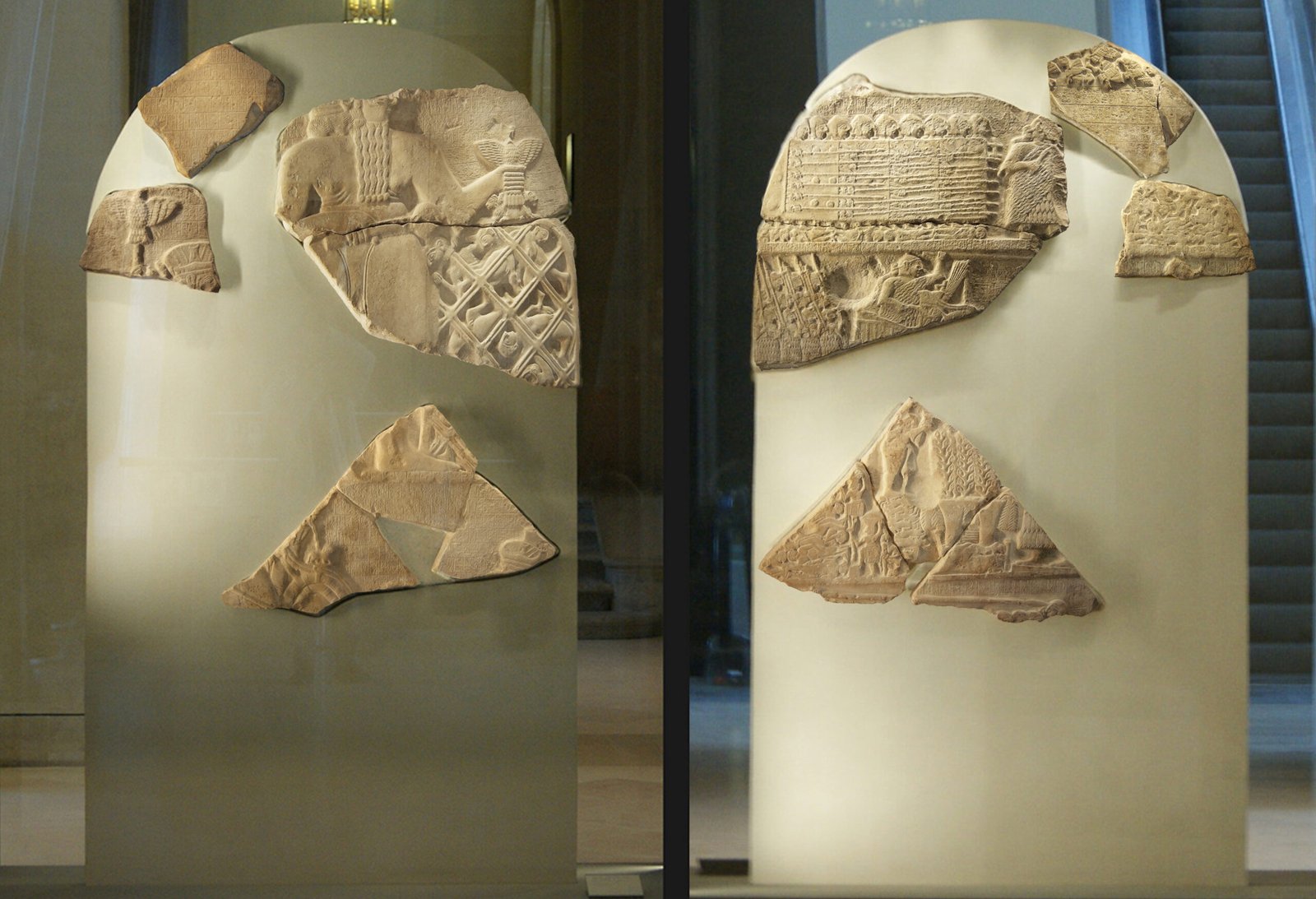
Stele of the Vultures in the Louvre Museum (enhanced composite)

Stele of the Vultures in the Louvre Museum (enhanced composite)

Bronze-Age hero-kings

By c. 3000 BC we meet named rulers whose real political power is retold in mythic terms. The Narmer Palette shows the Egyptian king smiting a captive under a sky-falcon—his victory becomes cosmic order. The Stele of the Vultures (Lagash, Mesopotamia) has King Eannatum marching beneath Ningirsu’s battle-net, merging man and war-god. Most vividly, the Epic of Gilgamesh casts an actual Sumerian king as two-thirds divine, slaying monsters, digging wells and setting city walls: the first full literary hero-king, mapping civic achievements onto an archetypal champion narrative.

Iron-Age codification

From roughly 1000-300 BC literate cultures lock the roaming hero motif into fixed narrative cycles:

Achilles (Greek): divine mother, refusal-exile, duel with Hector, fatal heel—a template for proud, semi-divine warrior doomed by hubris.

Cúchulainn (Irish): unknown youth, single-combat tests, warp-spasm powers, tragic death defending Ulster, localising the pattern on Atlantic fringe.

Arjuna (Indian): divine paternity, crisis of duty, quest for celestial weapons, flaw of hesitation, eventual enlightened victory—Bhagavad Gita embeds the hero within dharma.

These Iron-Age epics lay down the hero’s journey “beats”- a prophecy of greatness, withdrawal, super-weapon, monster or duel, fallibility, costly triumph—that later stories from Beowulf to comic-book sagas still echo.

Where did the archetype originate?

A single birthplace is unlikely to be found; cognitive science suggests three converging pressures created it wherever Homo sapiens lived:

Coalitional warfare: groups that rallied round a conspicuously brave individual survived inter-band conflict better.

Costly signalling: a hero who risked death proved value and earned mates and status; myths preserve and teach that template.

Story compression: oral cultures package moral and survival lessons into memorable “once-for-all” figures – the hero is the easiest to remember.

Thus similar hero shapes appear to emerge independently: the Lion-Man carver, the Göbekli sculptor and the Narmer court artist lived millennia apart yet answered the same narrative need. After 3000 BC the iconography explodes: Mesopotamian cylinder seals of Gilgamesh, Egyptian smiting kings, Indus bull-slayer seals, Aegean boar-hunt frescoes—each culture remixing the same primal schema.

The hero archetype is then seen to be “echoed everywhere”, an it seems to it solve a universal social problem: who leads, who guards, and how risk is rewarded. Its symbolic DNA is visible from the Ice-Age Lion-Man, through Neolithic sanctuaries, into Bronze-Age royal art and all later myth cycles. Rather than one birthplace, we see recurrent invention – each time society scaled up or faced new threats, artists reached for the familiar silhouette of a powerful human standing between the group and chaos.

Could the hero archetype have began with the “best forager in the most dangerous patch”?

Anthropologists and evolutionary psychologists think that it may well be that the concept of the hero, may have emerged from hunter gatherers, honouring their best and bravest gatherers. And that this may lie at the root of heroic story-telling. The idea is built from three well-studied observations:

Ecological fact Behavioural response Story outcome
Rich food patches (large game, honey cliffs, shellfish reefs in rough surf) often offer the highest caloric payoff but carry the greatest risk/injury, predators, falls. A minority of individuals repeatedly take those risks, sometimes returning with big hauls and sometimes dying. The band recounts those forays as cautionary but inspiring tales; over time the successful specialist is remembered as “the one who went where no one else dared” → proto-hero.

How risk-heavy hunting turns men into living (and post-mortem) heroes

Ethnographers have tracked the mechanism in three foraging societies that still practise high-risk “big packages” hunting.

Society & habitat Typical “big, risky” prey Why it is risky / hard Immediate social payoff Long-term reputational payoff
Hadza (savanna woodland of northern Tanzania) Giraffe, kudu, buffalo, zebra Requires stamina tracking, close bow-shot, real danger of gore-injury; success rates < 3 % per attempt. Entire camp (30–50 people) fed for two days; hunter gets A but no larger share. Hawkes, O’Connell & Blurton-Jones (1991–2001) show hunters who land ≥ 1 large carcass per month are named far more often as desirable camp-mates and marry younger, polygynously.
Ache (sub-tropical forest, eastern Paraguay) White-lipped peccary, tapir Peccaries travel in aggressive herds; tapirs flee into dense cover; hunters go solo with bow, may suffer fatal wounds. Meat shared by strict rule; hunter’s family portion identical to others. Hill & Kaplan (1987–1990) found widows of “elite big-game hunters” remarried fastest; songs retell their feats for decades, citing exact kill counts; a post-mortem hero cult.
Meriam (coral-reef and islet environment, Torres Strait, Australia) Green turtle, dugong (sea cow) Deep-water harpooning from small canoe; storms, shark risk; capture rate < 0.2 per hunter-day. Entire island community eats; hunter directs distribution, creating political alliances. Bliege Bird & Smith (2005) show successful dugong hunters are 10 × more likely to hold council leadership; after death they are spoken of as zugubal (ancestral spirit-heroes) who “still ride the turtle tracks in the sky.”

What the three cases teach us

Prestige not provisioning: Although meat is evenly distributed, status, mates and political sway flow disproportionately to the risk-taking hunter.

Memory selects for drama: The Hadza recount giraffe kills in informal “epic” evenings; Ache elders compose formal songs; Meriam print the hunter’s spirit into star-lore. Mundane monkey or fish catches never get this treatment.

Risk–reward ratio drives mythic condensation: The rarer and deadlier the prey, the more the narrative sharpens: one or two high-stakes exploits eclipse dozens of safe successes, simplifying the persona into an archetypal template; skill, courage, generosity, sacrifice.

Hero after death: Each society honours fallen hunters: Hadza carve giraffe-hoof marks on grave posts, Ache sing jay-rera elegies listing biggest kills, Meriam give special star-names. Ancestral hero status persists long after physical provisioning ends.

Relevance to the hero archetype

These real-world patterns fit both Jung’s and Campbell’s theoretical proposals:

  • Call & venture: The hunter leaves safe camp, entering lion grounds or dangerous fishing waters.
  • Ordeal: The possibility of gore, storm, or spirit attack.
  • Boast & gift: The carcass is displayed, the amount and quality of the catch praised, blessed and redistributed.

  • Apotheosis: Stories, songs and imagery elevate hunter into model of bravery and sharing, the stories and effigies carry their name and deeds into the future, beyond their death.

Across continents, the concrete economics of meat and danger furnish the raw material for the same myth-making machinery that later produces Lugh, Arthur, or St Michael—only scaled up from the campfire to the national epic.

From forager tales to mythic “perfect hunter”

Small-scale societies frequently develop a culture-hero who first mastered a perilous resource:

Culture Culture-hero Dangerous bounty
Inuit (Central Arctic) Nuliajuk tamer of sea beasts Deep-ice seal hunting in dangerous leads
San (Kalahari) !Kung’s Haasi Honeybee cliffs with lethal falls & stings
Northwest Coast Raven Salmon trapped at perilous tidal falls

These figures encode technical knowledge (how to approach the cliff / harpoon the seal) and provide a moral template: courage plus generosity of sharing.

How real hunting feats grow into “perfect-hunter” myths

Small-scale societies frequently develop a culture-hero who first mastered a perilous resource:

Culture-area Mythic culture-hero The perilous resource Key episodes that transmit know-how Moral lesson carried in the tale
Inuit (Central & Eastern Arctic) Nuliajuk / Sedna (sometimes male hunter, more often sea-mother goddess) Ringed-seal and walrus taken at moving pack-ice leads, where one slip means drowning

1 She is thrown into the sea; as she clings to the kayak gunwale, her fingers are cut and turn into seals and whales.

2 Hunters must dive to comb her hair and soothe her anger, or the ice will not open.

The seal harvest is conditional on ritualised courage and respect; success depends on cooperating with the sea-mother, not brute force. This speaks of flow and balance in their relationship with nature: The hunter in tune with the mother of life.
Hoan & Naro San (Kalahari Desert) !Kung’s Haasi (literally “Honey-guide Bird transformed”) Wild-bee honey in sheer cliff hives with swarming stings

1 Haasi follows the Indicator bird, chants the right song to keep bees calm.

2 He smears wax on hands, uses a forked branch as a ladder, invites the camp only after first taste.

This shows a deep relationship with nature, involving trust, skill, and a ritualised behaviour that ensures a safe harvest in a perilous situation. The bird being natures messenger. Showing which honey the tribe can take, and which, they therefore, cannot.

North-West Coast Salish & Tlingit Raven (trickster-hero) Sockeye salmon trapped at dangerous tidal narrows

1 The Raven steals the river-owner’s weir or dam, smashes it so the fish escape upriver.

2 He understands, and teaches the people the first-salmon ceremony to ensure the run returns yearly.

Clever risk unlocks staple food, but community must reciprocate with ritual thanks or the salmon will withhold themselves next season.

What “mastering the peril” really means

Technical blueprint

Nuliajuk stories embed knowledge of ice-edge reading and propitiation rituals; every unveiling of a lead recapitulates the myth.

Haasi tales encode mozzie-smoke, wax handling, and safe descent after harvest.

The Raven cycle teaches tide-timing, weir technology, and the taboo against catching the last fish.

Risk rationale

The hero’s unique bravery validates why ordinary members shouldn’t attempt the feat alone. It limits fatal copycat acts while still encouraging collective support.

Generosity norm

After the kill or acquisition the hero shares—the myth equates hoarding with supernatural punishment (Raven is punished for greed in some variants).

Spiritual contract

Each myth frames the resource as personified (Sea Mother, Bee Spirits, Salmon People). Human access is never free; ritual “grooming,” song, or first-fruit offerings renew the pact that the hero forged.

From local hero to universal archetype

These forager myths contain the same structural flows are then later expanded and into the Iron-Age hero epics:

Beat in small-scale myth Macro-hero version (e.g., Lugh, Hercules)
Risky quest for crucial food Quest for life-saving cattle of Geryon or Pigs of Tir na nÓg
Spirit / monster tests bravery Balor’s evil eye, Hydra’s poison heads
Success achieved by brains + nerve Lugh’s spear precision; Hercules uses lion skin as shield
Mandatory sharing or thanksgiving Lugh institutes Lughnasadh; Hercules dedicates spoils to gods

Expansion to war-hero

Once Sedentism and inter-group conflict intensified (from the Neolithic period onwards), the same narrative logic shifted from hunting risk to combat risk. Success in battle is likewise rare, high-payoff, dangerous—easy to package as heroic myth. The hunter-hero template was simply redeployed:

Spear vs mammoth → spear vs invader

Navigating dangerous waters → navigating enemy lines

Thus Heroes that form heroic archetypical legacies such as Lugh, Arthur and later Michael inherit a structure first honed in dangerous-patch foraging: a specialist confronts what others avoid, wins resources/order, returns as benefactor.

Ancestral embodiment

Lineages often claim descent from the specialist— “our clan mastered the falls.” Archaeologists find:

Trophy display (lion teeth, boar tusks) buried with particular males.

Totemic emblems linking a kin-group to the prized animal or patch.

Those graves become pilgrimage nodes; the remembered hunter merges into an idealised ancestral guardian – the nascent hero-ancestor.

The daily tasks of Palaeolithic foraging where few dare, but many benefit, may well have created both the selective pressure and the social appetite for celebrating a “perfect hunter.” That celebration probably crystallised into myths, myths often enhanced through a deep relationship with both nature, and increasingly well defined spiritual connection, and explanation.

As new dangers (warfare, monsters, cosmic dragons) emerged, the underlying heroic shell stayed intact while the external foe changes. The hero archetype can therefore be seen almost certainly to have grown out of stories of the handful of individuals willing to enter the most hazardous food patches and live to share the spoils, and later societies mapped the same narrative onto every new realm of risk that mattered.

Stage in the “life-cycle” of a hero myth

Stage in the “life-cycle” of a hero myth What usually happens in most traditions Why the pattern keeps repeating
Local point of origin A real (or plausibly real) problem-solver takes exceptional risks: the hunter who braves the hyena den, the voyager who crosses open sea, the warrior who wins a first skirmish. Small groups remember rare, high-pay-off behaviour — it helps them imitate success and assign status.
First narrative crystallisation The deed becomes an episode told around the fire; over just a few retellings the human gains helpful spirit-allies or luck-omens. Storytellers compress detail, heighten drama; adding a hint of the supernatural marks the event as morally instructive, not mere gossip.
Expansion into a cycle New “wins” solidify the myth: the hero invents tools, founds a lineage, defeats a monster that threatens the whole group. Each answers a practical question (“Where did we get spears?” “Why do we dance before hunting?”). Once a figure is recognised, new social or ecological challenges can be attached as “prequels” or “sequels,” saving inventors the labour of coining a fresh protagonist every time.
Integration into a pantheon The character is lifted above genealogy — now a demi-god, culture-hero or full deity. Worship (or ritual respect) develops at places linked to the original exploit. Converting the champion into a god secures group identity: the hero’s feats become timeless guarantees of territory, law or cosmological order.
Subordination to a still higher power In strongly theistic systems the former hero shifts one more rung down: from god to arch-angel / saint / “first king” who acts for the supreme deity. Monotheistic or imperial religions absorb local stories but must keep ultimate sovereignty clear; demoting the old hero maintains continuity while asserting new orthodoxy.

Why the similarities?

Convergent social ecology

Wherever humans live in bands or tribes, they depend on someone’s willingness to tackle risky-but-rewarding tasks. The social payoff (food, defence) and the signalling payoff (prestige, mates) are identical whether the quarry is seal, boar, jade, or an enemy war-party.

Cognitive compression

Human memory prefers a single, exaggerated protagonist to a list of ordinary contributors. So separate admirable deeds tend to coalesce onto one “perfect” figure.

Narrative problem-solving

Myths are cultural troubleshooting manuals. If a community already has a celebrated name, sewing new lessons onto the old hero is quicker than inventing a fresh personality.

Theologisation as politics

As groups merge into chiefdoms or states, leaders gain by folding each tribe’s champion into a shared divine roster: “Your Bear-Killer is really my Thunder-God’s brave nephew.” Over time the original person disappears behind the collective edifice.

Concrete examples

Initial “specialist” Later pantheon slot Structural echo elsewhere
Polynesian navigator Māui (fishes up islands, snags the sun) Demigod, trickster-culture hero Trickster-innovator pairings of Raven (NW Coast) and Coyote (Great Basin)
Greek Herakles (strongman monster-killer) Becomes full Olympian; later demoted to saint-like protector in Byzantine folklore Hindu Bhima, Norse Thor share strength + monster duel cycle
Celtic smith-hero Goibniu / Govannon God of the forge under Tuatha Dé Danann Mesopotamian Kulla, Yoruba Ogun, each born from skilled artisan ancestors
Historical war-leader Arthur Medieval rex quondam, later Christ-like Grail king Mede-Persian Kay Khosrow, early Japanese Yamato Takeru mirror arc from secular prince to semi-divine saviour

Independent tribes create their own heroic forebears, but because the social functions of risk-taking, teaching, and identity-marking are everywhere the same, those heroes evolve through remarkably similar thematic stages, eventually shedding much of their human detail and settling into a symbolic niche within a larger divine or semi-divine hierarchy.

That is why a Bronze-Age smith, a Romanised war-lord and a Hebrew arch-angel can look like variants of one indestructible template: each is the latest mask worn by a role that human groups have needed — and mythologised — since the first hunter walked beyond the safe horizon in search of better food.


Lugh’s “claim” as hero

There are a number of reasons to consider Lugh as embodying that heroic template:

The single decisive deed – at the Second Battle of Mag Tuired he kills his grandfather Balor, whose evil eye could wither armies. This is the classic “hero slays the chaos-monster/tyrant” scene, comparable to Perseus vs Medusa or Michael vs the Dragon.

Extraordinary birth and destiny – his mother is Eithne, Balor’s daughter, and prophecy foretold that Balor would be killed by his grandson. The threatened infant who grows up to fulfil the prophecy is a standard hero motif.

Exile and return – he is raised away from his birth-tribe (fostered by Manannán or Tailtiu), returns at maturity, and proves his worth at the gates of Tara by demonstrating mastery in every craft. The “outsider returns as saviour” is central to the hero’s journey.

The perfect warrior – he wields the Spear of Assal, a weapon of unstoppable victory. Weapons with inherent, almost divine power (Excalibur, Achilles’ shield, St Michael’s flaming sword) are hero emblems par excellence.

Where Lugh goes beyond a “mere hero”

Polymath identity: Unlike many one-note heroes, Lugh is called Samildánach (“possessor of many skills”). He embodies not just physical bravery but craftsmanship, artistry, rulership, judgment, and inspiration.

Integration into the divine order: The Tuatha Dé Danann accept him not as a passing champion but as a sovereign figure. He becomes king after Nuada’s death. This places him at the top of the pantheon — the slot usually reserved for a sky- or thunder-god.

Festival and cult: The great harvest festival Lughnasadh (“assembly of Lugh”) is instituted in his honour, rooted in rites of sovereignty and agriculture. This ritual enshrines him not just as warrior but as guarantor of the fertility of the land — something most “hero” figures never achieve.

A Comparison with other Irish pantheon figures

Deity Role Relation to Lugh’s “hero” claim
Nuada King of the Tuatha, “silver hand” after maiming A tragic hero-king: his wound disqualifies him from sovereignty. Lugh surpasses him by being whole and perfect.
Dagda “Good god,” fertility and magic More fatherly, earth‑bound; not a hero in the martial sense. Lugh is younger, radiant, sharper.
Ogma Champion, eloquent warrior Closer to a heroic strongman (like Hercules); lacks Lugh’s all-round genius.
Cúchulainn Semi-divine mortal hero In many ways Cúchulainn is Lugh’s mortal double: a battlefield prodigy who dies young. Unlike Lugh, he never crosses into sovereignty or divinity.

It can therefore be seen that Lugh is very much a hero archetype, and may well be one part of a common shared archetypical lineage which may be “baked-in” to human DNA. He fits the pattern of miraculous birth, exile, return, single decisive victory, possession of a unique weapon. But he is also a culture-hero and sovereign god, elevated above the normal champion’s slot. His “claim” is therefore stronger than any single Irish hero: he monopolises nearly every heroic quality and then ascends to rulership, where others (Nuada, Cúchulainn) falter.

In archetypal terms, if Cúchulainn is the “young hero,” Lugh is the “perfected hero”: The point where the archetype fuses into divinity and becomes a lasting cornerstone of the pantheon.

Can all of these heroes, myth and real, carry the same “DNA”?

Let us face facts: There are no facts! What we can do, is take a diverse sample, and compare the key aspects of their mythology, and just look for similarities and commonalities.

Element of the statement What holds up Where it over-compresses Evidence / counter-evidence
All three are ‘hero’ figures Each leads a decisive battle against a monstrous or chaotic foe:

  • Lugh slays Balor at Mag Tuired
  • Arthur defeats giants, Saxons and sometimes dragons
  • Michael casts down the Dragon (Revelation 12)
“Hero” is a very broad Jungian/Campbellian archetype: most warrior-leaders fit it, so similarity on this level doesn’t prove lineage. Comparative myth analyses (Dumézil, Campbell) put them all in the “warrior champion” slot, but cluster dozens of other figures there too.
Linear refinement from Celtic god ➜ legendary king ➜ Christian archangel Christian authors often grafted familiar pagan motifs onto saints and angels; St Michael cult sites in the Isles do sit on earlier high-place shrines. No textual or etymological chain links Lugh ⇢ Arthur ⇢ Michael.

Arthur’s name is Latin Artorius not cognate with Lugus.

Michael is Hebrew Mî ḵā’ēl (“Who is like God?”).

Arthurian tales borrow Celtic mythic units (Otherworldly sword, sovereignty goddess) but also draw on late-Roman military lore. Michael’s cult arrived with Mediterranean Christianity, not via British Celtic tradition.
Weapons as archetypal constants (spear ▸ sword ▸ flaming sword) Lugh’s spear, Arthur’s Excalibur, Michael’s sword all symbolise divine or royal authority and victory over chaos. Weapons are common hero attributes; the shift from spear to sword reflects changing military tech rather than evolving archetype alone. Spears dominate Bronze–Early Iron Age hero myths (Lugh); swords dominate post-Roman literature (Arthur) and angelic iconography (Michael) because those were the prestige arms of each milieu.
‘Hero of God’ framing shows Christian refinement Michael’s iconography recasts martial heroism in a fully monotheistic frame: the warrior fights for God, not as a semi-divine king. Arthur’s later‐medieval “rex quondam” becomes Christ-like, but in earliest Welsh sources he is worldly. Lugh is explicitly divine himself, not God’s deputy. Shift from immanent warrior-god ➜ mortal champion ➜ celestial general mirrors Britain’s conversion-era ideology, but is not a straight lineage—more a set of re-mapped functions.

We can also compare and contrast as follows:

Shared slot in the Indo-European “warrior champion” repertoire

All three answer the narrative need for a culture-guardian who overcomes an existential monster or invader.

That similarity is typological, not necessarily genealogical.

Cultural resets override direct descent

Lugh belongs to the polytheistic Iron-Age Gaelic cosmos.

Arthur begins as a possibly historical war-band leader whose legend absorbs Celtic mythic motifs.

St Michael arrives from the eastern Mediterranean with Christianity; any overlap comes from Christian writers overlaying older heroic themes onto a biblical agent.

Refinement vs. repurposing

Each figure is refined to suit the moral and theological ideals of its age—but each also drops earlier traits (Lugh’s craftsman/solar aspects vanish in Arthur; Michael loses kingship, marriage, earthly community).

Influence pathways

There is good evidence for Christian re-use of high-place sanctuaries once devoted to pagan deities (several “St Michael’s Mounts” stand where sun-god or sky-god worship is suspected), but no medieval text equates Michael with Lugh or Arthur.

Arthurian romances later Christianise Arthur (e.g., Quest for the Grail), but that is a convergence, not an inheritance from Michael.

How the single “perfected hero” idea travels, splits and re-merges

Taking a wider look at the post Iron-Age hero cults, and how they overlap each other:

Region & figure Core heroic episode Extra layers added by local culture Where it overlaps Lugh’s pattern Where it diverges
Ireland – Lugh Kills Balor at Mag Tuired; wins every craft at Tara Festival of Lughnasadh secures harvest; rises to kingship of Tuatha Dé Danann Miraculous birth, exile-and-return, unstoppable weapon, becomes guarantor of land Retains full divinity, not just champion
Britain – Arthur Defeats Saxons, giants; wins magic sword; leads Round Table Medieval romance makes him rex quondam, then Grail-seeker; death on Avalon, messianic return Hidden upbringing, magical weapon, single decisive victory Remains mortal king; tragedy & return motif dominate instead of permanent sovereignty
Heaven – St Michael Casts down the Dragon; weighs souls Christian angelology turns him into Heaven’s field-marshal; psychopomp, healer Monster-slayer, weapon with divine authority, protector of community Pure servant of God, not a sovereign; no birth/exile narrative
Iberia (Galicia) – Santiago Matamoros Appears at Clavijo (legend), routing Moors with flashing sword Localised as patrón de España; linked to pilgrimage road to Compostela Mounted warrior delivers victory at crisis; cult-festival parallel to Lughnasadh Entirely Christian saint; heroic epiphany not life-story; martial horse motif
Gaul / Celtic mainland – Lugus/Mercury No narrative survives; Romans identified Lugus with Mercury, patron of boundaries & trade Triadic statues (Mercury with Rosmerta) show craft & communication aspect Shares etymology and multi-skill epithet ‘inventor of all the arts’ Loses combat episode; becomes civilizing god not battlefield hero
Germanic North – Thor Slays giants (Jörmungandr, Hrungnir); protects Midgard Hammer returns to hand, oath-ring hallowing; Thursday named for him Monster combat, magical returning weapon, protector of humanity’s realm More thunder-god than ruler; never becomes culture-hero or king
Slavic East – Perun / St Ilija Hurls lightning at snake-dragon Veles Christian layer equates Perun with Elijah; icons show fiery chariot Sky-bolt weapons, guardian of cosmic order vs serpent chaos No exile/return, no multi-skill craft dimension
Greek – Herakles Twelve labours cleanse monsters & thieves; apotheosis on Olympus Model for later hero-cults; clubs & lion-skin as triumph tokens Superhuman feats, killing chaos beasts, ends as god Lacks political kingship, but becomes pattern for mortal “strong-man” heroes
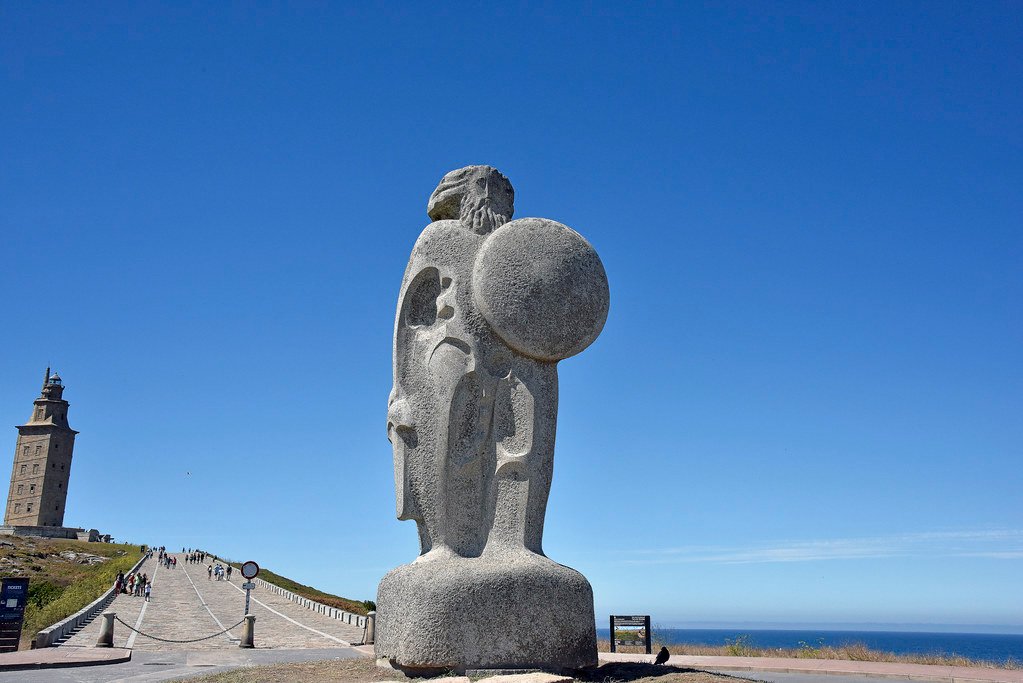
Galicia (Celtic folklore) – Breogán & his sons Found mythical Brigantia, sight Ireland from tower Origin legend of Irish Gaels; tower in A Coruña is Galician identity marker Culture-founder, voyage over perilous sea; sacred geography Non-combatant hero; emphasis on exploration/colonisation over monster-slaying

Patterns that repeat from Lugh outward

Monster-slayer + community saviour – Whether the dragon (Michael), Balor (Lugh) or Saxons (Arthur), a super-enemy defines the hero.

Weapon of authority – Spear of Assal, Excalibur, flaming sword, hammer Mjölnir, lightning-bolt; the armament itself becomes cult object or relic.

Festival or pilgrimage – Lughnasadh games, Santiago’s 25 July feast, Thor’s Thursday rites, Michaelmas: the people re-enact protection and harvest security.

Elevation or translation – Hero ends as king, god, angel or celestial patron (Arthur’s Avalon sleep; Herakles on Olympus; Michael enthroned as archangel).

The variables

  • Degree of divinity:
    • Lugh / Thor / Perun start as gods.
    • Arthur / Breogán are mythicised mortals.
    • Michael / Santiago are imported biblical or hagiographic figures overlaid on older hero ground.
  • Dominant function:
    • Ireland & Wales favour polymath-craft + kingship (Lugh, Arthur).
    • Continental thunder-gods focus on weather-warfare.
    • Santiago, Michael stress military epiphany within Christian cosmology.
    • Galician Breogán shifts to voyager-founder, echoing a coastal trading lens.

Why Galicia may be a key zone

  • Toponyms such as Lugo (Lucus Augusti) and Lugones keep Lugh/Lugus visible.
  • Roman Mercury-Lugus cult melds with later St Michael hill-shrines (Monte Medulio, San Miguel de Breamo) and finally with Santiago-Matamoros as the mounted protector of Christendom provide interesting cross-connects.
  • Thus Galicia shows layer-cake accretion: Celtic Lugus ⇒ Roman Mercury ⇒ Michaelite hill chapels ⇒ Santiago knight-hero. Each layer keeps the “champion-guardian” role but swaps theology and iconography.

What the comparison tells us

The hero archetype acts like an empty sleeve – local cultures can insert their key concerns (craft, kingship, thunder, crusade, voyage) into an inherited storyline of risk, victory, and social renewal.

Lugh sits at the “maximal” end – he fuses skills, rulership, warfare and divine status; later figures usually keep only two or three elements.

Christianisation does not erase the pattern – it merely channels the champion into service of the one God, producing Michael and Santiago.

Peripheral regions (Galicia, Brittany, Scotland) preserve hybrid forms because successive waves (Celtic, Roman, Christian) pile up without necessarily a total overwrite.

So Lugh is indeed a hero archetype—and by tracking the same structural features outward to Arthur, Michael, Santiago and beyond, we see how Europe continually re-clothes a very old narrative chassis in new theological and political fabrics, while the underlying role of “great protector who turns chaos into order” stays recognisably the same.

The Christian chapels on Galician castros – conquest or co-existence?

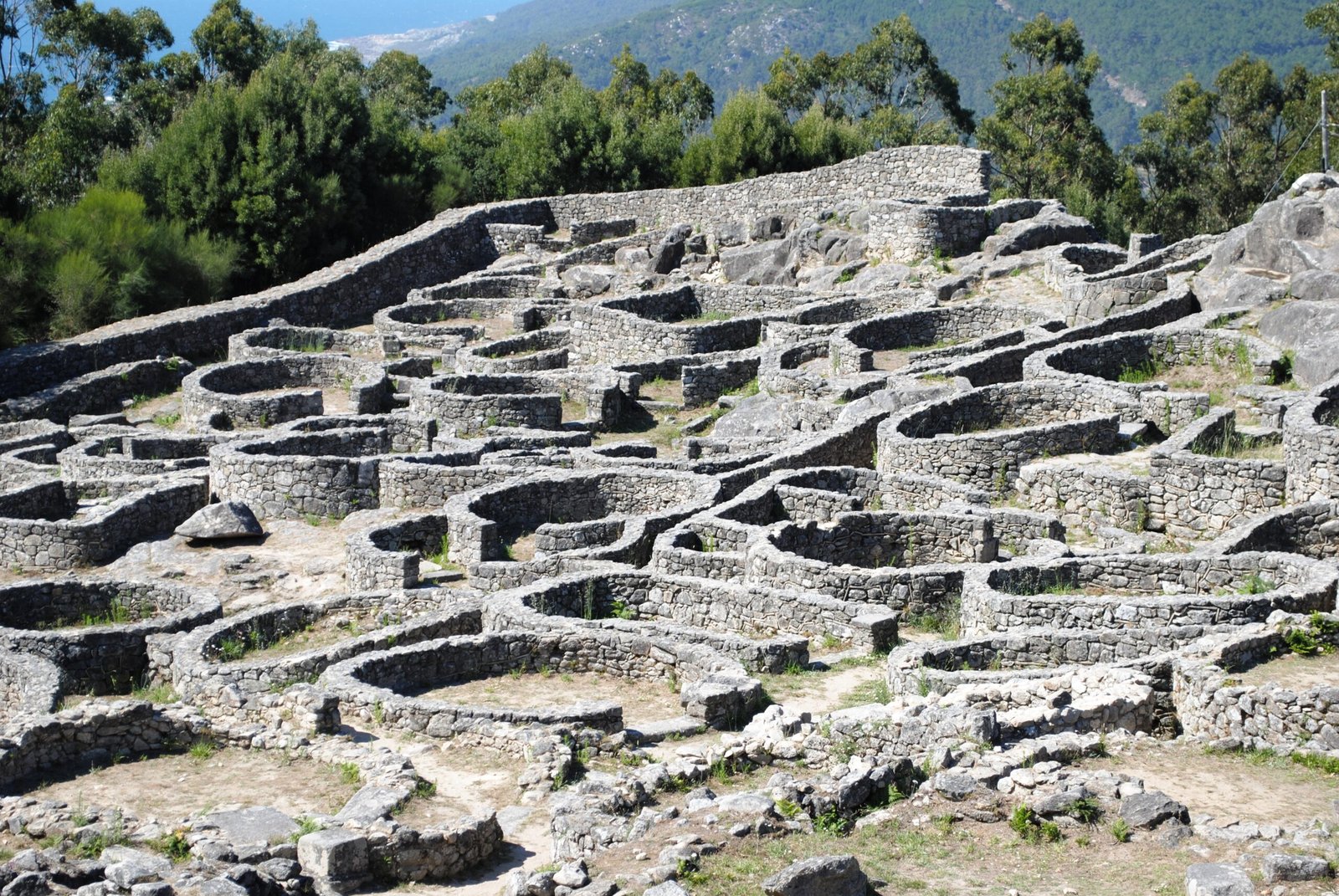
Many Iron Age castros in Galicia also form Christian shrines and places of pilgrimage. Is this a complete rewrite of the nature of those sites in a Christian frame? Or have the older, Iron-Age and Roman tradition’s also been “folded-in” to those newer, Christian practices? Archaeologists, historians of religion and folklorists now agree tend to agree on one broad answer: both suggestions are partly true. The medieval Church did plant crosses, hermitages and pilgrimage routes on the summits of Iron-Age hillforts (castros) as an assertion of Christian authority, but it did so because the places were already felt to be numinous and particularly spiritual by local communities. The new cults therefore absorbed rather than erased the older sense of sacredness.

What the record shows

Evidence “Triumph over paganism” reading “Syncretic adoption” reading
Stone chapels inside forts, e.g. Capela de Santa Trega on Monte Santa Trega; San Xiao at Castro de Troña Building a church on the acropolis proclaims Christ’s victory over demons linked to the old gods. Clerics chose the spot because people already climbed it for seasonal rites; replacing the shrine guaranteed the flock would keep coming. The chapel to Santa Trega still hosts an annual penitential climb that echoes earlier hill-top offerings. (turismoaguarda.es)
Pilgrimage and romarías held on castro summits Processions, Mass and viacrucis overwrite pagan gatherings. The calendar often aligns with pre-Christian dates (early August on Santa Trega ≈ Celtic Lughnasadh); saints’ legends borrow motifs of storm-control and healing long tied to hill spirits.
Iconography on site (crosses, cruceiros) facing seaward or skyward Marks of a reclaimed landscape; the cross nullifies “pagan demons”. Placement matches prehistoric sight-lines (sunrise alignments, river mouths); Christian symbol piggybacks on the same cosmological axis.
Toponymic continuitye.g. Lugo < Lucus Augusti < Lugus Latin/Christian names overwrite Celtic theonym. The survival of the root Lug- hints that the old deity’s memory lingered beneath the Roman and Christian layers.

How scholars explain the dual dynamic

Mission strategy: Early medieval bishops everywhere in Western Europe reused pagan high-places because they were natural assembly points; Gregory the Great’s advice to “turn the idol temples into churches” (letter to Mellitus, AD 601) set the tone.

Social leverage: For rural Galicians the hilltop was communal property, used for grazing and sanctuary; installing a saint ensured the Church sat at the centre of village economics and identity without costly land purchases.

Continuity of function: Castros already served as liminal landmarks between farm and wild, sea and land. Christianity offered a new guardian (saint, archangel, Virgin) but kept the protective and intercessory role once attributed to hill-spirits or sky-gods.

Criterion Assessment
Do chapels symbolise Christian victory? Yes. Sermons and hagiography often portray the saint “banishing devils” from the hill.
Did local belief in the hill’s power persist? Also yes. Pilgrims still ascribe healing, fertility or weather-luck to the site in terms that echo earlier folklore.
Did the Church tolerate residual folk rites? Usually, provided they were re-framed as penance or Marian/saintly devotion; outright “pagan” elements were pushed to the margins but not always stamped out.
Net result Syncretic Christianisation: a negotiated layering, not a clean sweep.

Modern ethno-archaeological studies of the of Santa Trega, Troña and other castros stress that villagers never spoke of “destroyed” pagan gods; instead they say the saint or archangel “took the old power under his wing.” That language betrays a perceived continuity under new management.

We can therefore suggest that the Christian iconography on Galician hillforts is both a sign of ecclesiastical appropriation and evidence that the Church folded enduring local sacrality into its own system. The stones, views and ancient ramparts kept their aura; the Cross and the chapel simply re-named the resident protector. In practice the line between “defeat” and “acceptance” is blurred—the old gods were not so much exiled as baptized under new patronage.

Ireland shows a similar two-layer picture—confrontation and absorption

If we now return to Ireland, we can see a similar story evolved as Christianity took hold:

Feature “Defeat of paganism” reading “Continuity under a new name” reading
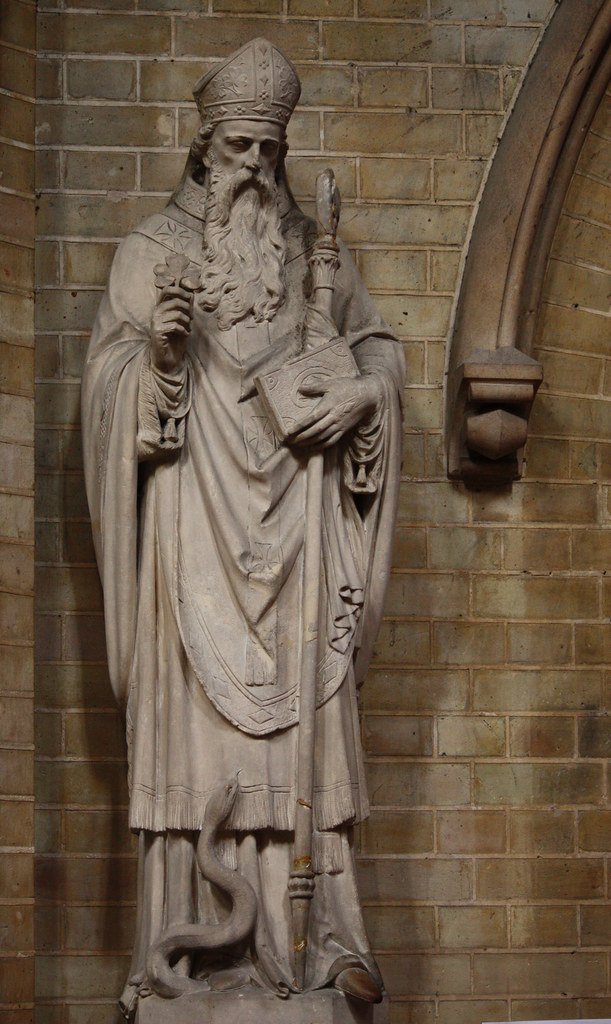
St Patrick “drives the snakes from Ireland” (first attested 11th c.) Snakes stand for the pagan druids; Patrick’s victory is a polemic that Ireland is now wholly Christian. Ireland never had native snakes; the image is borrowed from Mediterranean hagiography. Early sermons gloss serpents’ as “demons of idolatry” rather than real animals—so it is a spiritual cleansing metaphor, not a memory of literal suppression.
Christian takeover of sacred hills – Croagh Patrick, Hill of Tara, Slane, Uisneach Founding monasteries on high places proclaims Christ’s dominion where sky-gods (e.g. Lugh on Uisneach) once reigned. Pilgrimage to Croagh Patrick in July (Reek Sunday) keeps the calendar slot of Lughnasadh; the climb, fasting and sunrise rituals replicate pre-Christian hill assemblies, now framed as penance and Mass.
Holy wells and sacred trees Ancient healing springs and oak groves are re-dedicated; pagan rites condemned as “superstitions.” Many wells are still called Tobar Bríde, Tobar Lugh, yet bear a saint’s statue. Offerings of rags or coins—attested in Celtic Iron Age—continue today with a rosary and a candle.
Saint–goddess mergers – Brigid of Kildare The abbess-saint replaces the fire-goddess Brigid, extinguishing her cult. Same shrine at Kildare keeps a perpetual flame; poems still call the saint “mother of poetry, smithcraft, healing”—the triad of the earlier goddess. Scholars see a straight syncretism, not erasure.

How the “snake” motif works in Patrick’s legend

Biblical shorthand – In Christian scripture the snake is Ha-Nahash, the Satanic tempter. Medieval hagiographers routinely say that saints expelled snakes to signal victory over the Devil (e.g., Paul of Thebes in Egypt).

Polemic against druids – Irish clerical writers of the 7th–10th c. equate druidic wands and serpent symbolism with demonic arts. Saying “Patrick banished snakes” is shorthand for “he defeated druidic magic.”

Homiletic drama – Ireland’s real absence of snakes makes the miracle safe to claim; nobody could refute it. By the 12th c. the story is fixed in Vita Tripartita Sancti Patricii.

So snakes = “bad aspects” of the old religion, not its benevolent deities. Good qualities—healing wells, harvest fairs, fire symbolism—were baptised rather than banished.

Parallel with Galicia and other fringe zones

Ireland Galicia
Hill of Uisneach (centre of Ireland) – Lughnasadh assembly ➜ St Patrick’s fire and later Marian pilgrimage Monte Santa Trega castro – Lugus/Lugh shrine ➜ Chapel of Santa Trega with August romaría
St Brigid merges with Brigid the goddess; perpetual flame survives St Brigantia lighthouse legend on A Coruña Tower preserves name of Brigantia, Celtic goddess
Holy wells retitled “Tobar Mhuire” (Our Lady’s Well) Rock-cut springs on castros now have crosses but keep coin/rag offerings

Both regions show a Christian super-imposition chosen precisely because the older sanctity would draw the faithful.

Is there a hero in you?

So we have suggested that the hero may well be an archetypical trait that is inherent in our “DNA”. Does that mean that you might have it, yourself?

In Jungian terms, the answer is yes: the hero is not only a story out there but a potential in every persons psyche.  Jung saw mythic figures as archetypes: Deep-lying, inherited patterns of behaviour and imagination that surface in dreams, art, religion and personal crisis. When you feel the impulse to break old limits, confront a fear, or rescue a threatened value, you are touching the hero archetype within your own unconscious.

Jung’s map of the hero archetype

Jungian theme What it means in the hero pattern Key references
Archetype itself A primordial image of the ego separating from the Great Mother (undifferentiated unconscious) and struggling toward autonomous life. Symbols of Transformation (1912/52) §326–360
Miraculous birth & early peril Ego-spark appears, tiny and vulnerable, yet marked for greatness; monsters (dragons, giants, tempests) symbolize the overwhelming unconscious that threatens it. The Archetypes and the Collective Unconscious (CW 9 i) ¶275 ff.
Call to adventure / exile The conscious personality feels compelled to leave safe routines; psychologically, this is the first step in individuation. Psychological Types (CW 6)
Tests, helpers and weapons Helpers = positive complexes (wise old man, anima); Weapons = insight, active imagination. Trials surface projections of shadow material to be integrated. Aion (CW 9 ii) ¶11–34
Descent / night sea journey Encounter with the deepest layers of the unconscious (dragon, underworld). Here the ego risks dismemberment—depression, chaos—but retrieves vital energy. Symbols of Transformation ch. 5, “The Battle for Deliverance from the Mother”
Slaying the dragon / obtaining treasure The ego masters instinctual forces instead of being possessed by them; treasure = new consciousness, libido released for creativity. CW 5 “The Relations Between the Ego and the Unconscious”
Elixir / fire theft The ego brings back a gift (insight, art, social reform) that renews the community; failure to share leads to inflation. Two Essays on Analytical Psychology (CW 7)
Return & integration Hero reintegrates with society (or Self); in Jung’s schema this is the emergence of a mandala image, signalling psychic wholeness. Mandala Symbolism (CW 9 i, ¶644 ff.)

Integrating the Shadows of lost abilities and gifts

Jung often described the encounter with the Shadow or with unconscious contents of the mind in dynamic, even dramatic language, but he did not frame it as a literal “battle against the ego.” Instead:

The ego is the conscious centre of identity. It is not an enemy to be defeated; it is the negotiator that must stay intact while widening its horizon.

The Shadow is a cluster of disowned qualities—instincts, emotions, desires—that the ego has pushed into the personal unconscious.

The developmental task is not to crush either side but to bring them into a working relationship. If the ego refuses, the Shadow erupts as projection or neurosis; if the Shadow overwhelms, the ego fragments (psychosis, possession).

What does that mean for you?

Jung tells us that often, we disown many of our best traits, and throw them to our unconscious mind. The first task of any hero, therefore, is to return to that unconscious mind, via the ego (which often serves to hide these), and through imaginative dialogue, return those aspect into the conscious mind, where they can be used, so that your inner hero can be embodied, and expressed.

[The process] is like crossing a swift river: one must not fight the current, but find a ford where ego and unconscious can meet.

— Lecture notes, ETH Zurich, 1934 (paraphrase from student transcript)

Think of the process as mediation rather than war:

  • Ego brings conscious order and ethical standards.
  • Shadow supplies raw energy, spontaneity, instinct.
  • In analysis (or creative life-work) you let the two negotiate. Some Shadow elements are accepted, some remain outside but recognised, reducing projection.


Are there images of Lugh?

In Ireland, No image that can be firmly linked to the Irish Lugh has ever been found. Everything we know of his look comes from Medieval texts (mentions of his bright face, long arm, shining spear). There are no pre-Christian sculptures or metal pieces from Ireland that name or unmistakably depict him.

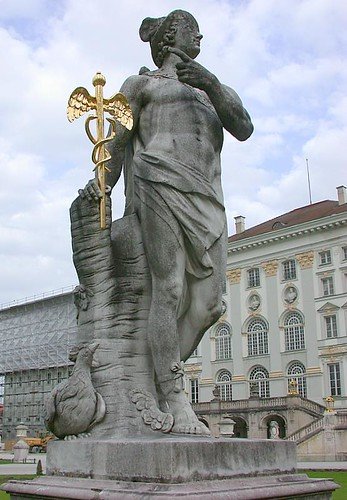
In Gaul and the Continent, the situation is different for the Gaulish god Lugus who is almost certainly the same deity behind the Irish name Lugh and the Welsh Lleu. In Roman Gaul he was routinely equated with Mercury, so most dedications show a standard Mercurial figure (cloak, caduceus, purse). A few pieces, however, carry three heads or three faces and have long been proposed—never proved—to be “triple Lugus”:

Find Description Status
Reims (Durocortorum) altar-block Squat sandstone block with a bust on each of three adjacent faces; once labelled “Tricephalic Mercury.” Popularly shown online as Lugh/Lugus, but the stone bears no inscription naming the god. Identification remains speculative. (Pinterest)
Pillar of the Boatmen, Paris (early 1st c. AD) Four-sided Limestone column dedicated by Seine boatmen; one panel names Lugu[us] (fragmentary) next to a single-headed, cloak-and-purse figure. This is the only certain epigraphic mention of Lugus accompanied by sculpture—and it is not three-faced. (Wikipedia)
Tri-cephalic busts from Vertault, Condé-sur-Suippe, etc. Heads carved back-to-back-to-back, often with a small purse or caduceus. Scholars debate between Lugus, a generic “triple-form Mercury,” or a local genius. No inscriptions.

Thus the popular tag Lugh of the Three Faces” is continental, not Irish, and even on the Continent the connection is argued, not settled. Medieval Irish sources never give Lugh three physical heads; his epithet Samildánach (“possessor of many skills”) may have encouraged modern authors to picture him “three-faced” in a metaphorical sense.

Mercury as a Hero

The Gaulish version of Mercury absorbed far more than the quick-witted messenger of Olympus; in Gaul he carried triple functions that still included the champion/war-hero layer of Lugus. Roman observers compressed those functions under a familiar name, so the heroic edge is hidden—but not lost.

Why the Romans reached for “Mercury”

Caesar (BG 6.17) says flatly: “Of all the gods they worship Mercury most; they regard him as the inventor of all the arts, the guide of travellers, the patron of trade and gain.
The italics echo exactly the epithets of Lugus/Lugh: Samildánach (“possessor of many skills”), guide, craftsman, guarantor of assembly. To a Roman ear that constellation shouted Mercurius. What Caesar leaves unstated—but archaeology supplies—is that this Mercury often bears:

  • Weapons – short sword, spear or lightning-wand.
  • War trophies – severed heads on some shrine pillars.
  • Protective role – placed at gates, bridges, hillforts.

All of which are heroic, even martial, not just mercantile.

Triple forms keep the multi-aspect god intact

The tri-cephalic busts and inscriptions to Lugoues (—to the three Luguses) show how Celtic devotees held on to a three-in-one construct:

Head 1 Head 2 Head 3
Craft & eloquence (bag or purse, caduceus) War-champion (short sword, shield, or severed head) Sovereignty & justice (scale, scroll, or oak-leaf branch)

Roman temple officials could label the whole carving “Mercury,” but Celtic worshippers still saw their own complete champion—craftsman, hero, ruler—in one statue.

The heroic flavour in continental evidence

Pillar of the Boatmen (Paris, c. AD 40): the named panel LUGU.. shows a god stepping on a prow as a protector of river crews in dangerous rapids, a practical hero role.

Clermont-Ferrand bronze tablet: dedicant thanks Mercury for victory in litigation et in bello (“and in war”), a war-aid prayer, not commerce.

Trefoil-headed spears in sanctuaries at La Tène and Mâlain are dedicated to Mercury: This weaponry points back to a warrior aspect.

So there you have it, my whirlwind tour of the Hero archetype and possible relationships with Lugh. I hope it helps fill some gaps, and raises deeper questions.

Gnaeus Julius Agricola

Cerialis, Agricola and the Conquest of Northern Britain

Gnaeus Julius Agricola

Gnaeus Julius Agricola was a Roman general and governor of the province of Britannia from 78-84AD. He is credited with overseeing the final conquest of Britain.

In a series of annual military campaigns Agricola put down revolts in north Wales, subdued the Brigantes tribe in the north, extended Roman control over the Scottish lowlands, where he established a string of forts between the Forth and the Clyde, sent troops into Galloway, and made inroads into the eastern Highlands. During the latter campaign his vessels were the first to circumnavigate the islands.

In 83 or 84AD Agricola met the Caledonian war leader Calgacus in a major battle at Mons Graupius. The Caledonians attempted to attack the Roman line from the rear but were routed by Agricola’s reserve cavalry. According to Roman reports Calgacus’ men suffered 10,000 dead compared to but 360 Romans casualties. The actual site of Mons Graupius is not known.

Shortly after this last triumph, Agricola was recalled to Rome by Domitian, perhaps because of jealousy over Agricola’s successes and his growing reputation. He never returned to Britain, but was sent to quell disturbances on the Danube frontier.

Agricola’s life and exploits were later made famous in the biography written by his son-in-law Tacitus.

NOTE: Agricola’s name is sometimes spelled “Gnaeus” rather than “Cnaeus”

Tacitus, a historian with bias?

Our chief source for the Roman conquest of northern Britain is, of course, the historian, Cornelius Tacitus, in his eulogistic biography of his father-in-law, Gnaeus Julius Agricola. Not surprisingly, Agricola’s achievements, culminating with those in Britain, provide the centrepiece of this work. The impression that Tacitus clearly wished to give was that it was largely down to Agricola that Roman arms progressed from the north Midlands almost to the very north of Scotland, and that it was a short-sighted and envious emperor (Domitian) who ordered a retreat from much of this territory.

It has long been suspected that this account is, to say the least, ‘economical with the truth’; recently, however, we have begun to acquire the means to put the matter to the test rather more confidently. The first point to make is that the dates of Agricola’s governorship were almost certainly AD. 77-83 (not 78-84, as previously accepted); the change is due to the impression which Tacitus clearly gives, that the interval between Agricola’s consulship in AD. 77 and the taking up of his governorship was short, and that he is unlikely to have ended his consular tenure later than June or July. His first campaign (in north Wales), therefore, which we are specifically told was undertaken very late in the campaigning season, fits much better if it belonged to the autumn of his consular year.

The revised dating has important implications for the understanding of the course of Agricola’s governorship, as crucial points in it can now be seen to coincide with what were politically the most important dates of the period AD. 79 (the death of Vespasian and the accession of Titus; end of campaign three), and AD. 81 (the death of Titus and the accession of Domitian; end of campaign five). We must allow that such events in Rome were capable of having major effects on the conduct of provincial governors and campaigning armies, as incoming emperors must have carried out reviews of ongoing activities.

The Conquest of Britain

The chief purpose of the present paper is to attempt to create a more realistic account of the conquest of northern Britain, bearing in mind the whole assemblage of evidence that can be derived from literary, epigraphic and archaeological sources and the observation, made many years ago by Professor Barri Jones and which pointed the way to the present exercise, that ‘Agricolan is a much overworked adjective’. When the Romans came to Britain in AD. 43, it is likely that they very soon forged a mutually beneficial relationship with Cartimandua, the leader of the northern tribe of the Brigantes.

Her name suggests that she may have been intrusive from further south, as the mandu element is reminiscent of Mandubracius, a leader of the Trinovantes (of Essex) in the time of Julius Caesar. From Rome’s point of view, the value of such a treaty relationship would have been to provide a tribe that was at least ‘neutral’ on the northern flank of the initial advance. For Cartimandua, friendship with Rome would have meant help, when necessary, against Venutius who was possibly an indigenous tribal leader and who is singled out for comment by Tacitus for his qualities as a warrior.

It may indeed have been Rome that insisted upon the marriage of these two as a means to ensuring stability in the region. The first test of the relationship that is on record came in A.D. 51, when the southern warlord, Caratacus, after defeat by Rome somewhere on the Wales/Shropshire border, asked Cartimandua for sanctuary.

It is possible that the hoard of mainly Trinovantian gold coins, which was found in 1998 in West Yorkshire, represents the whole (or part) of a payment by Caratacus’ southern kin to secure his safety. Instead, Cartimandua felt sufficiently confident in her Roman alliance to run the risk of local political ‘fall-out’, and handed the British leader over to Rome.

It may be that this act of betrayal precipitated the first outbreak of trouble between Cartimandua and her husband. Although chronologically very imprecise, Tacitus alludes to periodic disturbances which had to be put down by Roman military intervention. It is apparent that these episodes, in the 50s and 60s, did not lead to permanent Roman occupation, but were rather characterised by what would nowadays be called ‘search-and destroy’ missions.

Such activities are difficult to fix with any precision archaeologically, but it may be surmised from find spots of characteristically early Roman copper coins that land-based troops worked northwards from such bases as Wroxeter and Littlechester, whilst other troops were taken by coastal shipping, perhaps from a fort at Chester, to be disembarked in the northwest’s river estuaries to effect junctions with the land-based troops; it is likely that the Ribble estuary will have been particularly important, providing access via the Ribble/Aire corridor to Barwick-in-Elmet, which has been canvassed as Cartimandua’s centre .

The final upheaval certainly occurred in AD. 69, when Roman troops were distracted by civil war. It is evident that on this occasion Venutius prevailed over his former wife, who had to be rescued by Roman troops, and is not heard of again.

The Brigantian War

As Tacitus shows, overnight this changed Brigantian territory from a treatied to an openly hostile neighbour. Tacitus is far from complimentary in his remarks about the then Governor, Vettius Bolanus, who, he says, was too mild a man for a dangerous province. It would, however, be as well to remember two things: first, Bolanus remained in position for two years after the Brigantian volte-face, and can hardly have spent that time in idleness. Secondly, one source specifically and another more generally, suggest that during this period, Roman arms penetrated into Caledonia – a term of rather vague location in Roman writers, but evidently suggesting an area to the north of the Forth/Clyde isthmus.

Respectively, these sources are the Domitianic poet, Papinius Statius, and the encyclopaedic historian, the Elder Pliny, who perished in the eruption of Vesuvius in AD. 79. Further, this early entry into Scotland is confirmed by another contemporary poet, Silius Italicus. It would not be unreasonable to suggest that not only did Bolanus’ troops range widely in northern Britain but that they may have been responsible for the defeat and removal of the hostile Venutius, perhaps having chased him into Scotland; it would not be the last time that Rome would be troubled by political and military connections between the Brigantes and certain of the tribes of southern Scotland.

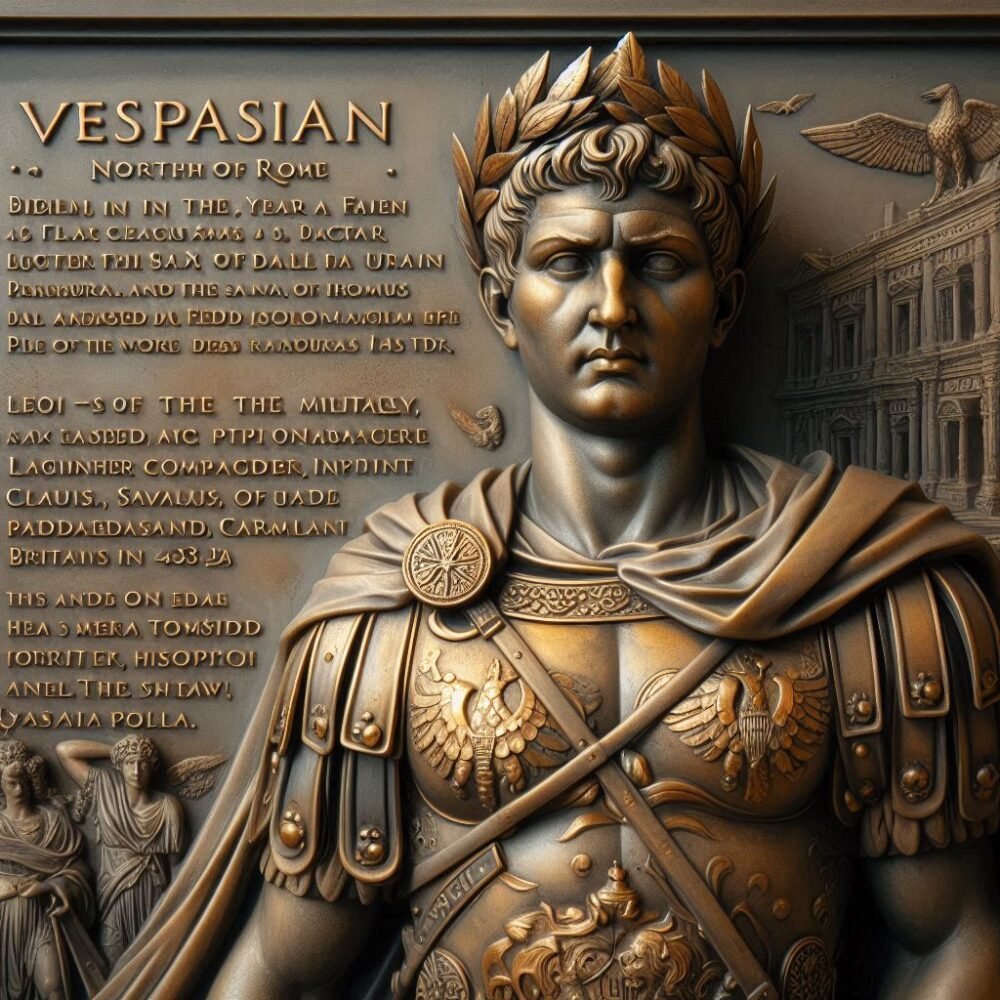
Further, it is evident that although Bolanus did not live long after his governorship, he was regarded by the emperor, Vespasian, as a man of considerable achievement. The next governor was a man of impressive status in the new Flavian regime; Cerialis Petillius was the son-in-law of Vespasian. He had served in Britain before during Boudica’s rebellion and had taken a part (albeit not too distinguished) in the war which had in AD. 69 brought his father-in-law to power; most recently (AD. 69-70) he had brought to a close a dangerous rebellion among tribesmen on the Rhine (though again not without mishap along the way).

Tacitus and Cerialis

It has been written that Tacitus loathed Cerialis; certainly, he does not go out of his way to load the man with praise for his achievements either in Britain or elsewhere. The historian does nonetheless admit that under Cerialis much of the Brigantian territory was conquered, or at least fought over, though he has to add that the fighting was not uncostly. Professor Anthony Bidey has argued that Tacitus’ dislike of Cerialis may have stemmed from Cerialis’ part in AD. 83, along with his brother-in-law, the emperor Domitian, in the removal of Agricola from the governorship of Britain.

This may have contributed, but another cause suggests itself: in AD. 60-61, both Cerialis and Agricola were in Britain, the former as commander (legatus) of legion IX (which received something of a mauling), the latter as a military tribune (tribunus militum) evidently on the staff of the governor, Suetonius Paullinus. In the aftermath of the rebellion, it is likely that Cerialis and Agricola found themselves on opposite sides of an exceedingly acrimonious post-mortem. In temper, too, the two men were very different: Cerialis, highly placed, an opportunist and a risk-taker (not always successfully); Agricola, efficient, methodical, and perhaps a little colourless – or, as he has recently been described, a ‘modest achiever’. Envy for the latter, about the former, is not unknown in the human condition.

Cerialis in Britain

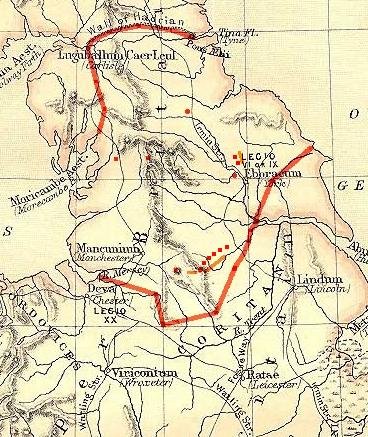
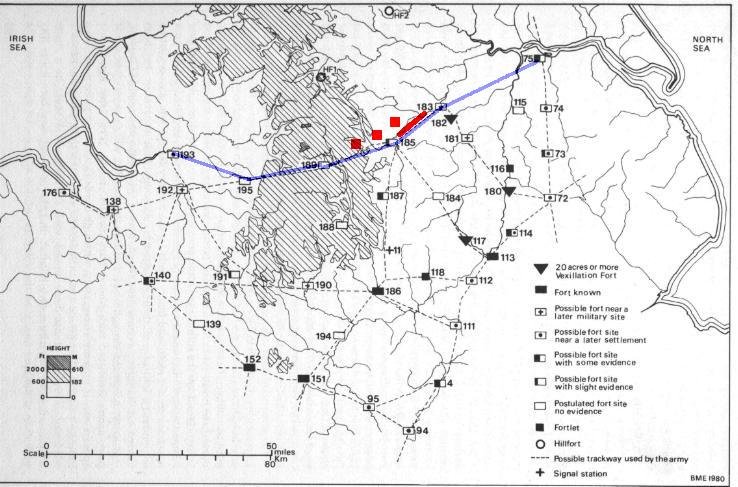
Cerialis came to Britain in AD.71; his instructions were plainly to move the conquest forward, and he brought with him a new legion, II Adiutrix, which had recently been recruited from members of the fleet at Ravenna. It would seem reasonable to suppose that part, at least, of this unit was based at Chester, to convey troops up the coast of north-west England. Once again, it is not easy to trace the movements of Cerialis’ campaign archaeologically, although coinage and Samian pottery help, and dendrochronology has recently highlighted two probable military sites of this period, Ribchester and Carlisle. Tacitus provides one extra clue – that Cerialis divided his army between himself and Agricola, who was commander of legion XX Valeria Victrix at Wroxeter. Considering this, it would not seem unreasonable to suppose that Cerialis operated east of the Pennines with his old legion (the ninth), whilst Agricola ‘mirrored’ his commander’s actions on the western side of the country.

It would appear that the western advance was again on two fronts, overland from sites such as Wroxeter and Littlechester, crossing the Mersey near Wilderspool, the Ribble at Walton-le-Dale, and probably establishing a fort on the Lune at Lancaster. From Lancaster, the Lune and Eden valleys were followed to Carlisle. The eastern route established a new fortress for legion IX at York, and reached perhaps as far as Corbridge, although some at least of Cerialis’ troops must have crossed Stainmore to meet up with Agricola’s. The fleet, too, will have played its part, taking troops to the Mersey and the Ribble with a disembarkation-site at Kirkham, which in Roman times was much closer to the water than it now is, and from which it was a straightforward advance to Ribchester. That Chester was the base for this seems clear, though it should be noted that Chester was not, until Agricola’s own governorship, a base for a land-based advance. Indeed, it has been observed that the road northwards from Whitchurch originally crossed the Dee at Farndon/Holt, the extension to Chester being secondary to this.

Each side of the Pennines also saw the separation of people whom the Romans evidently chose to protect: in the east, the coastal Parisi were separated from their Brigantian neighbours, whilst in the north-west, a road from Carlisle to Maryport (or perhaps Beckfoot) through Blennerhasset separated the good agricultural land of the Solway Plain, evidently the territory of the Carvetii – from the Brigantian hill-farmers. These provide good examples of the policy of ‘divide-and-rule’, with which Tacitus credits Cerialis in Germany and Agricola in Britain during his own governorship.

Advances into Scotland

Again, it seems likely that Cerialis’ troops advanced into Scotland: the objective here may have been, in part at least, the protection of the grain-producing land of the Votadini and Venicones in the east, on either side of the Firth of Forth. Coin evidence suggests that Cerialis advanced northwards from Carlisle to Newstead, Cramond and Camelon, and from there perhaps as far as Strageath. If, indeed, Cerialis is to be traced that far north, it does not seem unreasonable, considering what had been done elsewhere, to suggest that he may have inaugurated the Gask Ridge watchtowers, as a way of separating the coastal Venicones from their inland neighbours.

All of this suggests that the achievements of Cerialis’ governorship were considerable in terms of territorial gain and political and infrastructural organisation; so what of Agricola’s own governorship from 77 to 83? Tacitus is insistent that Agricola’s tenure got off to a dramatic start, with an assault, very late in the campaigning season, (presumably of A.D. 77) on the Ordovices and Anglesey. The base for this was probably Wroxeter, as Chester, because of marshland to its west, will have provided poor overland access to north Wales. Further, epigraphic evidence, dateable to A.D. 79, shows that Agricola was responsible for building, the fortress, at Chester. Although the site was not, as we have seen, regarded as ideally placed for land-based campaigns of conquest, its access to the north-west by land and sea enhanced its potential as a base for occupation.

It would seem likely that we should link with this the construction of a route across the Pennines from Chester to York, with new forts along it at Northwich, Manchester and Castleshaw. Further, another road was taken northwards from Manchester to Ribchester, joining the earlier campaign-route at Burrow-in-Lonsdale. It would appear that this further penetration of the north-west was, as Tacitus suggests, in pursuit of the policy of ‘divide-and-rule’. The amount of ground evidently covered in Agricola’s second campaign would seem to leave little leeway for serious fighting, and it is fair to conclude that, since this territory had already been fought over during the governorship of Cerialis, the main thrust of Agricola’s work was political. Again, it appears that the Lake District, south of the Carlisle to Maryport line was omitted; none of the Lake District forts, on the evidence of coins and pottery, seem to have come into existence earlier than the late 80s or early 90s that is, after the post-Agricolan evacuation of Scotland.

It would suit the tactics of this campaign, with its two northward thrusts laterally linked, if it was Agricola who was responsible for the establishment of the road between Carlisle and Corbridge which, since medieval times, has been known as the Stanegate. Although this route did not come to form the frontier of Britannia until after Agricola’s departure from the province, the question of possible ‘stopping-points’ did arise during his tenure. Thus, whilst clearly some military action took place during this campaign, the chief imperatives were probably consolidatory and political, forming relationships with friendly groups, and protecting them from those that were more hostile, as Cerialis had done during his tenure.

Agricola’s third campaign

Agricola’s third campaign in A.D. 79, the last year of Vespasian’s reign – extended northwards the lines of advance of the previous year Tacitus affords us a clue in his observation that Agricola reached as far as the river Tay. It appears likely that this campaign represented an advance upon previous work: the Gask Ridge lines, which separated the coastal people of Fifeshire from those of the interior, was developed and extended as far as the Tay, and an internal line of ‘glen blocking’ forts was established from the Clyde in the direction of the later legionary fortress at Inchtuthil. This line facilitated the policing of movement in the glens, which was particularly important if pressure was to be kept on the Caledonian leadership.

The accession of Titus, however, appears to have brought about a change of policy; the next two campaigns (of AD. 80 and 81) were evidently concerned with ‘consolidation’ in southern Scotland. A line of forts (Barochan, Mollins and Camelon) anticipated the principle of the Antonine Wall in ‘fortifying’ the narrow neck of land between the Forth and the Clyde, though the Agricolan line was a little to the north of that of Antoninus Pius in the second century. From what Tacitus says, it appears that disputes were surfacing whether the Forth/Clyde line should mark the northern limit of the province, or whether ‘total conquest’ should still be the objective. By describing advocates of the former policy as ‘cowards’, Tacitus makes it very plain what his (and presumably Agricola’s) views were on this matter.

It is not unlikely that Titus was becoming aware of problems nearer to home, which might have made total conquest in Britain a luxury. In this connection, it is worth mentioning that inscriptions show that in AD. 80 detachments were sent from all the British legions for service elsewhere.

The activities of the fifth campaign (of AD. 81) are harder to place because of vagueness in Tacitus’ language and difficulties with the text itself. However, it seems reasonable to suppose that some, at least, of the campaign was occupied with Dumfries and Galloway – an area that proved to be of persistent difficulty to Rome. We are also told that, during this year, Agricola contemplated the conquest of Ireland, and it is assumed that he may have been around Stranraer or Portpatrick.

Although there is no evidence to suggest that Agricola pursued the ‘Irish objective’ at all, Rome’s relations with Ireland have recently received a higher profile because of the disclosure of the discovery of Roman material at the promontory-fort at Drumanagh (north of Dublin). Tacitus’ reference to the use of ships in this campaign also suggests that the method of proceeding in south-west Scotland may have been with the dual approach of land-based and sea-borne troops, which is again specifically mentioned in connection with the following year’s activities in northern Scotland.

Unexpectedly, Titus died in AD. 81, to be succeeded by his younger brother, Domitian, an emperor for whom Tacitus had no regard at all. Domitian’s accession, however, appears to have initiated another revision of policy, with a decision to proceed into northern Scotland. However, it is not clear whether this was directed towards total conquest, or whether the objectives remained more limited – for example, delivering a hammer-blow which would effectively neutralise the Caledonians, and thus allow Roman options to remain more flexible. In the event, the sixth and seventh campaigns appear to have been concerned with a principal objective – to force the Caledonians to battle and thus achieve a Roman victory.

This was done by denying to the Caledonians access to the fertile coastal lowlands and interfering with their grazing-practices in the glens, intending to making them sufficiently desperate and frustrated to want to fight sooner rather than later. The Romans did not have things all their own way; Tacitus records how the ninth legion very nearly suffered a disaster in a camp which, in the aftermath, was named Victoria (possible Dalginross). Further, the Caledonian chieftain, Calgacus, in an oration ‘given’ to him by Tacitus seems to suggest that Agricola was having to keep his army up to strength by recruiting British auxiliaries. Agricola’s progress is marked by permanent forts up to the Tay, and thereafter by a line of campaign-camps up to and along the coast of the Moray Firth. These camps are characterised by their unusual entrance-ways (known as ‘double-claviculas’), which created very narrow access. It seems likely that these constructions guarded river-crossings along the coast of Moray, perhaps as far as Inverness. Again, it would seem logical that simultaneous landings by the fleet were involved. However, the decisive engagement of these last two campaigns was the battle at a site called by Tacitus Mons Graupius, in which the Romans perpetrated what seems to have been genocide on the male (that is, fighting) population. This should have bought peace for approximately twenty years. The battle-site remains elusive, although it must have been close to the Moray Firth. One author has even suggested that the latin words, montem Graupium, may represent a manuscript corruption of words meaning ‘Hill X’.

With the battle won, Agricola was shortly afterwards withdrawn from Britain; he had served approximately twice the normal length of tenure. Yet Tacitus represents his recall as unnatural and unreasonable, and due to Domitian’s jealousy of Agricola’s achievement, an accusation that is borne out neither by the length of Agricola’s tenure nor by the character of Domitian’s own military successes on the Rhine. It is likely that the decision was taken by Domitian with the consul of A.D. 83, who was either Petillius Cerialis himself or a close relative of his; hence, the probable reason for the historian’s dislike of Cerialis.

Deriving a working frontier

The recall of Agricola did not, however, mean the immediate end of the occupation of northern Scotland. Considering its eventual abandonment in A.D. 87, still unfinished, it would seem likely that all construction-work on the legionary fortress at Inchtuthil post-dated Agricola. That this fortress was commenced, however, demonstrates the expectation that Britain would retain a garrison of four legions a hope which, by A.D. 87, was shown to be beyond fulfilment. A legion (II Adiutrix) was recalled to the Continent, and with its transfer went realistic hopes of maintaining, in the long term, the hold on northern Scotland. Agricola’s victory at Mons Graupius, however, had done its job; for it facilitated an orderly, thorough and safe withdrawal in A.D. 87, to a series of large forts, which had been built in anticipation on the Stanegate-forts, such as Vindolanda and Corbridge, and perhaps the newly discovered Cummersdale (south-west of Carlisle).

Thus, a working frontier-zone had been achieved; the Stanegate remained the frontier of Britannia until its enhancement in the early 120s by Hadrian’s Wall. Tacitus, however, retained his intoxication with the days of hope and glory, spurred on no doubt by his sense of loyalty to the memory of his father-in-law: “Britain was completely conquered, and immediately allowed to slip” a literally true statement, but ‘loaded’.

In reality, however, Domitian’s advisers realised that consolidation of conquest further south was much more important than holding on to every square inch of territory that had been won. Agricola’s victory had provided the opportunity to consolidate successfully, but subsequent events showed that it was no easy matter to achieve a balance, whereby in Scotland Rome could do business with its friends (such as the Votadini and Venicones of the East Coast) and yet keep under control enemies and nuisances such as the Novantae of Dumfries and Galloway.

In truth, the Flavian period deserves to be seen as one of great achievement in northern Britain, and the contributions made to this by Petillius Cerialis, Julius Agricola and their unknown successor(s) are by no means inconsiderable. Perhaps, too, Cerialis’ predecessor, Vettius Bolanus, also deserves from posterity more credit than, thanks to Tacitus, he has normally received.

Snake Iconography in the British Isles

Snake Iconography in the British Isles

The emergence and spread of certain iconographic symbols, such as that of a snake, or serpent like form, have been with us from at least the Neolithic period. In addition, many less obvious snake-like patterns, such as waves and zig-zags have been related to snake like forms or having been suggested as suggesting similar meanings, including spiritual powers, and heroic or other archetypical traits.

If we look specifically at the iconography of the snake, then we can see that is has been attributed to all parts of the British Isles, with some of the older, more certain forms being found in Ireland:

Earliest snake / serpent imagery and names across the British‑Irish Isles

Period Region Secure evidence of a snake‑idea Earliest terminus & context Sources
Late Neolithic (c. 3300–2900 BC) Ireland Knowth passage‑tomb kerbstones – multiple Serpentiform grooves that meander across the slabs (e.g., K17, K78, K91). Although Ireland has no native snakes, the artists clearly conceived a sinuous, living creature. Built during construction of the Boyne Valley passage graves. (knowth.com, Mythical Ireland)
Neolithic–Early Bronze Age (?3000–2000 BC) Scotland (Argyll) Loch Nell Serpent Mound – 120 m long Earthwork shaped in a double curve with a Cairn “head”; antiquarians opened a small stone chamber inside the head. Radiocarbon absent, but environmental work puts the mound within the local cairn‑building horizon. (The Megalithic Portal, themodernantiquarian.com)
Middle / Late Bronze Age (c. 1300–700 BC) Ireland & Britain 1. Gold “penannular rings” and coiled torcs whose terminals imitate snake heads (Mooghaun hoard, Co. Clare; Scottish ribbon torcs). 2. Welton (Lincs.) Penannular ring typology shows same date‑range. Ornament worn by elites; not true naturalism but abstract serpent power. (lincolnmuseum.com)
Early Iron Age (4th–1st c. BC) Britain La Tène dragonesque brooches, scabbard slides and enamel mounts with confronting snake‑heads; widely distributed from Thames basin to northern England, proving the motif was fashionable before Rome. Peak c. 100 BC–AD 50. (Balkan Celts)
Later Iron Age / Early medieval (6th–8th c. AD) Scotland & Pictland Class I Pictish “Serpent‑and‑Z‑rod” stones (Aberlemno I “Serpent Stone”, Meigle slabs, Craw Stone). Snakes are rendered naturalistically with jaws, eyes and curved body. Symbol repertoire begins c. AD 550–600. (ancient-scotland.co.uk, lizthorne.com)
Roman Britain (1st–4th c. AD) England Snake‑headed arm‑rings & bracelets – e.g., two gold examples on a child in the Southfleet (Kent) lead coffin; late Roman bronze bracelets at Stanford (Kent). Serpents here symbolise protection and regeneration. Jewellery fashions span late 1st–4th c. AD. (Kent Archaeological Society, Kent County Council)

Landscapes and place‑names that embed the serpent idea

Given the apparent sparsity of early dateable serpentine monuments and objects, another place to look for clues as to the possible spread of this serpent/snake symbology into those early cultures, is to look into the etymology of the names that have naming similarities. Some rivers, for example, wind around in a snake-like way – is that reflected in some local names? When did that name originate? Here’s a few initial ideas:

Island Early / traditional toponyms & monuments Etymological note
England River Nadder (Wilts.) & Nadder Valley; Adderley (Shrops. “island of snakes”); Snake Pass (Derbys. – later coaching‑inn sign but perpetuates motif); Rotherwas Serpent Mound (Herefordshire, 60 m long burnt‑stone spine). OE næddre = snake(Etymology Online, andrewcollins.com)
Wales Llyn Nadroedd (“Lake of Snakes”) on Moel Hebog; stream‑names with Neidr (Welsh “snake”) such as Nant y Neidr (Denbighshire). Folk zoology keeps the term alive in the dragonfly epithet gwas‑y‑neidr (“servant of the snake”). (raw-adventures.co.uk, WWT)
Scotland Loch Nell Serpent Mound; conjectured Serpent Mound, Greenock; hill Meall‑na‑Nathrach (“hill of the adders”) in Argyll; the Pictish “Serpent Stone”. nathair / nathrach = snake.
Ireland Townland names with Nathair (e.g., An tLeacain Nathrach, Clare); folklore claims of “serpent’s path” at the winding River Shannon. Pre‑Christian myth records the monster An Muirdris (sea‑serpent) of Loch Mask. OE loan‑root absent: Irish retains Old Celtic nathair (Wiktionary)

Initial thoughts

  • The iconography is ancient – the Boyne‑Valley Serpentiforms (c. 3200 BC) are the earliest unambiguous snake‑shaped carvings in north‑west Europe.
  • Bronze‑Age elites adopt the coil – gold rings/torcs invoked serpents as symbols of cyclical power and protection.
  • Iron‑Age La Tène art mainstreams the motif, carrying it onto weapons and personal dress fasteners.
  • Pictish stones give us the first named “serpent” images on stone sculpture in Britain, linking to broader Insular zoomorphic art.
  • Roman period jewellery shows continuity: snake‑bracelets for health, fertility and apotropaic magic survive into Christian times.
  • Toponyms anchor the serpent in living memory, preserving Brittonic, Gaelic and Old‑English words (neidr, nathair, næddre) long after real adders became rarer in the cultural imagination.

Together these datasets show that while Britain and Ireland never teemed with actual snakes, the serpent has slithered through their visual and verbal landscapes for at least five millennia—first as a cosmic, perhaps solar power; then as a protective amulet; finally as a heraldic and folkloric emblem whose trace lingers in streams, passes and sculptured stones.

Looking wider

Elsewhere in the world, one can clearly see the snake linked to sine-wave or zig-zag symbology within the late Neolithic and beyond. Given we have such early examples in Ireland and Scotland, one wonders why there seems to be a lacking of such symbology at an early date in England and Wales? Part of the issue, is not only with agreement of symbological interpretation, but also, of the date of the artefact itself. And so, to push forward, other, less well known examples need to be identified. Here are some of the more likely, but also, highly debated examples:

Candidate class Sites most often cited as “snake‑like” What they actually show Why acceptance is weak
Grooved cup‑and‑ring panels (open‑air Atlantic rock art) Ketley Crag (Northum.), Weetwood Moor, Copt Howe (Cumbria) Meandering gutters link cup‑marks and sometimes loop back; a few have a “head‑like” widening. The lines may be drains, paths or purely abstract connections; none is incontestably zoomorphic and there is no eye/jaw detailing.
Neolithic passage‑grave art in Britain Bryn Celli Ddu (Anglesey) has a carved “pillar” with spiral/serpent possibility; Barclodiad y Gawres (Anglesey) shows sinuous bas‑reliefs. Spirals and lozenges that could evoke coils but also match solar or geometric symbolism. Most motifs are geometric across the Atlantic façade; only at Knowth do we see a body and tail unmistakably styled as a snake. Dating is secure for the tombs (~3200 BC) but not the meaning.
Later prehistoric Earthworks Rotherwas Ribbon (Herefordshire) – serpentine pebble kerb; Serpent’s Mound, Grampian; a faint “snake” lynchet at Dinedor. Serpent shape is visible in plan but the symbolic intent is assumed, not recorded in artefacts or myth. Radiocarbon exists only for Rotherwas. Shape alone ≠ iconography; builders might have sought drainage or processional curves. Absence of accompanying snake ornament leaves the reading speculative.
Portable art Early Bronze‑Age pestles or mace‑heads with S‑curves. Abstract S‑scrolls (could be water, plants, energy). No heads, scales or contextual snake paraphernalia.
Maesmor Mace Head

Maesmor Mace Head” by Wolfgang Sauber is licensed under CC BY-SA 3.0

Briefing: Bronze Age mace-heads with S-curves

Early Bronze Age mace heads with S-curves, also known as “horned mace heads,” are a distinctive type of artifact found in various regions, including Britain, Ireland, and Scandinavia. These mace heads, characterized by their S-shaped or curved blades, are generally interpreted as symbols of status or ceremonial objects rather than purely functional weapons, though some may have been used in combat.

Shape: The S-curve, or “horned” shape, is the defining characteristic, distinguishing them from more common, simple, or knobbed mace heads.

Construction: Typically made of stone, often flint or other fine-grained rock, they required considerable skill and effort to produce. A central Shaft hole was carefully drilled to allow for hafting the mace head onto a wooden handle.

Symbolic Significance: While some may have been used in combat, their elaborate form and the effort involved in their creation suggest a symbolic or ceremonial function, possibly associated with status or leadership.

Dating: While dating can be challenging, they are generally associated with the Early Bronze Age, with some examples possibly extending into the Neolithic.

Distribution: Finds of these mace heads are concentrated in specific regions, like Scotland, Wales, and Ireland, with evidence suggesting some degree of movement or exchange.

Examples

Maesmor Mace Head (North Wales): A well-known example made of white flint, highlighting the skill and effort involved in their creation.

Skara Brae (Orkney): A knobbed mace head was found at this Neolithic settlement, along with other mace head fragments, suggesting their use in the region.

Starrieheugh Farm (Dumfries): A polished, ovoid mace head with an off-centre shaft hole was found at this site.

Three “serpents”, three very different stories

Although their seems to be a dearth of information in relation to the two “serpent” mounds mentioned previously. I thought it might help to better understand them if I contrasted those two with a third, better known, but not obviously connected serpent mounds, that of Ohio, USA. This is by no means any attempt to establish a direct connection, but rather, to try to allow some of it’s characteristics highlight what may be missing from our mindset, when thinking of those of the British Isles.

Feature Loch Nell Serpent Mound (Argyll) Rotherwas “Ribbon”/Serpent Mound (Herefordshire) Great Serpent Mound (Ohio, USA)
Form & scale  120 m long S‑shaped turf‑and‑stone bank ending in a cairn “head”.  ≈ 60–75 m sinuous pavement of fire‑cracked quartzite pebbles, dug into a hillside; no head or tail built of earth.  411 m long earthen effigy with coiled tail and oval “egg” in its jaws.
Dating evidence  Unpublished charcoal & pollen suggest mid–late Neolithic / Early Bronze Age, c. 2600–1800 BC (no direct ^14C yet). (Current Archaeology)  Charcoal beneath the pebble bed gave multiple AMS dates 2100–1700 BC— firmly Early Bronze Age. (Current Archaeology)  Radiocarbon from undisturbed fill argues for 300–100 BC (Adena) with repair c. AD 1070 (Fort Ancient). Debate continues. (Wikipedia, Ohio History Connection)
Construction materials Natural turf, boulders, a chambered cairn; no burning. Pebbles deliberately heated then laid in alternating red/white colour bands. Unburnt local earth and stone; placed on crater‑rim ridge.
Cultural context Sits beside chambered tombs around Loch Nell; may be part of a ritual/solar landscape at a time when adders were rare but known. Built on slope between Iron‑Age hillfort (Dinedor) and River Wye; purpose unknown—processional path, water‑ shrine or symbolic guardian. Effigy aligns with solstice sunset; overlooks resource‑rich valley; long tradition of Adena & Hopewell mound‑building.
Preservation & research Stone‑robbed and antiquarian‑dug (1870s); scheduled but little modern excavation. Rescue‑excavated 2007, then re‑buried for protection; visible only in records. State‑managed park; pathways and viewing tower interpret the monument.
Iconographic certainty Serpent outline plain in L‑iDAR; cairn “head” strengthens reading, but no eyes/tongue carved – still debated. Name “serpent” coined by media; absence of head/tail means serpent ID remains interpretive, yet sinuous plan and alternating colours persuade many. Undisputed serpent effigy— head, body, coils are unmistakable; the archetype for all later comparisons.

What the contrast shows

Chronology: If Loch Nell’s provisional Neolithic/Bronze‑Age bracket holds, Scotland hosts the earliest British serpent monument, predating Rotherwas by centuries and the Ohio effigy by two millennia.

Material choices: Britain’s serpents rely on stone and burnt pebble mosaics; Ohio’s builder used earth, suggesting different engineering traditions answering a shared impulse to monumentalise the snake.

Symbolic clarity: Only Ohio’s mound is unequivocally zoomorphic. British examples lack sculpted heads or egg motifs, leaving function ambiguous—processional way, boundary marker, or stylised river?

Research gaps: Loch Nell still awaits modern dating and geophysical survey; Rotherwas is known from a single rescue dig; Ohio continues to refine its chronology but benefits from sustained conservation.

While Britain’s two “serpent” mounds hint at a very long indigenous fascination with sinuous, possibly ophidian forms, their scale, certainty and scientific documentation remain modest beside the Great Serpent Mound of Ohio—reminding us how much Early Bronze‑Age ritual topography in Britain still lies in outline rather than sharp relief.

Bryn Celli Ddu Stone

NMW – Bryn Celli Ddu Stone” by Wolfgang Sauber is licensed under CC BY-SA 3.0

Why the dating problem persists

Open‑air carvings lack sealed contexts – Cup‑and‑ring panels sit on bedrock, eroding for millennia; we get Terminus ante quem only when they are overlapped by later soil.

Serpentine gutters re‑pecked – many grooves show multiple recuts, complicating micro‑erosion or lichenometry.

Symbol vs. form ambiguity – Without definite snake traits (eyes, forked tongue) archaeologists hesitate to label sinuous lines as animals; geometric dates run from 3800 BC to Iron Age.

Which earliest dates are more solid?

Ireland ≈ 3300–2900 BC – Knowth kerbstones are snake‑shaped beyond doubt, and the passage‑tomb mound can be radiocarbon‑anchored.

Scotland (Loch Nell) – probably mid‑late Neolithic, but only pollen brackets the build; secure ^14C would refine the claim.

England – Rotherwas Ribbon at 2100–1700 BC remains the earliest dated serpentine construction south of the Wall. No securely carved serpent pre‑dating that is yet accepted.

Wales – still awaits a clearly zoomorphic serpent carved in the Neolithic; The Bryn Celli Ddu pillars remain ambiguous.

Serpents in wider Neolithic–Bronze‑Age of Europe & North Africa

Anyone who has studied the serpent in antiquity, will not have missed the prevalence of the serpent in those wider, and perhaps, in some cases, more developed societies. A review of these should reveal some themes that may apply to the use of the serpent in the British Isles. Now that we know, for sure that very lengthy trade and exchange routes existed during this period, we should accept that their may well be conceptual exchange between the wider cultural base.

Recurring images, materials and the ideas they seem to encode:

Cultural zone (c. 4000–800 BC) Typical medium & date anchor Dominant strands of meaning* Representative examples
Atlantic façade (Ireland → NW Iberia) Deeply pecked serpentiform grooves on megaliths (Knowth kerbstones K17, K78, K91; c. 3300–2900 BC) • Flowing “life‑force” or calendrical wave (link to solar/lunar count‑spirals carved beside the same lines)
• Path of a cosmic river rather than zoological snake (no snakes in Ireland) Kerbstone 17, Knowth passage tomb .
Western Scotland & Isles Turf‑and‑stone earth effigies such as the Loch Nell Serpent Mound (prob. 2600–1800 BC) • Landscape guardian marking ceremonial route to adjacent Cairns
• Cyclical fertility: cairn “head” contains cremation—death feeding rebirth Loch Nell serpent mound plan (Wikipedia)
North European plain Coiled or snake‑headed gold torcs & penannular rings (1300–900 BC) • Protective amulet encircling the body; endless coil = unbroken prestige/frequency
• Terminals model snake heads → apotropaic bite against evil Mooghaun hoard snake‑head torcs
Aegean Bronze Age Faience Snake‑Goddess figurines from Knossos temple repository (c. 1650 BC) • Female power over household regeneration & chthonic earth‑energies
• Raised snakes channel “earth‑up / sky‑down” energy circuit—an early “information flow” motif Knossos Snake‑Goddess figurine (Wikipedia, Smart History)
Nile Valley (Predynastic–New Kingdom) Gold or copper uraeus cobra worn on royal brow (from c. 3000 BC) • Sovereignty & instant protective strike (goddess Wadjet)
• Snake as vertical axis: kundalini‑like rise of divine energy up the spine of the king Met Museum uraeus, Third‑Intermediate Period (Wikipedia, The Metropolitan Museum of Art)
Central Sahara (Tassili, Libya‑Algeria) Rock‑painted horned serpents in pastoral scenes (c. 4500–2000 BC) • Rain‑maker, keeper of hidden water; undulating body = groundwater veins
• Opposition symbols: wet vs. dry season, life vs. sterility (Academia, Bradshaw Foundation)

*Interpretations combine excavation context, ethnographic analogy and, increasingly, cognitive‑archaeology models that read undulating lines as visualisations of periodicity (seasonal water pulse, solar path, “frequencies” of time).

Converging symbolic themes

Motif Repeats across zones Probable root idea
S‑waves / meanders carved in stone Boyne Valley kerbs · Atlantic rock‑art gutters · early Iberian stelae Visual shorthand for oscillation—tides, rivers, or celestial cycles; a “wave‑frequency” glyph.
Coil or ring you can wear Gold torcs (Britain, France, Portugal) · copper bracelets Egypt Endless loop = continuity of authority; when shaped as a snake it adds protective bite.
Serpent paired with sun/egg Knowth wave abutting spiral; uraeus flanking solar disk; (later) Ohio serpent holding “egg” Snake mediates rebirth: swallows sun at dusk, releases it at dawn / egg as germ of renewal.
Horned or crested snake Saharan “horned serpents” · later Celtic horned‑snake brooches Amplifies status from earthly reptile to mythic beast controlling rainfall or underworld riches.

Information‑flow & “frequency” hypothesis

Researchers who model megalithic art as early notational systems point to:

Amplitude‑modulated serpent waves on Knowth K17 that can be counted as 19‑segment lunar cycles. (Mythical Ireland)

Parallel sinuous gutters on Atlantic rock panels whose spacing may encode seasonal beats (fishing runs, tidal windows).

Minoan Snake‑Goddess posture echoing the double helix of DNA/energy rising—later echoed in Greek caduceus.

While still speculative, such readings share a core insight: the snake’s body is a natural graph of periodic motion, so artists borrowed it to carry information about repeating natural events.

Sequence of influence (broad strokes)

North‑African & Eastern Mediterranean early focus (c. 4000–3000 BC): uraeus and horned‑serpent rain symbols fix the snake as a high‑status power emblem.

Atlantic Neolithic (c. 3300 BC): the symbol leaps—perhaps by maritime contact—into megalithic Ireland and Iberia, where it shifts toward abstract wave‑counts.

Bronze‑Age Europe (c. 2000–800 BC): serpents migrate into personal goldwork, marrying frequency coil to elite display/ protection.

Later Bronze–Iron Age: La Tène art and Pictish stones recombine earlier strands (guardian, cosmic wave) into enamelled weaponry and symbol stones, keeping the serpent alive well into the historic era.

Take‑away

Across Neolithic and Bronze‑Age Europe and North Africa the snake became a multi‑layered symbol: At once predator, protector, river, lightning, solar path and invisible life‑current. Whether carved as vast earth undulations or miniaturised in gold coils, the undulating body offered a ready visual metaphor for any phenomenon that moved rhythmically: tides, seasons, kingship’s renewal, even the intangible “frequencies” by which information or power flows. Regional traditions coloured that core with local priorities—rain in the Sahara, royal wrath on the Nile, calendrical precision in the Boyne—and those colours blended repeatedly as seafarers and metal‑traders wove the Atlantic and Mediterranean worlds together.

Prehistoric mounds, cairns and boundary earthworks in Coverdale

Prehistoric mounds, cairns and boundary earthworks in Coverdale

Below is a gazetteer of probable prehistoric mounds, cairns and boundary earthworks in Coverdale. It is not complete and is still being researched. They are grouped from the west (near the source of the Cover) to the east (where the river meets the Ure at Ulshaw). Where no excavation has taken place, the date is flagged as “uncertain”.

The west-east spread is a choice in reference to Yvonne Luke’s suggestion that there tends to be long cairns in the west and Long Barrows in the east of the Barrow found around the wider Wensleydale region.

Upper Coverdale: Little Whernside to Hunters Stone

  • Little Whernside paired cairns – two chest-high stone heaps set about 60 m apart on the south rim of the watershed plateau (SE 071 808). Likely boundary markers; weathered surfaces suggest prehistoric rather than Victorian origin (date uncertain).
  • Great Hunters Stone ridge cairns – directly opposite Little Whernside on the first skyline north of the dale (SE 077 820). Two matching cairns face the Little Whernside pair across the young river, forming a “gateway” at the dale head (date uncertain, probably prehistoric).
    • Both pairs sit just inside (not on) the modern parish boundary between Carlton Highdale and Bishopdale. This supports the idea they were already recognised boundaries when medieval townships were laid out.
  • Stake Moss cross-ridge bank – a low turf-covered bank and shallow ditch, c. 120 m long, running at right-angles to the ridge (SE 085 816). No finds; may be an Iron-Age or early-medieval territorial dyke (undated). Historic Environment Record (HER 2291) notes two slight breaks in the bank that look like blocked cart gateways: could indicate late-medieval intake rather than Iron-Age defence. Flagging that possibility keeps the entry honest: “Could be early-medieval land-claim dyke; an Iron-Age date is only one option.”
Hunters Stone

Hunters Stone – Geograph.co.uk

Mid-dale: Horsehouse, Braidley, Scrafton

  • Horsehouse Round Barrow – grass mound on the spur east of Horsehouse village (SE 087 849). Diameter c. 18 m, height 1.2 m; undisturbed; morphologically Bronze-Age.
  • Braidley Moor cairn group – scatter of small stone cairns on the moor edge above Braidley (centred SE 094 837). Some show kerb rings; likely a Bronze-Age cemetery. No modern disturbance. The Yorkshire Dales HER calls the scatter “funerary or clearance uncertain.” LiDAR may be able to clarify this aspect, by, for example, finding rings ditches.
  • West Scrafton Moor twin Barrows – two heather-covered mounds on the Limestone shelf north of West Scrafton (SE 111 854). About 14 m across, 1 m high; scheduled as Bronze-Age but never dug.
  • Ring-dyke above Arkleside – faint circular bank approx. 25 m across with outer ditch, on the slope north of Arkleside Beck (SE 101 859). Lidar shows no interior structures; function and date uncertain—could be a small stock ring or ritual enclosure.

Lower Coverdale: Carlton to Ulshaw Bridge

  • Braithwaite Moor cairns – line of three low cairns on the ridge south-east of Carlton (SE 110 866). Likely prehistoric way-markers on the route towards Penhill. The northernmost cairn in the row has a shallow central pit, this is probably a modern walker’s dig.
  • Penhill crest cairn (Beacon Hill) – large cairn with later beacon stone inserted (SE 117 868). Core almost certainly prehistoric; re-used in post-medieval beacon system.
  • Ulshaw long mound 1 – egg-shaped mound 15 × 10 m, c. 1.5 m high, on the inner edge of a glacial ridge 230 m east of Ulshaw Bridge (SE 143 875). Shape, orientation and position suggest an early-Neolithic long mound.
  • Ulshaw long mound 2 / modified knoll – broader natural rise 80 m east of long mound 1 (SE 144 875). The summit bears a small round cairn; lower slopes may be natural. Needs further assessment; included here as a possible paired monument.
  • Roman road agger and side-ditches – slight raised strip with quarries beside the Bainbridge–Catterick line just north of Ulshaw (runs through SE 138 878). Later field walls follow the agger, showing how a Roman boundary line became a medieval and modern one.
  • Motte hill at Middleham – could this have an earlier date than the Norman Motte? Excavation in 2018 (Historic England project 7580) found redeposited Roman pottery in the motte fill but no pre-Norman structures. A cautious line, is included, however: “No evidence yet for a pre-Norman phase, but redeposited Roman finds show earlier activity in the neighbourhood.”
  • Castlesteads “Iron-Age” fortified enclosure.
  • “Iron Age” fortified enclosure at Braithwaite Hall.
    • Both are plotted as multivallate on LiDAR, but HE interprets them as “large medieval stock garths.” They have been traditionally labelled Iron-Age. The morphology needs to be compared with other high-medieval cattle enclosures. Dates remain untested.
  • Tor Dyke
  • This sits just outside the dale mouth on the Wharfedale watershed but would still have controlled Coverdale traffic via Park Rash Pass. This defensive structure would singlehandedly block all horse/wheeled traffic coming from the south, and must have played a role in the Coverdale story.

Features whose date or function is still open

  • Terrace steps on south-east slope of Little Whernside – broad benches cut into the hillside. A single sherd suggests Bronze-Age origin, but some steps may be medieval plough-strips; interpretation mixed.
  • Terrace steps to the north of West Scrafton – broad benches cut into the hillside. On or close to Granny Hill.
  • Terrace steps to the west of Carlton Town – broad benches cut into the hillside that travel away from the village and seem to continue to Gammersgill.
  • Terrace steps at Caldbergh – heading north towards the river Cover.
  • Terracing and earthworks between Melmerby and Agglethorpe.
  • Earthwork structure to the north-east of Cover Bridge. Shown on early maps and LiDAR.
  • Pit-alignment north of Coverham Abbey – straight line of sub-circular pits visible on spring lidar (SE 140 877). Could be Iron-Age land-division or a post-medieval drainage attempt; no fieldwork yet.

Your updated gazetteer hangs together very well: west-to-east flow, clear grid references, straight descriptive tone. A few fine-tunes and cross-checks will make it even stronger.

Distinguish barrow cemeteries from stock-cairn scatters

  • Braidley Moor cairn group – the Yorkshire Dales HER calls the scatter “funerary or clearance uncertain.” If any cairns have visible kerb-rings keep them under “likely cemetery,” but note that field clearance piles sometimes copy kerb-like rings. A one-line caution avoids misleading readers.
  • Braithwaite Moor cairns – the northern-most cairn in the row has a shallow central pit, almost certainly a modern walker’s dig. Mentioning that shows you have checked current condition.

Medieval and later “forts” near Middleham

  • Motte at Middleham – Excavation in 2018 (Historic England project 7580) found redeposited Roman pottery in the motte fill but no pre-Norman structures.
  • Castlesteads and Braithwaite Hall enclosures – HE interprets them as “large medieval stock garths.” Maybe: “Traditionally labelled Iron-Age; morphology could fit high-medieval cattle enclosures—date remains untested.”

Reading the pattern

Valley gateways marked – long mounds at Ulshaw guard the eastern exit; paired cairns at Little Whernside/Hunters Stone guard the western source.

Mid-dale cemeteries – Horsehouse, Braidley and West Scrafton mounds cluster near lateral becks, hinting at family burial grounds beside summer pastures.

Continuity of bounds – Roman road, medieval field walls and modern parish lines often follow or re-use earlier marker cairns and banks, showing long-term respect for prehistoric routeways.

Hillforts: Defence or Ritual? – Part 1

Setting the scene for debate — defence, dwelling or ceremony?

Over the last five years Iron-Age specialists have been re-examining what British hillforts were really for. The question is no longer just “fortress or farm?” but whether many of them were built first and foremost as places of gathering, display and ritual. Three factors have pushed the issue back onto conference programmes and journal pages:

  • high-resolution LiDAR that shows elaborate entrances and viewing platforms which make little military sense;
  • a run of large, open-area excavations (Caerau, Ham Hill, Broxmouth) revealing surprisingly thin domestic layers inside huge ramparts;
  • a fresh look at ethnographic parallels where imposing Earthworks host ceremonial arenas rather than battles.

Two quotations capture the poles of the current argument.

Barry Cunliffe (defence-first, with settlement in mind):

The forts provided defensive possibilities for the community at those times when the stress burst out into open warfare … Some were attacked and destroyed, but this was not the only, or even the most significant, factor in their construction.” (en.wikipedia.org)


Mark Bowden & Dave McOmish (ceremony-first):

The idea that some hillforts performed ceremonial functions is not a new one … The morphology and topography of the ramparts themselves may indicate ceremonial activity.” (valeofleven.org.uk)

Between those positions sits a growing middle-ground view—championed by scholars such as Niall Sharples and Ian Armit—that hillforts could switch emphasis through time, sometimes housing households and livestock, sometimes staging seasonal assemblies, and sometimes offering real refuge when trouble loomed.

The need for debate

Personally, as a Mortimer Wheeler “fan-boy”, it took a lot to shift my boyish delight in the idea of all these forts, built by tribes that were forever fighting over something, as Julius Caesar and other Roman writers were keen to imply. However, the work I did trying to stop the ritual landscape of Thornborough had it’s affect, and as I opened myself to ideas of ritual and Henges, it struck me that many hillforts may well have been more like an evolution of henges, and other similar earthworks into a new Iron Age, which included a need for more elaborate structures, that may also serve as defence if needed, but this was, to me, increasingly seeming like a third design input, behind, tribal ritual, and acts of leadership.

The fact that so many of these forts were built in graveyards from the past, or had cursus or other Neolithic and Bronze Age monument inside them, or closely related to them. In addition, discoveries such as the Iron Age date for Castle Dykes Henge in Wensleydale adds fuel to this notion.

Similarly, such discoveries as the Arras style square Barrows at Thornborough, again shows, to my mind, a potentially very significant inter-tribal ritual act, which pays full attention to the henges and the wider ritual landscape. Not to mention the Iron Age pit alignments, one of which seems to travel directly to the Northern Henge.

Wider zones of control

Also, research based on wider geographies seems to show to me, that the Iron Age was one of regional, not, village locality based command and control. Tribes occupied and protected large swaths of land, and those hillforts that sit on tribal boundaries served to protect entire regions, not just the local village. So to me, increasingly, the notion of a local tribe building a fort to retreat to, when attacked, is really, far too simplistic, and assumes some kind of “cave-man” quality to our Iron Age ancestors that speaks, to me, more of a Christian/Roman need to see our ancestors as “thick” 🙂

I recently did a quick survey of Edinburgh, for example, and it seemed very likely that Edinburgh was a very old tribal capital, and it have a ring of forts demarking a much wider territory then the immediate surroundings of those forts and other structures.

Location over absolute best defence

From my perspective, I think it clear that some Iron Age forts, were never so, they had too many entrances, and whilst build on a steep hill, tended not to use that steep slop of the hill to it’s maximum advantage. i.e., many forts are built back from the edge to the hill, and that means, any “enemy”, can climb up the hill, catch their breath, and attack the fort from a much lower height difference. I personally think that this is a very important question, as it determines the types of questions archaeological investigators ask of these places in their research. We all know that it is too easy to “prove” a cognitive dissonance simply by only looking for evidence that supports the dissonant idea.

So I thought I would put my oar into the debate and suggest so ways that we could start trying to identify exactly what particularly types of forts were for.

Next steps in this could be to test the “ritual first” idea at a handful of case-study forts where the stratigraphy is well dated and domestic traces are minimal. For example, Yeavering Bell in Northumberland or Traprain Law in East Lothian comes to mind as good targets for that. So let us first take a look at Yeavering Bell.

Yeavering Bell

Yeavering Bell walk” by Pete Reed is licensed under CC BY-NC 2.0

Yeavering Bell – why this North-Northumbrian hillfort is a key test-case

Where and what it is

Yeavering Bell rises to 396 m in the northern Cheviots, overlooking the broad mouth of the River Glen near Kirknewton, Northumberland. On its twin-peaked summit sits the largest prehistoric hillfort in the county, enclosing about 5–6 hectares behind a massively built stone wall up to 3 m thick. Survey has mapped more than 120 round-house platforms inside the rampart, and a polygonal inner enclosure that seems to post-date the main occupation. (heritagegateway.org.uk, archaeologydataservice.ac.uk, doi.org)

Why it matters to the “ritual vs defence” debate
The fort combines some of the clearest defensive traits in Britain with a position that also proclaims power and identity.

Topography made for war – steep scree slopes guard three sides; the only original gateway lies on the gentler south saddle, funnelling any attacker up a long, exposed approach.

Stone rampart and vitrification – core‐drilling confirms deliberate burning of the wall, a phenomenon widely taken as evidence of siege or deliberate destruction.

Crowd capacity – the sheer number of house platforms suggests either a permanent community or, more likely, a place where hundreds of people (and their stock) could retreat in crisis.

Commanding visibility – the fort crowns the highest point for kilometres; even if it was primarily defensive, its silhouette would have projected the status of the Votadini (the Iron-Age tribe credited with its building).

Because Yeavering Bell scores high on every defensive metric, it is a useful counter-example when set alongside low-lying, multi-entranced enclosures that have been argued to serve mainly ceremonial purposes.

Voices from each side of the modern discussion

“Hillforts provided defensive possibilities for the community at those times when stress burst out into open warfare.” — Barry Cunliffe, Iron Age Communities in Britain (quoted widely) (en.wikipedia.org)
Yeavering Bell fits this view: strong walls, limited access, room for refuge.

“The ramparts and ditches around many hillforts were so complicated as to undermine any defensive function … a ceremonial role is a more likely explanation.” — Bowden & McOmish, “The Required Barrier” (1987) (researchgate.net)
Their critique works better at hillforts with multiple, theatrically in-turned entrances. At Yeavering Bell, the single gate and cliff-edge walls answer their objections, making it one of the few sites that even ritual-first scholars concede was purpose-built for real defence.

Why start the case-study here

  1. Clear defensive architecture lets us set a baseline for what a genuine stronghold looks like in northern Brigantia.
  2. Abundant internal platforms provide evidence to test refuge-versus-residence models.
  3. Later re-use – the early-medieval royal site of Ad Gefrin sits directly below, offering a chance to see how a defensive Iron-Age monument was re-read in post-Roman power politics.
Maelmin Heritage - Milfield style Henge

Maelmin Heritage Trail” by itmpa is licensed under CC BY-SA 2.0

Yeavering Bell and the older ritual landscape – a clear-spoken overview

A fort on a natural balcony above a ritual valley

Yeavering Bell stands at the south edge of the Milfield Basin, a wide, fertile floor that has the densest cluster of Neolithic henges in northern England. From the summit you can look straight down onto:

  1. Yeavering Henge – a 75-metre-wide earth ring tucked beside the River Glen, just 800 m south-east of the fort (Waddington 2005, pp. 67-71).
  2. Coupland and Milfield North/South henges – two to four kilometres downstream, forming a chain along an old river terrace (Harding 2013, chap. 9).

These monuments were built about 3000-2500 BC, two thousand years before the hillfort was started.

Bronze-Age cairns on the summit itself

Before any rampart encircled the peak, small stone cairns—probably Bronze-Age burial markers—were set on the natural crest. Excavations by Jobey (1965) found one Cairn partly sliced by the later Iron-Age wall. This shows the builders of the fort were aware of, and perhaps deliberately incorporated, an earlier sacred feature.

Saint Paulinus of York. Etching by A. Walker after S. Wale.

Saint Paulinus of York. Etching by A. Walker after S. Wale.

” by null is licensed under CC BY 4.0

Visual dialogue, not physical overlap

Unlike later medieval castles that often sit on top of churches or Roman forts, Yeavering Bell does not bulldoze the henges. Instead, it rises above them like a watching platform. Anyone visiting a ceremony in the valley would have seen the stone-walled rampart crowning the skyline. That commanding view may have been the point: the Iron-Age Votadini could project their authority over a landscape already loaded with ancestral meaning.

Continuity into the early medieval period

After the fort was long abandoned, the early-seventh-century royal settlement of Ad Gefrin (Hope-Taylor 1977) was planted on the valley floor, right beside Yeavering Henge and under the north slope of the hill. There Bishop Paulinus baptised King Edwin’s followers in AD 627. The site choice suggests that both the pagan henge and the Iron-Age hill-top still carried prestige that Northumbria’s new Christian rulers wished to tap.

Why Yeavering Bell is a good “defensive” control case

Despite sitting in this ritual landscape, the fort itself is textbook military:

  1. a single, easily-defended gate on the least-steep side;
  2. massive stone walls, some vitrified by intense heat (a sign of attack or deliberate firing);
  3. over a hundred round-house platforms that could shelter a large population in crisis.

Its builders may have saluted the older sacred valley below, but the hilltop enclosure was clearly designed to hold out against real enemies—a reminder that not every Iron-Age fort was primarily ceremonial.

Key sources for further reading

  1. Hope-Taylor, B. Yeavering: an Anglo-British centre of early Northumbria. HMSO, 1977.
  2. Waddington, C. Milfield Basin: Archaeology and Environment. Oxbow, 2005.
  3. Harding, J. Henges and Ring Monuments of the British Isles. Tempus, 2013.
  4. Jobey, G. “Excavations at Yeavering Bell.” Archaeologia Aeliana 4th ser. 43 (1965): 1–28.

Was Yeavering Bell built to face a real enemy?

A fort with ‘hard’ defensive gear

  1. Massive stone wall: up to 3 metres thick, built of rubble faced with large blocks.
  2. Single usable entrance: a narrow south-side gate reached by the only gentle slope; all other sides plunge down loose scree.
  3. Vitrified rampart stones: trenching on the west side has revealed blocks fused by extreme heat, the classic trace of a wall deliberately fired—usually during attack or a ritual destruction after occupation ended. (doi.org)
  4. Round-house crowding: more than a hundred platforms lie inside; that is far more than a family farm needs and matches the idea of a refuge that could hold many households and their stock in danger periods. (etheses.dur.ac.uk)

No arrowheads or slingshot caches have been found in the published excavations (Jobey 1965), so we cannot point to a known battle. But the deliberate burning of the wall and the costly stonework make it clear that the builders planned for genuine sieges, not just ceremony.

What threat might the builders have had in mind?

Rival Iron-Age communities: Classical geographers place the Votadini south-east of the Cheviots and the Selgovae just to the west. Ian Armit (2012) notes a chain of strongly walled hillforts running along Dere Street between the two zones, suggesting chronic low-level tension. Yeavering Bell sits on that same line overlooking the Glen valley route into the Milfield Basin. (doi.org)

Control of stock and pasture: The summit commands the best summer grazing in north Northumberland. A fort that can be seen for kilometres is a statement of ownership—and a secure pen if raiding parties appear.

Late-Iron-Age instability just before Rome: Coin finds from Traprain Law and Eildon Seat imply vigorous cross-border movement in the first centuries BC/AD. A large, stone-walled fort would offer insurance while power blocs shifted.

But could the fort also have been ceremonial?

Possibly—but the evidence is weaker than at sites built for ceremony, such as the Hill of Tara.

View of older sacred places: Yeavering Bell rises directly above Yeavering Henge and its neighbouring henges. That sight-line might have been meaningful, yet the fort does not encroach on the valley monuments; it towers over them.

Bronze-Age cairns on the summit: at least two earlier cairns underlie the rampart, so the peak already held ancestral echoes.

No built platforms or entrance forecourts: forts argued to be “ritual first” (for example Hambledon Hill in Dorset) often have wide funnel entrances and meeting terraces; Yeavering’s single tight gateway and sheer flanks look purely tactical.

Contrast with the Hill of Tara (Co. Meath)
Tara’s main Earthwork, the Ráth na Ríogh, has broad gaps, gently sloping banks and internal Ritual Mounds (the Mound of the Hostages, the LIA Fáil stone). Nothing about it would halt an army for five minutes. Tara’s earthworks frame assemblies and inauguration rites; Yeavering Bell’s walls are built to keep enemies out.

Working conclusion

Yeavering Bell stands out in the Cheviots as a fortress first:

  1. Its builders spent huge labour on a stone wall and chose the steepest summit in sight.
  2. The only certain violent trace is the vitrified wall—proof that someone set the defences ablaze, whether attacker or abandoner.
  3. While the valley below remained an important ceremonial arena right into the early medieval period, the peak above was almost certainly picked for security, surveillance and statement power rather than for hosting gatherings.

Future excavation that samples the house-platform interiors or the gate passage may yet uncover weapons or slingstones, but—on present evidence—Yeavering Bell is best read as the hard-edged military counterpoint to the softer ritual landscape spread out beneath it.

Enter the Raths

However, a wider look shows the Hill of Tara does not sit in splendid isolation. A belt of smaller earthworks –Rath Lugh, Rath Maeve and scores of early-medieval ringforts (known in Irish as ráth or lios) – forms a loose halo two to five kilometres out from the royal enclosure. These are true defended homesteads: circular banks and ditches about 25–50 metres across, once topped by a timber palisade and intended to keep stock in and raiders out. Some of them, notably Rath Maeve on the western ridge, were large enough to muster armed retainers for Tara’s ceremonies.

That defensive cordon is one reason Tara’s own summit earthworks could remain almost theatrical in design: when a king convened an inauguration or an óenach (fair) on the hill-top, his followers were already quartered – and his flanks already guarded – in the ringfort belt below.

How that differs from Yeavering Bell

  1. Single peak versus dispersed network
    Yeavering Bell is itself the defensive hub; there is no known ring-fort necklace on the surrounding slopes. If the Votadini wanted cover, livestock pens and look-outs, they put them all inside the big stone wall on the summit. However, we need to take care to not expect an exact similarity in design or purpose between the two locations. The is a need for a wider review of the tribal area that Yeavering served.
  2. Scale and date
    The Irish ringforts around Tara belong mainly to the 6th–9th centuries AD, long after the large Iron-Age rampart on Yeavering Bell had gone out of use. They are also far smaller – farmsteads, not hillforts.
  3. Ceremony kept low versus high
    At Tara, public ritual happens inside the ring-fort-protected hollow on the crest of the ridge, while the practical defence lies further out. At Yeavering, the ritual focus (Yeavering Henge and, later, the Anglo-Saxon royal hall and baptismal site of Ad Gefrin) stays on the valley floor; the hill-top is reserved for the stronghold.

Take-away

Yes, Tara’s ritual core is shielded by a scatter of ringforts, but that pattern belongs to the early-medieval period and to the Irish farming landscape. In Iron-Age north-east England the Votadini solved the same security problem in a different way: they put one massive wall around a single summit and looked down on the ceremonial plain below.

An opposing viewpoint

At this point, I’d like to turn this debate on it’s head, and suggest that we have been ignoring a great deal of evidence of ritual practice, when thinking of the Iron Age people.

Archaeologists have tended to start with the question “how well could this place fight?” instead of “why did people think this place mattered?” In doing so we risk pushing a long ritual history into the background and treating later walls as the reason for the site, when in fact they may be an after-layer added to protect – or proclaim – something older and sacred.

Below is a way to re-frame Yeavering Bell that keeps the ritual landscape at centre stage while still noticing the stone wall defences of the fort:

A sacred valley first

The Milfield Basin is thick with Neolithic henges and Bronze-Age cairns. Those circular earthworks are not random: they line the river terrace as if staking out a processional way. Long before anyone hauled stone up Yeavering Bell, people already treated this valley as special ground.

The hill chosen for its outlook, not its slope

Stand on the summit and the henges lie almost like beads on a string below you. The wall encloses both peaks, but the single gate points directly toward the valley floor – as though the builders wanted a controlled, framed view down to the ritual arena. That orientation makes just as much sense for ceremony and display as for defence.

A wall as theatre as much as shield

Yes, the rampart is massive and the entrance tight; that can deter enemies. But a huge stone circuit also turns the hill into a kind of open-air stage-set. When people gathered for midsummer at the henge, the ring of masonry glowing on the skyline would have dramatized the event and, at the same time, marked out who owned the high ground.

Continuity into early Christianity

When Bishop Paulinus set up his baptismal pool beside Yeavering Henge in 627 AD, he – or more likely his local advisers – chose a spot already freighted with meaning. Early missionaries often did that, baptising in “pagan” rivers and re-naming local gods as saints. The iron-age wall on the summit needed no new use; its looming presence simply underlined the authority of the rite below.

Absence of battle evidence cuts both ways

We have a vitrified section of wall – that proves intense fire, but it doesn’t prove an assault; ritual “closing” fires are just as possible. We lack arrow-heads, sling-stones or mass graves. Until they appear, wall-thickness alone is not enough to call Yeavering Bell a fortress “built because of war”. It could just as well be a sacred enclosure given monumental strength.

Working hypothesis

Yeavering Bell began as the high-altar to a valley of sanctuaries.
Its later stone defences served to frame, protect and proclaim that ancient holy ground, not only to keep out an unnamed enemy but to demonstrate, in stone, who controlled the rites performed below. The wall is therefore an addition to ritual continuity, not proof that ceremony stopped.

How we can test “continuity-of-ritual” at Yeavering Bell — step by step

  1. Map the finds by context, not by modern categories.
    Where an object lies tells us why it may have been placed. If a sword turns up jammed upright in a rampart gap or buried under a round-house floor, that looks like deliberate offering, not a dropped weapon.

    • What we have so far at Yeavering Bell is thin: a handful of rotary-quern fragments, a small bronze brooch, two or three iron blades (Jobey 1965, 12-15). We need a new gridded metal-detector and soil-chemistry survey to see whether a pattern of “special places” emerges, particularly around the gate and the inner enclosure.
  2. Compare “special finds” with known ritual hoards.
    Bronze Age people buried polished axes in rivers; Iron-Age people bent swords and spears before sinking them in lakes (Llyn Cerrig Bach; Hallstatt; South Cadbury rampart deposits). If the Yeavering material shows the same bending, burning or careful hiding, that points to ritual action continuing into the Iron Age.
  3. Look for signs of forced entry or crisis layers.
    A truly besieged fort usually leaves arrowheads in the entrances, sling-shot piles on the walls, or a burn-layer full of roof-daub and broken crockery inside the houses (Danebury, Ham Hill, Castle Dore). Yeavering Bell so far shows vitrified wall-stone but no battle rubbish. Vitrification can equally be an abandonment rite: walls burnt to seal the site when its owners moved away. Scientific work on the heat-altered rock (magnetic susceptibility, thin-section) can tell us whether burning was localised and controlled—common in ritual “closing”—or widespread and chaotic—more likely in attack.
  4. Cross-reference with the valley ritual sequence.
    The henge at Yeavering has Late Bronze-Age animal-bone deposits and Iron-Age pits dug beside the bank (Waddington 2005). If the hill-top finds and the valley finds share artefact styles or radiocarbon ranges, that supports the idea that both places stayed ritually linked.
  5. Strip away Roman spin.
    Julius Caesar, Tacitus and Dio called northern peoples war-mad, but they were writing propaganda for Roman audiences. We balance their words against what the ground says. Absence of mass-grave trauma, plus careful deposition of “weapons,” undercuts the picture of a hill constantly at war.

A quick analogy: the stone axe becomes the iron sword

  • 2500 BC – a polished jade axe from the Alps is buried in a Dorset Barrow: no one expects to chop wood with it.
  • 800 BC – bronze leaf-shaped swords go into the River Thames, bent double.
  • 100 BC – iron swords are burnt, broken and buried at sites like Danebury.

Different materials, same behaviour: offer a high-status object to a powerful place.
If Yeavering’s iron blades were heat-treated, snapped or buried under floor posts, that is continuity of practice, not evidence of combat.

What this means for Yeavering Bell

The stone wall could still be a genuine fortification, but its first role may have been to frame and guard ceremonies already anchored in the valley. Until we have artefact patterns that scream “battle debris,” a cautious reading is:

  1. Ritual first – defence added because sacred ground is worth guarding.
  2. Later Christian rites (Paulinus) follow the same valley-hill dialogue, re-energising the place rather than replacing it.
Yeavering Bell Finds Distribution

Yeavering Bell Finds Distribution

Here is a schematic plan to show where the main features and find-spots lie on Yeavering Bell:

  1. dashed black line — stone rampart
  2. blue polygon — small inner enclosure near the higher summit
  3. brown Xs — two Bronze-Age cairns incorporated into the rampart line
  4. red X — the only original entrance (south gate)
  5. orange X — stretch of vitrified wall on the west side
  6. green X — spot where Jobey (1965) recorded two iron blades
  7. purple X — find-spot of the small bronze brooch
  8. grey dots — some of the round-house platforms scattered inside

Positions are approximate, based on Jobey’s site plan and the National Monuments Record grid; the drawing is meant to help orientation rather than replace a surveyed map.

This layout makes two things clear:

  1. Weapons and brooch both lie well inside the wall, not in the gateway or on the rampart, supporting the idea that they were placed (or lost) during peaceful use of the interior rather than during a fight.
  2. The vitrified sector is localised—it does not ring the whole fort—consistent with a deliberate burning event focused on one stretch of wall.

I’m going to end this first part of my contribution to this debate. Clearly, there are many other areas to look into, and I won’t eat this elephant in one bite.


Guide: Piles of Stones (OS Maps)

Why so many “Pile of Stones” labels appear on the Ordnance Survey

On every late-Victorian and early-20th-century OS sheet the surveyors marked any conspicuous heap of stones they could not instantly classify as a tumulus, beacon, trig-point or boundary stone with the catch-all term Pile of Stones.” The words tell us that something big enough to map was there, but say nothing about age or purpose. Up on the Limestone hills one label might hide a prehistoric burial Cairn; the next, only a shepherd’s guide-pile from fifty years ago.

Below are the most common reasons such heaps were made:

Prehistoric burial or ritual cairns

Usually on a skyline, often 10 m or more across.
Bronze-Age people raised stone mounds over graves or as territory markers. These cairns weather down but still sit very broad and low; their edges merge with the turf. If you see a ring of kerb-stones or a slight hollow where antiquarians dug, you are probably looking at a true barrow rather than a later pile. Examples: Penhill Beacon cairn, West Scrafton twin barrows.

Boundary-marker cairns

Often smaller (3–7 m), placed exactly on a ridge crest or parish line.
Medieval and early-modern township shepherds built neat heaps to mark summer-pasture limits. Where two or three align, as on Little Whernside / Great Hunters Stone, they form a visual gateway. These cairns seldom have kerbs or central pits and often sit right beside later drystone walls or boundary stones.

Guide cairns for travellers

Shoestring piles beside old moor lanes.
Before signposts, a tall cairn every few hundred metres kept Pack-horse trains on route in mist or snow. The Hunter’s Stone in Coverdale guide-pillar represents the formal end of such a cairn line on the high road over Bycliffe Bank. Roadside cairns rarely exceed two metres diameter and look “perched” on the edge of the track rather than bedded into the turf.

Clearance heaps and “scree-pikes”

Low, ragged, and sitting in or beside former fields.
Where the dale-bottom soils were full of limestone slabs, farmers dragged stones to the field edge and tipped them into rough cones. These mounds usually lie well below the 300-metre contour and beside medieval ridge-and-furrow or strip lynchets (for instance, on the terraces above Caldbergh). Digging into one reveals a careless mix of soil, stones and pottery sherds.

How to decide which is which when you meet a “Pile of Stones”

Check the position

  • Skyline or watershed? Likely ritual or boundary.
  • Field corner or lynchet lip? Probably clearance.
  • Beside a straight track? Often a guide-cairn or butt.

Look for construction clues

  • Kerb-ring, laid courses, or a deliberate capping platform point to prehistoric work.
  • Haphazard tippings mixed with top-soil suggest clearance.
  • A squared-off front or recess cut into the slope usually means a grouse-butt.

See what the map edges do

If a parish or township line runs through the cairn, the heap had boundary value when the tithe maps were drawn (early 1800s). That does not prove it is prehistoric, but hints at long-standing respect.

Look for artefacts.

Flint flakes, Bronze-Age pottery or hammer-scale on the surface push you earlier. Clay-pipe stems, glass and cartridges push you later.

A “Pile of Stones” on the OS is an invitation to look closer. On the high Coverdale ridges most prove to be either Bronze-Age ritual cairns or medieval/post-medieval boundary heaps; those near tracks and on shooting moors often resolve into Victorian grouse butts. Noting their size, setting and build will usually tell you which story you are looking at.

Guide: Ritual/Ceremonial Mounds

Silbury Hill

Silbury Hill

Ritual / Ceremonial mounds

These are raised platforms created first and foremost for cult, procession, assembly or conversion—not for fortification or routine boundary-making. They tend to be much more significant and monumental than other mounds and raised platforms. Some are the largest structures known of their type. In Britain, possibly the best known example is Silbury Hill in Wiltshire.

The Neolithic taste for very large mounds

A great example is Silbury Hill in Wiltshire. Excavations and radiocarbon dating show it was raised in several stages between about 2400 BC and 2300 BC (Bayliss et al. 2007, English Heritage monograph 121). Cores taken through the centre found no chamber and no burial; instead the builders used chalk of different colours in deliberate horizontal bands, perhaps so the gleaming sides caught sunlight and rain. Archaeologists now see Silbury as a giant stage – a place from which processions, feasts or seasonal rites could be seen across the Avebury landscape.

Newgrange.

Newgrange.” by young shanahan is licensed under CC BY 2.0

Early Bronze-Age revival on a smaller scale

In Ireland the Mound of the Hostages at Tara tells a similar story, though on a reduced footprint. It began life as a passage tomb around 3100 BC, was reopened for high-status burials during the Bronze Age, and later became the focus of royal inauguration rituals in the first millennium BC (O’Sullivan 2005). Here a single mound carried several layers of ceremony over two thousand years.

Iron Age Hillforts as Ritual Rather than Defence?

Recent thinking with regards to many Iron Age structure currently identified as Hillforts has suggested that these were often, in the least, multi-functional, and had relationships with barrows and other monuments that indicate there may well have been a ritual side to some hillforts which may even have been their primary purpose.

Tynwald Hill - Isle of Mann

Tynwald Hill” by paulafunnell is licensed under CC BY-NC-ND 2.0

Early-medieval assembly and law

Jump forward to about AD 800 and the Viking world adds new examples. Tynwald Hill on the Isle of Man is a four-terraced earthen mound, probably built in the Norse period, where the island’s parliament still reads out new laws each year. Its stepped shape turns the mound into a natural theatre: officials on the upper rings, listeners on the lower.

In northern England a parallel tradition appears at Ad Gefrin (Yeavering) in Northumberland. Excavations directed by Brian Hope-Taylor in the 1950s discovered a timber grandstand built on top of a pre-existing earth mound in the early seventh century AD, when the site was an Anglo-Saxon royal residence. Bede records that Bishop Paulinus baptised the Northumbrian king’s followers here in AD 627, showing how a pagan assembly mound was quickly reused for Christian ritual.

Medieval re-use of prehistoric mounds

When Christianity spread, older Earthworks gained new meanings. Many Bronze-Age barrows across Wessex were later crowned with carved crosses, chapels or small graveyards. The Moot Hill at Scone in Scotland, famous for medieval coronations, is thought to be an earlier prehistoric mound reshaped and re-clad with imported soils symbolising every Scottish province (Driscoll 2022).

Shared features to look for in the field

  • A deliberately level or gently domed summit large enough to hold a crowd.
  • No obvious burial chamber or cist if excavated.
  • Placed where the mound is visible from a distance, often near water, routeways or earlier monuments.
  • Sometimes reshaped in later periods ­– terracing, added steps or a stone revetment reveal new phases of use.

Ritual Mounds by Culture

Period & cultural background Type & defining traits Stand-out examples Core ritual/ceremonial use Fate & later re-use
Late Neolithic (c. 2900–2300 BC) Monumental cult mounds – huge, often flat-topped; built in multiple stages; oriented within henge complexes Silbury Hill, Wiltshire – 39 m high, 248 000 m³ of chalk; built 2400–2300 BC, part of the Avebury sacred landscape (en.wikipedia.org) Processional focus & cosmic statement (size rivaling Egyptian pyramids); possible platform for seasonal rites Remained a revered landmark; Anglo-Saxon charter boundaries reference it; summit flattened in the Middle Ages for a lookout
Early Bronze Age to Iron Age Royal/ancestral inauguration mounds – smaller, often covering passage-tombs now used as assembly places Mound of the Hostages, Hill of Tara, Ireland – passage-tomb c. 3100 BC reused for burials until 500 BC; axis lights sunrise at Samhain/Imbolc; later seat of Irish High Kings (en.wikipedia.org) Seasonal kingship rituals, “Feast of Tara”, oath-taking Christian monks re-interpret the hill; later an Anglo-Norman motte added nearby
Viking / Norse (c. 800–1100 AD) Thing-mounds – terraced or conical earthworks used for law-courts & cult sacrifice Tynwald Hill, Isle of Man – 4 stepped terraces, ∅ 25 m; first recorded c. 979 AD; laws still promulgated here each 5 July (asmanxasthehills.com) Public assembly (þing), royal proclamations, open-air worship of patron gods Ceremony survives; Christian church built beside mound (Cronk y Keeill Eoin)
Anglo-Saxon / early-Christian (7th c.) Preaching / baptism platforms – purpose-built timber stages or re-shaped barrows where missionaries addressed crowds Yeavering (Ad Gefrin), Northumberland – royal vill with stepped timber “grandstand” on an earthen mound; Bishop Paulinus baptised converts in 627 AD (en.wikipedia.org) Mass baptisms; royal gift-giving; fusion of royal and Christian spectacle Site is abandoned mid-7th c.; mound fossilises in ridge-and-furrow
Early-medieval Christian (8th–11th c.) Christianised barrows – pagan burial mounds crowned with a cross, chapel or cemetery Dozens across Wessex & Mercia; e.g. re-used Bronze-Age barrow with 12 Anglo-Saxon graves, Leicester (ULAS 2016) (archaeology.org) Appropriation of ancestral authority; visible focus for out-parish worship Many become churchyards; some levelled for ploughing, others preserved under later churches

Common threads (pre-Christian ➜ Christian)

  • Visibility commands attention: From Silbury’s gleaming chalk cone to Tynwald’s stepped terraces, height plus open skyline turned a mound into a natural pulpit or stage.
  • Layered continuation of practice: Later societies repeatedly appropriated older mounds instead of flattening them—Christian crosses on Bronze-Age barrows, Viking law-courts beside earlier chapels—because visibly ancient earth conferred ancestral legitimacy.
  • Ritual setting: Most mounds sit within larger ritual landscapes: Silbury aligns with Avebury henge and stone circle; Tara’s mound lies inside the royal Ráth na Ríogh enclosure; Yeavering’s preaching mound fronts a timber hall compound.
  • Material pragmatics: Earth is free, quick to heap, and symbolically “of the land.” Even when timber or stone rails crown a mound, the bulk of meaning remains the soil itself—a physical binding of community, cosmos and territory.

Take-away working model

Ritual/ceremonial mounds are “platform monuments” first, containers second: Whether supporting Neolithic processions, Celtic kingship feasts, Viking parliaments or early-Christian sermons, their primary task is to elevate people and rites into public view while rooting those events in the very fabric of the landscape. Their long biographies—constantly repurposed yet rarely erased—make them one of the clearest material threads linking prehistoric religion to medieval Christian practice across north-western Europe.

Marlborough Mound, Wiltshire

Marlborough Mound began as a Neolithic water-linked ceremonial platform, was commandeered by Normans for its strategic height, and finally became a show-piece of aristocratic garden theatre.

Marlborough Mound is a Neolithic monument in the town of Marlborough in the English county of Wiltshire. Standing 19 metres (60 ft) tall, it is second only to the nearby Silbury Hill in terms of height for such a monument. Modern study situates the construction date around 2400 BC.

Metric Figure
Height today ≈ 19 m (original probably c. 28 m before landscaping) (en.wikipedia.org)
Basal diameter ≈ 83 m; summit c. 31 m across (en.wikipedia.org)
Earliest construction 2400 BC ± 100 yrs (four radiocarbon samples from 2010–11 coring) (theguardian.com)
Principal phases Neolithic mound → Norman motte-and-bailey (after 1067) → 17th-c. garden focus → modern college landmark

Neolithic “giant”

Coring showed stacked packages of chalk rubble, coloured clays and flinty gravels identical to Silbury Hill, confirming the mound was built in staged lifts over perhaps a century just after 2500 BC. No burial chamber or ramp has been found; like Silbury, it may have been a ritual platform linked to the River Kennet flowing below. (en.wikipedia.org)

Norman royal castle

William I’s surveyors saw a ready-made motte only weeks after the 1066 conquest:

  • Wooden palisade & tower first: A stone shell-keep added c. 1175.
  • Favoured residence of King John and Henry III: Queen Eleanor’s apartments rebuilt in the 1240s. (castlestudiestrust.org)
  • By 1400 the keep was ruinous: The licence to take stone for local building triggered collapse.

Marlborough is the only securely dated case of a Neolithic mound re-used as a Norman motte so far identified. (castlestudiestrust.org)

Stuart & Georgian makeover – the spiral steps

When the castle site became a Seymour country house (1620s), the mound was recast as a garden eye-catcher:

  • A spiral path, 1.5 m wide, makes four circuits to the top, echoing Italian “mount” gardens.
  • A shell-and-flint grotto was tunnelled into the flank, and a water tower planted on the summit to feed cascades. (castlestudiestrust.org)
  • 20th-c. concrete treads on the south-side staircase maintain the route; the Marlborough Mound Trust completed safety repairs and vegetation clearance in 2023. (marlboroughmoundtrust.org)

The garden grotto at Marlborough Mound

Attribute Details
Date & patron Cut into the south-east base shortly before 1735 for Frances Seymour, Countess of Hertford (later Duchess of Somerset). (historicengland.org.uk)
Setting Re-uses the earlier Norman castle ditch. A spiral path climbs the mound above; three ornamental pools were dug in front so reflected light would dance inside the cavity. (en.wikipedia.org)
Structure Flint-rubble façade with a domed, shell-decorated interior. A round-headed niche occupies the rear wall; the vault is just high enough to stand upright (~2 m). The whole chamber is only c. 4 m deep, more an embellished alcove than a tunnel. (historicengland.org.uk)
Water & spectacle Lady Hertford installed a brick water-tower on the summit; a lead pipe fed a cascade that plunged past the grotto mouth and powered a narrow canal in front—turning the Neolithic/Norman mound into an 18th-century water-feature. (en.wikipedia.org)
Purpose Part of the early-Georgian vogue for picturesque garden mounts: intimate “cool retreats” lined with shells, mirrors or minerals, offering sudden shade and theatrical sound of water after walking the sunny spiral. Joseph Addison and Alexander Pope praised exactly such grottoes.
Later history 19th-century college used it as a bicycle shed; by 1980 the flints and shellwork were collapsing. A pupil-led programme (1980s) and the Marlborough Mound Trust (2000-16) stabilised the vault and repointed the façade. (en.wikipedia.org)
Legal protection Listed Grade II as “Grotto at base of south side of Castle Mound” (NHLE 1273151). (historicengland.org.uk)

Key Features

  • Surviving Georgian garden fabric – most of Lady Hertford’s cascades and canals are long gone; the grotto is the sole intact relic of a celebrated ferme ornée garden.
  • Triple-layer biography – Neolithic mound → Norman motte → Georgian shell grotto: few British monuments pack three distinct landscape fashions into a single Earthwork.
  • Hydraulic ingenuity – the summit water-tower (now lost) used the mound’s height exactly as a Renaissance garden mount would, turning prehistoric chalk into a working gravity-feed reservoir.
  • Shellwork rarity inland – unlike coastal shell grottoes (e.g., Pope’s, Margate), Marlborough sits 70 km from the sea; shells were carted specially, underscoring the Countess’s wealth and fashionable connections.
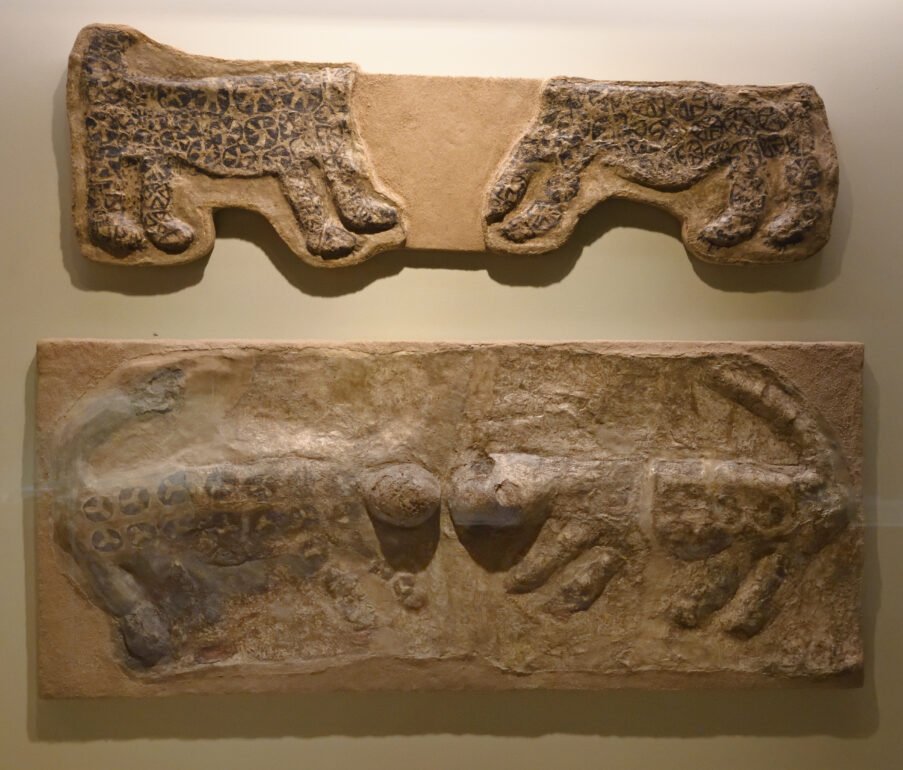
Modern investigation & conservation

Since 2000 the Marlborough Mound Trust (with English Heritage) has:

  • drilled six geological cores, securing the 2400 BC date;
  • stabilised the grotto and rebuilt collapsed steps;
  • opened limited educational access for Marlborough College students. (marlboroughcollege.org, castlestudiestrust.org)

Why Marlborough Mound matters

Significance Details
Twin to Silbury Hill Second-tallest Neolithic mound in Europe, 5 mi down-river from Silbury; both harness the Kennet flood-plain and may have shared water-cult symbolism. (en.wikipedia.org)
Rare biography Only mound known to serve three monumental lives: prehistoric cult focus → royal castle motte → baroque garden mount.
Architectural curiosity The spiral walk and stepped path are early-Stuart landscape engineering, pre-dating better-known garden mounts at Hampton Court.


Guide: Spoil Heaps

Waste-mounds & spoil heaps

These are artificial hills made from the unwanted rock, Shale and tailings that come up with coal, metal ore, stone or clay when it is being mined or quarried. Because extractive industry is both deep and long-lived, single collieries or pits can generate tens of millions of cubic metres of spoil; pushed out by locomotive, conveyor or tippler wagon and dumped in successive layers, the piles quickly become a distinctive landform.

From the moment the first Neolithic miner prised nodules of flint out of chalk at Grimes Graves, humans have left piles of unwanted earth and stone beside every hole they dug. These discard mounds—whether waist-high humps of hand-shovelled spoil, or low ridges pushed aside by wooden waggons—are often the only surface traces of extractive episodes that left no standing buildings or other structures. Being able to “read” them is therefore essential background to any landscape study.

What exactly is a “spoil-heap”?

In archaeological terms it is any artificially accumulated mass of overburden or tailings that results directly from subsurface extraction—stone, ore, clay, pigment, salt or peat. Its form depends on three simple variables:

Variable Controls Typical archaeological signals
How the spoil was moved basket, barrow, sledge, cart, rail-tub tiplines, ramps, track ruts
Where it was tipped edge of Shaft, lip of opencut, over cliff cone, fan, linear bank
How long the pit stayed active months, vs. years number of layers, weathering horizons


Talus fan:  A small fan-shaped pile where loose spoil naturally slides down.

Cone tip:A pointed heap (like an anthill) formed when carts always dump in the same spot.

Rail-fan embankment: A long, gently curving bank created when tip-wagons move forward a little each time they unload.

Ganister: A very hard sandstone once quarried for lining industrial furnaces (mainly in South Yorkshire and Derbyshire). A “ganister pit” is simply the shallow quarry left by that work.

How mining activity changed over time

Stone Age and Bronze Age.

Early miners worked with antler picks, stone hammers and baskets. They tipped the waste right beside the hole. The result is a low, lumpy mound, usually no more than a metre or two high. You can still see these soft heaps around flint mines such as Grimes Graves in Norfolk.

Iron Age and Roman times.

By the Iron Age, people were using small carts or sledges pulled by people or animals. Spoil was thrown out along the line of the trench, creating a shallow ridge rather than a simple lump. The Romans went further: where water was handy, they sometimes washed whole hillsides with stored water to expose ore. The flushed-out rubble forms wide fans or gullies below the workings—good examples survive at the Roman gold mines of Las Médulas in Spain and at Dolaucothi in Wales.

Medieval period.

Water power, horse power and simple rails allowed deeper shafts and larger open cuts. Waste could be hauled a short way from the pit and dumped at a fixed point, load after load. Over decades this built a small cone-shaped hill, a familiar sight in many medieval lead and iron districts. In Brigantia country you may meet these pointed tips beside old lead hushes in Swaledale.

Early modern (before heavy industry).

From the sixteenth to the early nineteenth century, wooden or iron rails, bigger horse carts and the first steam engines let mines handle still more material. Spoil-heaps of this date are larger cones or long banks with wheel-ruts or rail beds still visible on their flanks.

Period / power source Haul method Spoil form European examples
Neolithic–Bronze Age Human power – baskets & hides Small, irregular talus fans hugging the trench; sometimes rampart-like rings round vertical shafts Flint mine spoil at Krzemionki (Poland); copper prospect scatters in the Austrian Tauern
Iron Age–Roman Pack animals & two-wheeled tip carts Elongated embankments flanking opencast fronts; spoil occasionally graded to form working platforms Iron pits on the Weald (UK); hydraulic gold waste at Las Médulas (Spain)
Early-Medieval Hand barrows, timber sledgeways Low, lumpy hillocks beside bloomery shafts; often reused as later field lynchets Early‐medieval iron “scoriae” mounds in Lorraine; lead hush spoil in the Pennines
High-Medieval–Tudor Horse tramways, stackings over shaft mouths Steeper conical tips up to 6–8 m as ore volumes rise; ragged trackways visible on LiDAR Lead–silver tips in the Erzgebirge; coal “hillocks” of North Derbyshire
Early-Industrial (17 th – early 19 th c.) Wooden or iron plate-way trucks, water-balance lifts Regular “chevron” lines or rail-fan embankments; first signs of ash-rich black spoil Charcoal-iron tips of Styria; bell-pit ridges across Durham and Northumberland

Why they matter

  • Palimpsest recognition – Many sites re-occupy earlier extraction grounds (e.g., Bronze-Age Hushing scarps reused for iron-ore diggings), so recognising a low Iron-Age cart-tip against an earlier talus bank is key to correct phasing.
  • Resource economy – Spoil chemistry (hammer-scale, Slag flecks, Ochre stains) tells us what ores or pigments local people valued and how they processed them.
  • Territorial signals – In upland Swaledale or Nidderdale, linear tips often double as visual claims across valley floor grazing, tying industrial practice to land-holding strategies.

Tips for disentangling mixed mounds

Check the layering: prehistoric hand-dump tends to show thin, unsorted chalk or clay layer lenses; high-medieval cart tips build thicker, better-sorted layers.

Look for track imprints: twin ruts or sleeper-pits betray late horse-tram spoil routes slicing across an earlier tip.

Use LiDAR: subtle slope-breaks and zigzag haul ramps appear even under pasture, helping to separate conical “basket tips” from later rail fans.
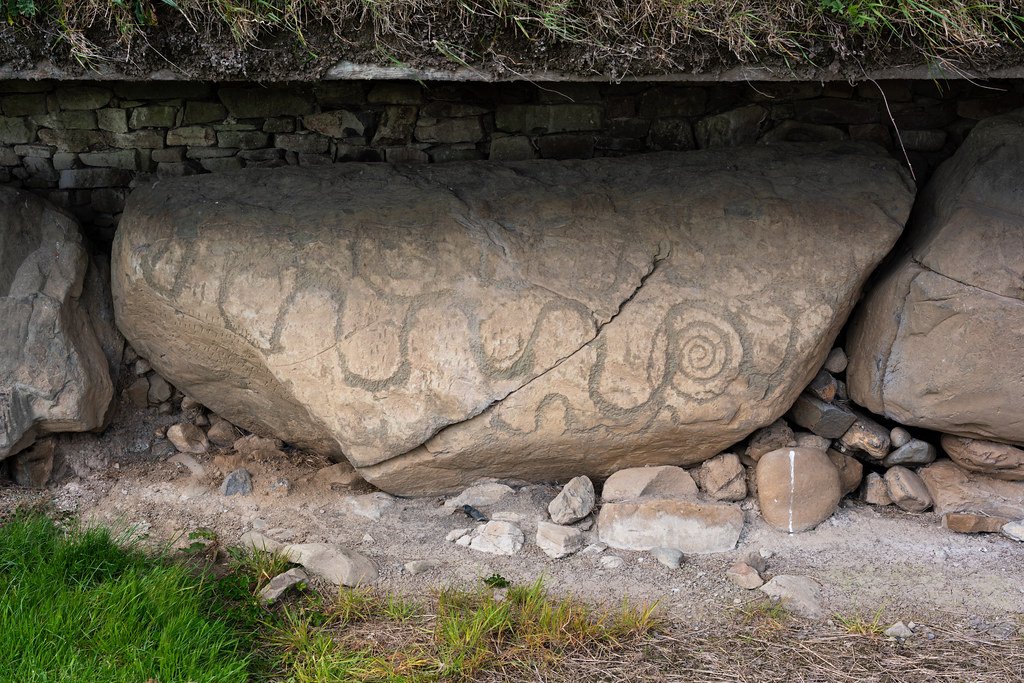
Ochre mine in the Lion Cavern in Eswatini southern Africa - Credit - Jörg Linstädter

Ochre mine in the Lion Cavern in Eswatini southern Africa – Credit – Jörg Linstädter

Chronology of mining development

Date Break-through What it unlocked
c. 40 000 BCE Ochre quarry at Lion Cavern in Eswatini (formerly Swaziland) World’s earliest evidence of deliberate mineral extraction for pigment.
c. 3000 BCE Timna (Israel), and Cypriot copper mines Large-scale bronze metallurgy needs organised mining & smelting.
c. 100 CE Roman hushing & hydraulics at Las Médulas (Spain) Water power strips overburden & washes gold—first “industrial” hydraulics.
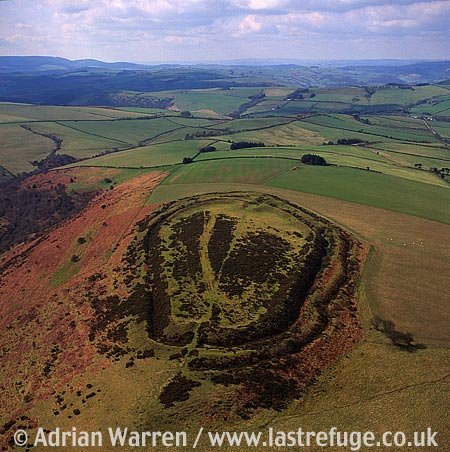
1627 Gunpowder blasting reaches German & Swedish metal mines Rock-breaking no longer relies on firesetting; galleries drive faster. (en.wikipedia.org)
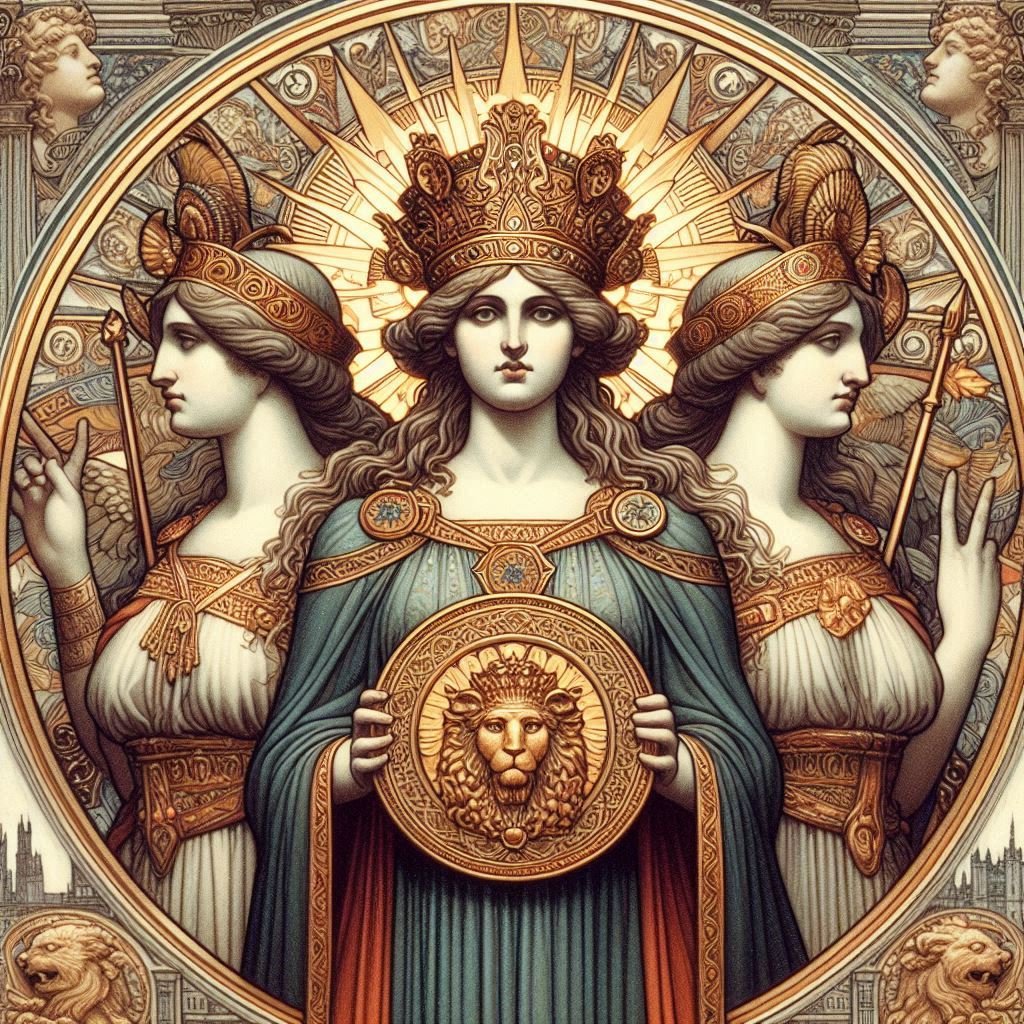
1712 Newcomen steam Engine pumps flooded shafts in England Enables mines deeper than 30 m.
1770s Cornish high-pressure engine (Watt → Trevithick) Doubles efficiency; drives man-engines & winding gear. (cdn.cornishmining.org.uk)
1867 Dynamite patented by Nobel A safer, more powerful explosive replaces black powder. (en.wikipedia.org)
1880s Pneumatic rock drills Mass tunnelling & hard-rock stopes.


Contact Us
close slider