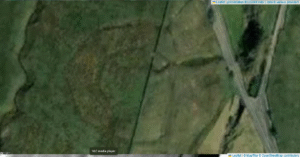
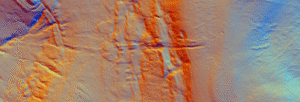
Camp Green (often called “Danes Camp”) crowns a limestone-capped knoll immediately north-east of St Michael’s Church in Hathersage (OS grid SK 234 819). Perched above the Hope Valley, it commands wide views down the River Derwent corridor and sits at the transition between the Millstone Grit plateaux to the north and the lower limestone and sandstone vale to the south
Site Section: The Brigantes of Britain
Dryburn Henge, Cumbria
Dryburn Henge lies on Alston Moor in Cumbria, within the North Pennines Area of Outstanding Natural Beauty. It occupies a strategic nodal point on the high moor, roughly at NY 760 430, where routes across the Pennine watershed converge. The surrounding terrain is underlain by Carboniferous Great Scar Limestone and interbedded Yoredale shales, with scattered fluvioglacial gravels in valley bottoms.
Black Dike – Coverdale
Black Dike is the diminutive counterpart to the great Tor Dike, rising from its western arm and climbing to the watershed between Great and Little Whernside. Beginning at roughly SD 988 756—where Tor Dike cleaves the limestone scarp—the Black Dike pursues a steep, sinuous course uphill for nearly 0.6 km, finally spilling onto the ridge crest at about 675 m above sea level
Bishopdale
Bishopdale lies within the northern limb of the Askrigg Block, its underlying bedrock dominated by Carboniferous limestones with intermittent shales and sandstones of the Yoredale Series. The Great Scar Limestone, a thick, massive unit formed around 330 million years ago in a shallow tropical sea, underpins the dale’s steeper scarps and cliff lines, while the thinner-bedded limestones and intervening mudstones of the Yoredale Group create the characteristic terraced flanks on which many of Bishopdale’s field systems are laid out
Castle Dykes Henge, Thoralby – North Yorkshire
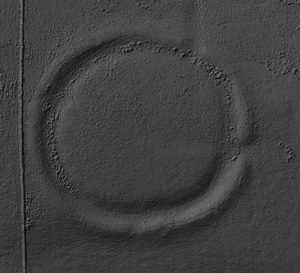
Castle dykes it is a small class one henge, 90m across, perched on the high ground up in the North Yorkshire dales. The bank survives up to 1.5 m high in places, and the ditch up to 3 m deep. Early 20th-century reports (1908) noted its intact form, and recent LiDAR-based surveys have confirmed its classic henge profile with minimal later disturbance.