
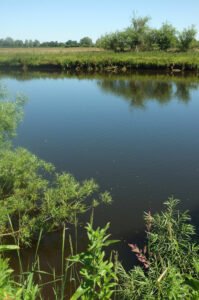
A henge at Nunwick visible both as a low bank and shallow internal ditch and as a cropmark. A berm was originally present between ditch and bank.
A henge at Nunwick visible both as a low bank and shallow internal ditch and as a cropmark. A berm was originally present between ditch and bank.

Sutton Common is an early Iron Age fort/enclosure site just north of Doncaster, A key feature of this “marsh fort” is that it seems to use the surrounding marsh land as part of its defence – a twist on the more common hill fort.
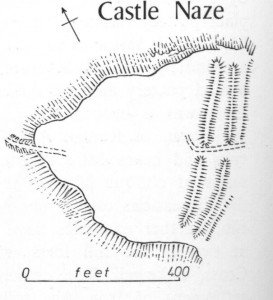
This is a promontory fort of probable Iron Age date. It uses the natural cliffs of the hill that it stands to protect its northern and western sides. It is triangular in form, and to protect its south-eastern face, a very impressive double rampart of possibly later Iron Age construction has been thrown up.
East Yorkshire’s Middle-Iron-Age story stands out in Britain because the communities who farmed the chalk of the Yorkshire Wolds developed what archaeologists call the Arras culture: a distinctive blend of continental La Tène fashions and local invention that is visible above all in their cemeteries. Three elements make it special.
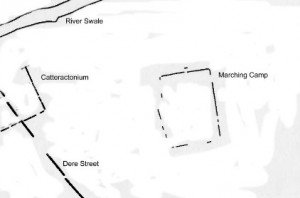
Discovered only recently by air survey and geophysics, this camp lies on the alluvial plain of the River Swale, on the south bank of the river just north-east of Catterick racecourse. The camp lies some 350m to the west of Dere Street.
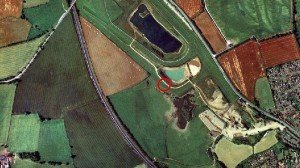
The henge at Catterick racecourse is an intriguing prehistoric site. Initially thought to be a Roman amphitheatre, it is now believed to be a henge, a type of Neolithic earthwork. Crop-mark mapping defined the henge, the 1990s rescue dig explained its mixed bank and cairn fabric, Roman-town excavations showed how much of it was levelled in antiquity, and the motorway programme set the site back into a much larger prehistoric landscape.

Castle Steads is a Hill-Side Enclosure, seemingly built without worry of threat from the upper slopes of the hill it is built on.

“We were shocked to discover such a huge complex,” said Alastair Oswald, archaeological field investigator for English Heritage. Preliminary examinations of the remains suggest it was more than twice the size of most other prehistoric strongholds. Built of timber palisades and girdled by a 1.3 mile circuit of ramparts, 60 per cent of which are cut out of solid limestone, the fort has been provisionally dated at 400BC.
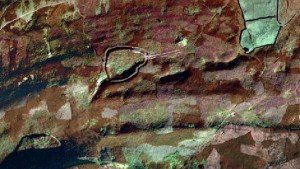
For over five hundred years, the miners and smelters of Reeth produced mountains of precious lead. The lead ores from Reeth had high concentrations of Silver, Lead itself became and important ingredient in bronze. Maiden Castle, deep in the Swaledale lead mining territory a unique piece of Iron Age architecture. It is the only known fort with what seems to be a processional entrance.
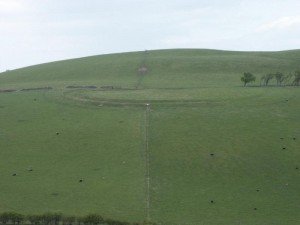
A superbly circular “fort”, built on the side of the hill, which seems to be a Brigantian fashion (see below). This is built with two rampart walls and a very narrow ditch between – 1-2m. If these were defences, they seem pretty slight. In it’s way, a miniature version of Wandlebury, but only about 200m circumference.
 NLS Map Explorer
 Google Earth
 Google Maps
 Lidar Finder
 TMA
TMA
 Megalithic Portal
 Yorkshire Arch. Air Mapping
 ADS
ADS
 Brigantian Adventure FB Group
Stone Bothering FB Group
Stone Faces FB Group
Brigantian Adventure FB Group
Stone Bothering FB Group
Stone Faces FB Group
 Heritage Gateway
 ARCHI® MAPS: UK
 Atlas of Hillforts
 Portable Antiquities
 British History Online
Brigantes Nation FB Group
British History Online
Brigantes Nation FB Group

