

Syncretism, the amalgamation of different religions, cultures, or schools of thought, has its roots in the ancient world.
Jul 06
Syncretism, the amalgamation of different religions, cultures, or schools of thought, has its roots in the ancient world.
Jul 05

The Lawson-Tancred family, with its roots deeply embedded in English history, boasts several notable figures who have made significant contributions to their fields and society. The lineage of the family can be traced back to the Norman Conquest, with Richard Tankard, who owned lands at Boroughbridge in Yorkshire shortly after this pivotal event in English history.

Aldborough Hall, nestled in the picturesque village of Aldborough in North Yorkshire, England, is a testament to architectural evolution and historical significance. The origins of the hall can be traced back to the early 17th century

Studforth Hill, a site of historical significance located near the village of Aldborough in North Yorkshire, England, is known for its association with Aldborough Castle. The motte is a testament to the area’s rich past, built upon the remnants of a former Roman amphitheatre.
Jul 04
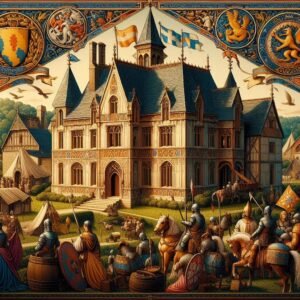
This article introduces the concept of houses that embody a dynasty of influence and control, driven by feudal and familial responsibilities and agreements. It explores how houses worked during this period and examines the response by the Brigantian people to this increase in control by the Normans.

In the grounds of Paradigm Sharpening, Nelholme, West Burton, on both sides of the roads are what looks like two natural amphitheatres, which may have been enhanced by the local people are used as a meeting place. I can’t find any research on this location, but it is of sufficient interest to record.
Jul 03

We look at the development of Christianity from 50AD to 1100AD in both the broader European context and also for the people of Brigantia.
Jun 19

Prehistoric Yorkshire is a landscape rich with history, revealed through various archaeological finds that offer a glimpse into the ancient past. The oldest evidence of human activity in this region dates back to around 125,000 years ago, but it is the later periods, particularly the Iron Age, that have yielded significant discoveries related to ploughing and farming.

There is an earwork, approximately 300m east of the entrance to swinton castle. It is a small elongated hill, with three terraces on either side of it. It sit along in the landscape as such a feature, and the terraces seem impractactacle and redundant for crops in what is otherwise a flat landscape. It looks like a garden feature, a work of art, but it is outside of the castle grounds, and I have seen similarly carved hills elsewhere, far from stately grounds.
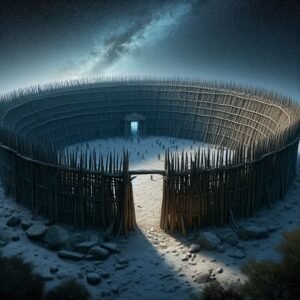
The recent discovery at Catterick has unveiled a significant Late Neolithic palisaded enclosure, shedding light on the prehistoric landscape of North Yorkshire. Excavations revealed two concentric sub-circular palisades, with the outermost having a diameter of up to 200 meters.
 NLS Map Explorer
 Google Earth
 Google Maps
 Lidar Finder
 TMA
TMA
 Megalithic Portal
 Yorkshire Arch. Air Mapping
 ADS
ADS
 Brigantian Adventure FB Group
Stone Bothering FB Group
Stone Faces FB Group
Brigantian Adventure FB Group
Stone Bothering FB Group
Stone Faces FB Group
 Heritage Gateway
 ARCHI® MAPS: UK
 Atlas of Hillforts
 Portable Antiquities
 British History Online
Brigantes Nation FB Group
British History Online
Brigantes Nation FB Group

