Publisher: Brigantes Nation

The Story of Boltby Scar

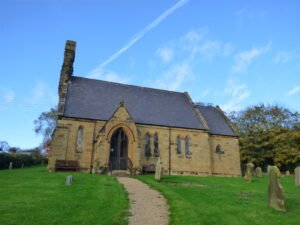
Boltby Church, Yorkshire Moors

Boltby is a very important ancient site IMO. A gold “hair braid”, was found there, linking it to the Amesbury Archer, buried with two similar hair braids. This also provides a link to the founding of Stonehenge, which helps set a potential scene for a possible “zeitgeist”, of the day.
Guide: Parliamentary-walls and the Northern Enclosures

Ingleton Visit 3/13 (il16)

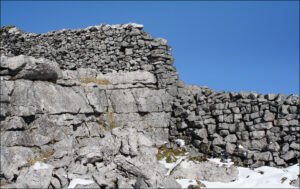
Between the mid-18th and late-19th centuries the British Parliament passed almost 5,000 local “Inclosure Acts.” Each Act authorised a team of appointed commissioners to survey one specific township or parish, divide its open-field strips, common pastures, and “wastes” into new, privately owned parcels, and lay out straight roads and boundary walls or hedges. The commissioners issued a legal award map and schedule that became the new title deeds.

The hero archetype and Lugh

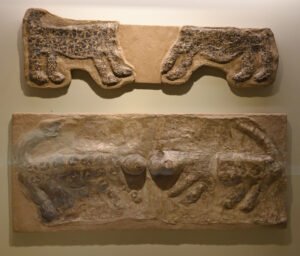
Museum of Anatolian Civilizations Çatalhöyük Leopard reliefs all in 2019 01

At its core the “hero” is the figure who steps out of ordinary society, confronts chaos or a monster, and returns (or dies) having secured order for the group. In Jungian and comparative-myth terms it sits in the “warrior-champion” slot of the collective story-board; evolutionists would say it crystallises the survival value of decisive coalition leadership in small bands.

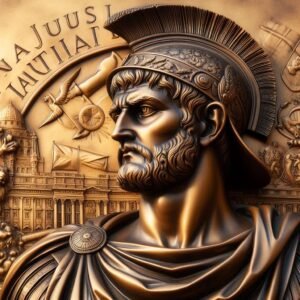
Gnaeus Julius Agricola

In a series of annual military campaigns Agricola put down revolts in north Wales, subdued the Brigantes tribe in the north, extended Roman control over the Scottish lowlands, where he established a string of forts between the Forth and the Clyde, sent troops into Galloway, and made inroads into the eastern Highlands. During the latter campaign his vessels were the first to circumnavigate the islands.

Snake Iconography in the British Isles

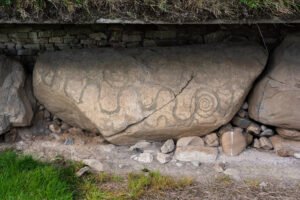
Knowth, Brú na Bóinne (Boyne Valley), Ireland

Syncretism through the ages Syncretism, the amalgamation of different religions, cultures, or schools of thought, has its roots in the ancient world. Thoughts on Celtic Religion – Raimund, Karl To begin with, lets first look at the sources available to us: There are quite numerous sources available, contrary to Read more Hillforts: Defence or Ritual? …

Continue reading

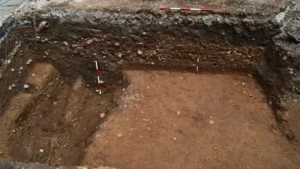
Roman Road to the West uncovered under Manchester Street

Sections of a Roman road can be seen in this trench

A stretch of Roman road just 38-40 cm (15 in) below Liverpool Road in Castlefield. The trench shows the classic Roman construction sequence – a cambered rubble core surfaced with tightly packed cobbles – and runs on a north-east/south-west alignment that leaves Mamucium’s north gate and heads towards modern Salford.

What might Stonehenge Mean? Dartmoor and Carnac add to the Picture

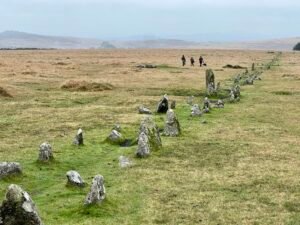
Dartmoor Stone Rows

Stonehenge has always been enigmatic, due to its use of those definitive morticed trilithons, all of which where squared of, more like the structures of the Maltese temples and other stone structures closer to Africa, as opposed to those of the rest of Britain and most of the wider North-west European ritual landscape.

Guide: Spoil Heaps

Ochre mine in the Lion Cavern in Eswatini southern Africa - Credit - Jörg Linstädter

These are artificial hills made from the unwanted rock, shale and tailings that come up with coal, metal ore, stone or clay when it is being mined or quarried. Because extractive industry is both deep and long-lived, single collieries or pits can generate tens of millions of cubic metres of spoil; pushed out by locomotive, conveyor or tippler wagon and dumped in successive layers, the piles quickly become a distinctive landform.

Drumanagh Promontory Fort – First Ever Intact Roman Pot Found in Ireland

Roman samian ware

RTE Ireland has reported that more recently they have made yet another remarkable discovery—an intact Roman pot. the first one to be uncovered on Irish soil, and providing more tantalising clues about ancient Roman-Irish interactions.

Although the Roman Empire they never reached Ireland (except, seemingly, in myth). That does not mean, that Roman influence and goods did enter Ireland, and it means that Drumanagh continues to headline as one of Irelands most tantalising archaeological sites for that same reason – exactly what were the Romans doing in Ireland?

Brigantes Tribe

Thornborough Henges c.2004

The name Brigantia represents three separate concepts: a goddess, a people, and a tribal federation. By the Roman period, the name represented a tribal federation compromising all of what would become the Roman province of Britannia Secunda, except for the Parisi territory, east of the River Derwent.

Contact Us
close slider