Category: Landscape feature

Guide: Classification of Henge Monuments

Avebury Landscape

Archaeologists use the word “henge” for later-Neolithic and earliest Bronze-Age earthen rings whose ditch lies inside the bank, creating a deliberately bounded interior. The term itself was coined in 1932 by Kendrick; it was refined in the 1950s by Richard Atkinson, whose system still frames most discussion.
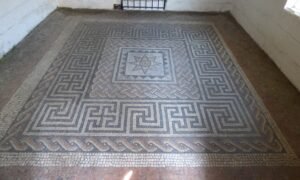
Aldborough Roman Town

Aldborough Roman Town mosaic

Aldborough, or Isurium Brigantia as it was known in Roman times was the capital of Brigantia, at least from some point during Cartimandua’s acceptance as client Queen, governed by Rome. As such, it is a key site in our search for Brigantia

Lady Hill, East Scrafton – Coverdale

Lady Hill East Scrafton - LiDAR

Located in East Scrafton, a small hill called Lady Hill is marked on the OS Series 1 map. The term “Lady” is of interest, since it has been used elsewhere in sites that appear important for religious purposes.

Mound in field of Bridge Barn, Nathwaite Bridge

Mound in Bridge Barn Field, close to Nathwaite Bridge, Coverdale

Located in the same field as Bridge Barn, close to the Cow Ford, there is a mound. In may be around 4-5m in diameter and perhaps 1.5-2m high. Our initial search drew a blank as to what it may be. But it’s proximity to Cow Ford suggests it may have a mining, or masonic origin.

Guide: Fortified Barns in Yorkshire – A historical overview

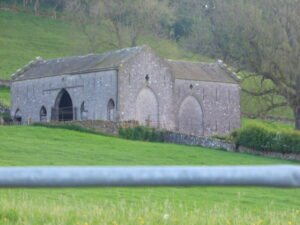
Monastic Fortified tythe barn in Wenseydale

Even in a rural community of mainly farmers, there are often reasons to wish to build or create a structure that is for, at least in part, for defensive purposes. Thus, some barns in Yorkshire and other places can be seen to have “arrow slits”, and later, square “gun ports”. This article provides a brief overview of what these structures are, why they were built and how they were used.

West Scrafton – Coverdale

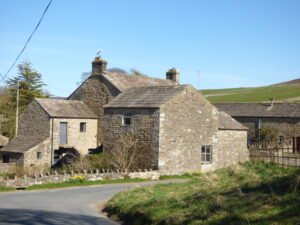
West Scrafton

West Scrafton is a village located in Coverdale in the Yorkshire Dales. It sits on the southern upward slops of Coverdale, and had its most recent heyday in the 19th century when coal mining took over the village.

Flats Hill – Carlton in Coverdale

Flats Hill Mound - Carlton-in-Coverdale - view from road

Flats Hill mound is approximately 30 meters in diameter and stands about 3.6 meters high. It has never been excavated, although a dry stone wall seems to have been started, and then stopped, partly over its top. It has been suggested as, and is listed as a probable barrow, with a presumably wide date, likely to be in the Bronze Age or Iron Age date range.

Round Hill Motte at Carlton-in-Coverdale

Motte_at_Carlton_in_Coverdale_-_geograph.org.uk_-_Gordon_Hatton

Carlton Castle, or Round Hill Motte, at Carlton-in-Coverdale is an intriguing historical site that offers a glimpse into the medieval past of the Yorkshire Dales. The structure seems related to an extensive set of linear earthworks that have been interpreted as agricultural, however, their existence asks a question: if these are not older than this medieval interpretation. 

Were Thornborough Henges built by giants?

I’ve started to realise there are an awful lot of myths involving giants in Yorkshire, and in the rest of Britain, regarding monument having been built by giants

Unveiling the Archaeological Landscape of Nosterfield

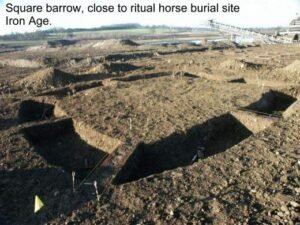
Square Barrow at Nosterfield Quarry, near Thornborough Henges

The Nosterfield Quarry excavation sits at the heart of one of Britain’s most enigmatic prehistoric landscapes—the Thornborough Henges Complex.

Contact Us
close slider