Site Section: Cultural Heritage

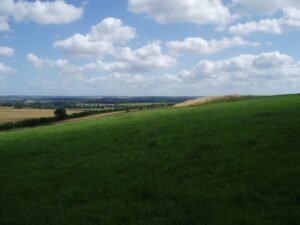
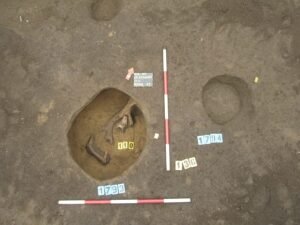
The Story of Boltby Scar

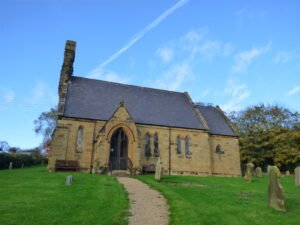
Boltby Church, Yorkshire Moors

Boltby is a very important ancient site IMO. A gold “hair braid”, was found there, linking it to the Amesbury Archer, buried with two similar hair braids. This also provides a link to the founding of Stonehenge, which helps set a potential scene for a possible “zeitgeist”, of the day.
Swaledale

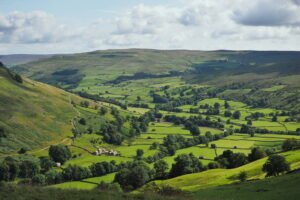
2015 Swaledale from Kisdon Hill

Swaledale occupies the long, sinuous valley carved by the River Swale on its 45-kilometre descent from Nine Standards Rigg (662 m) on the Pennine watershed to Richmond in lower Teesdale. The dale narrows between rough gritstone scarps near Keld, broadens to a patchwork of hay-meadows around Muker and Gunnerside, then opens into a tree-fringed flood-plain west of Reeth before the river cuts through the Carboniferous escarpment to meet the Vale of Mowbray.

Guide: Parliamentary-walls and the Northern Enclosures

Ingleton Visit 3/13 (il16)

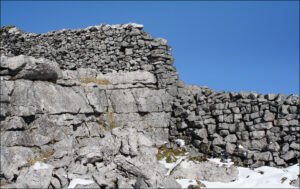
Between the mid-18th and late-19th centuries the British Parliament passed almost 5,000 local “Inclosure Acts.” Each Act authorised a team of appointed commissioners to survey one specific township or parish, divide its open-field strips, common pastures, and “wastes” into new, privately owned parcels, and lay out straight roads and boundary walls or hedges. The commissioners issued a legal award map and schedule that became the new title deeds.

The hero archetype and Lugh

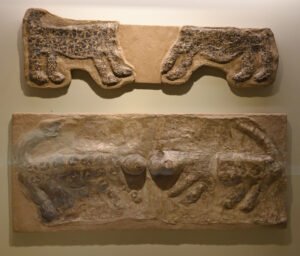
Museum of Anatolian Civilizations Çatalhöyük Leopard reliefs all in 2019 01

At its core the “hero” is the figure who steps out of ordinary society, confronts chaos or a monster, and returns (or dies) having secured order for the group. In Jungian and comparative-myth terms it sits in the “warrior-champion” slot of the collective story-board; evolutionists would say it crystallises the survival value of decisive coalition leadership in small bands.

Anciens Arsenaux Neolithic Settlement, Sion – Switzerland

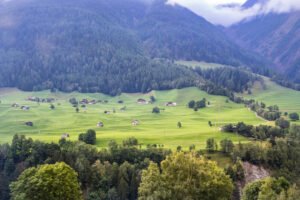
Upper Rhone Valley

Sion lies midway along the upper Rhône Valley, an east‑west trench gouged by repeated Pleistocene glaciers and now flanked by the Pennine and Bernese Alps. The settlement area sits on the alluvial fan of the Sionne torrent, a cone of well‑sorted sands and gravels that projects onto the wider Rhône flood‑plain. 

Snake Iconography in the British Isles

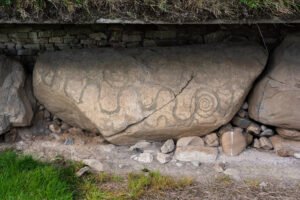
Knowth, Brú na Bóinne (Boyne Valley), Ireland

Syncretism through the ages Syncretism, the amalgamation of different religions, cultures, or schools of thought, has its roots in the ancient world. Thoughts on Celtic Religion – Raimund, Karl To begin with, lets first look at the sources available to us: There are quite numerous sources available, contrary to Read more Hillforts: Defence or Ritual? …

Continue reading

South Street Long Barrow, Avebury

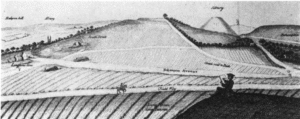
South Street Long Barrow - Stukely plate including South Street Long Barrow

South Street long  barrow once lay 1 km south‑west of Avebury village, midway between the Kennet spring‑line and the Windmill Hill plateau (OS grid SU 090 678; 165 m OD). From its crest the ground falls gently north‑east toward the henge and west toward Beckhampton, so the mound would have been visible from all Early‑Neolithic foci in the area yet lay on good grazing that could be tilled by the first farming groups.

Millbarrow long barrow (Winterbourne Monkton)

Tumulus on Millbarrow

Millbarrow once stood on a low chalk spur 2 km north‑west of Avebury, just above the spring‑line where the Kennet valley opens onto the Marlborough Downs (NGR SU 0943 7221). From its east–west‑aligned crest the ground falls gently south to Windmill Hill and east  into the Kennet valley, giving the mound clear sight of the Avebury monument complex, and easy access to water and pasture.

Horslip (Windmill Hill) Long Barrow, Avebury

Horslip Barrow - AI Recreation

Sitting on the south‑east shoulder of Windmill Hill (grid ref. SU 086 070), 140 ft (43 m) above the Kennet valley, the Horslip long barrow commands the same chalk ridge that carries the famous Early‑Neolithic causewayed enclosure 400 m upslope.

Bubeneč Neolithic Farm, Prague

Bubenec excavations - Institute of Archeology of Academy of Sciences

Quite recently, initial excavation evidence from Bubenec, close to Prague was first announced to the public, pending full publication. As part of that media activity, the head archaeologist for the dig, Petra  Maříková  Vlčková explained that the excavation; below the future Canadian Embassy, in Prague’s Bubeneč district, cut through almost two metres of undisturbed deposits – a rarity in Central Europe.

Contact Us
close slider