
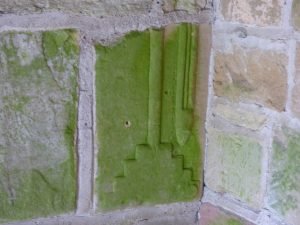
Whilst the current church lacks much in the way of indications of ancient origins, it’s entry porch boasts a wealth of 12c carved stones and is definitely worth a visit.
Whilst the current church lacks much in the way of indications of ancient origins, it’s entry porch boasts a wealth of 12c carved stones and is definitely worth a visit.
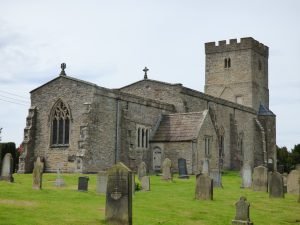
The church at Stanwick sits very close to the original centre of the Iron Age fort. It’s churchyard seems to respect a more ancient ritual use and it’s siting in conjunction with not only Mary Wild Beck but also the Sacred Spring in at the front of this church and it’s 10th century origins indicate this site was a focal point for ritual activity right back to the Iron Age and before.

St Michael’s Church at Kirklington stems from prior to the Norman Period and has ghosts of an even earlier period in the form of the various carved heads found inside and outside the church.

The name Brigantia represents three separate concepts: a goddess, a people, and a tribal federation. By the Roman period, the name represented a tribal federation compromising all of what would become the Roman province of Britannia Secunda, except for the Parisi territory, east of the River Derwent.
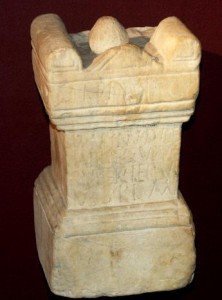
Eboracum was the Roman capital of Northern England

This Bronze Age site comprises of three large standing stones, it is thought originally there were as many as five stones in this alignment. Being Bronze Age little is known about the origin of the Devil’s Arrows, the name reflecting a more recent myth. The monument is strongly linked with an alignment with several others covering a line of over 50 miles and heading north south through North Yorkshire.
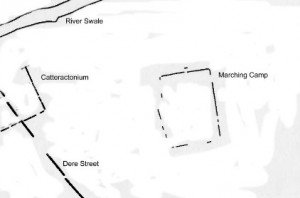
The Fort at Catterick. It has an unusual shape due to multiple fort plans being overlaid on it. Originally, it was a Roman fort, but a settlement soon sprang up outside the fort, which soon dominated the fort, and Catterick became one of the most important ‘Small towns’ in the north of Britain.
Discovered only recently by air survey and geophysics, this camp lies on the alluvial plain of the River Swale, on the south bank of the river just north-east of Catterick racecourse. The camp lies some 350m to the west of Dere Street.
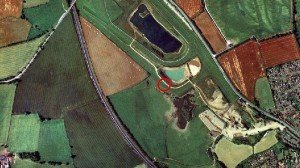
The henge at Catterick racecourse is an intriguing prehistoric site. Initially thought to be a Roman amphitheatre, it is now believed to be a henge, a type of Neolithic earthwork. Crop-mark mapping defined the henge, the 1990s rescue dig explained its mixed bank and cairn fabric, Roman-town excavations showed how much of it was levelled in antiquity, and the motorway programme set the site back into a much larger prehistoric landscape.

Castle Steads is a Hill-Side Enclosure, seemingly built without worry of threat from the upper slopes of the hill it is built on.
 NLS Map Explorer
 Google Earth
 Google Maps
 Lidar Finder
 TMA
TMA
 Megalithic Portal
 Yorkshire Arch. Air Mapping
 ADS
ADS
 Brigantian Adventure FB Group
Stone Bothering FB Group
Stone Faces FB Group
Brigantian Adventure FB Group
Stone Bothering FB Group
Stone Faces FB Group
 Heritage Gateway
 ARCHI® MAPS: UK
 Atlas of Hillforts
 Portable Antiquities
 British History Online
Brigantes Nation FB Group
British History Online
Brigantes Nation FB Group

