
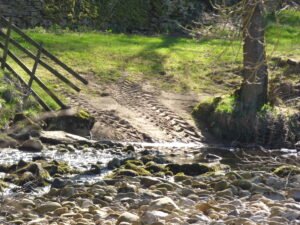
In the field of Bridge Barn, close to Nathwaite Bridge, there are two fords marked on the OS Series 1 map. This site page holds the details of our investigation into the fording point we think may be called Intach Ford.
In the field of Bridge Barn, close to Nathwaite Bridge, there are two fords marked on the OS Series 1 map. This site page holds the details of our investigation into the fording point we think may be called Intach Ford.
May 20
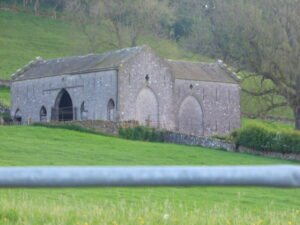
Even in a rural community of mainly farmers, there are often reasons to wish to build or create a structure that is for, at least in part, for defensive purposes. Thus, some barns in Yorkshire and other places can be seen to have “arrow slits”, and later, square “gun ports”. This article provides a brief overview of what these structures are, why they were built and how they were used.
May 20

“Coal Barns”, are, in the case of Coverdale, and smaller coal producer, often, simply ordinary barns, which have been used, and perhaps partially converted for use as coal storage.

Nathwaite bridge over the River Cover is a strategically placed river crossing, for centuries it has been the only crossing point over the river Cover, and with a fortified barn right next door to it, this is an enigmatic site worthy of closer attention.

Geophysics and three hand-excavated trenches uncovered ten further uprights, in addition to the known standing stone at Farley Moor Woods, lying just below the leaf-litter, defining a ring c. 18 m in diameter around the visible stone. A low stone-built platform or “kerb cairn” occupies the circle’s south-eastern arc; charcoal lenses and a smashed Collared-Urn sherd in its make-up gave an early Bronze-Age radiocarbon estimate of c. 1700 BCE (3,700 cal BP).
May 18

Antonine Wall Map Gask Ridge Map Roman Military Sites in Scotland English names, Roman names where known, four figure map reference, site type, size, and history, including garrisons and associated military Read more Mystery of Vitrified Forts It was during a trip to.Scotland, in the Summer of 1997, that I first heard of vitrified hillforts. …

Hutton Rudby was once known as Hutton-juxta-Rudby, or Hutton-nigh-Rudby, because it is really two villages: Hutton and Rudby, separated from each other by the River Leven. How old is the village? There have been people living here for thousands of years. Stone Age tools have been found in North End.
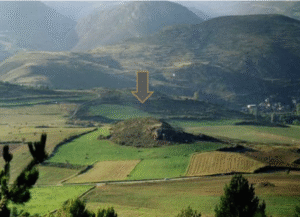
Montlleó sits at 1,144 m a.s.l. on a low knoll in the high, east–west Cerdanya valley of the eastern Pyrenees, a natural corridor between the Bay of Biscay and the Gulf of Lion. Excavated since 2000, the open-air site preserves a 23,000 – 17,000 cal BP occupation sequence that spans the harshest part of the Last Glacial Maximum (LGM) through early deglaciation. Because mountain ice in the Pyrenees retreated earlier than the global LGM, Montlleó shows that hunter-gatherers could exploit altitudes that were once thought permafrost-bound.

Summary and supplemental information in relation to the publication: Early‐Middle Bronze-Age Agricultural Terraces in North-East England: Morphology, Dating & Cultural Implications.

Flats Hill mound is approximately 30 meters in diameter and stands about 3.6 meters high. It has never been excavated, although a dry stone wall seems to have been started, and then stopped, partly over its top. It has been suggested as, and is listed as a probable barrow, with a presumably wide date, likely to be in the Bronze Age or Iron Age date range.
 NLS Map Explorer
 Google Earth
 Google Maps
 Lidar Finder
 TMA
TMA
 Megalithic Portal
 Yorkshire Arch. Air Mapping
 ADS
ADS
 Brigantian Adventure FB Group
Stone Bothering FB Group
Stone Faces FB Group
Brigantian Adventure FB Group
Stone Bothering FB Group
Stone Faces FB Group
 Heritage Gateway
 ARCHI® MAPS: UK
 Atlas of Hillforts
 Portable Antiquities
 British History Online
Brigantes Nation FB Group
British History Online
Brigantes Nation FB Group

