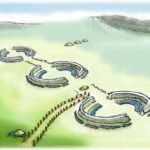
Summary and supplemental information in relation to the publication: Early‐Middle Bronze-Age Agricultural Terraces in North-East England: Morphology, Dating & Cultural Read more
These small, delicate gold objects are highly significant, they offer insight into the social status, trade connections, and cultural practices Read more
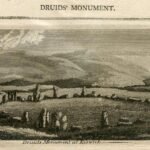
This unexcavated and undated barrow matches many of other Late Neolithic / Early Bronze-Age Round Barrows (c. 2400–1500 BC) dotted Read more
Kirkhaugh Cairns
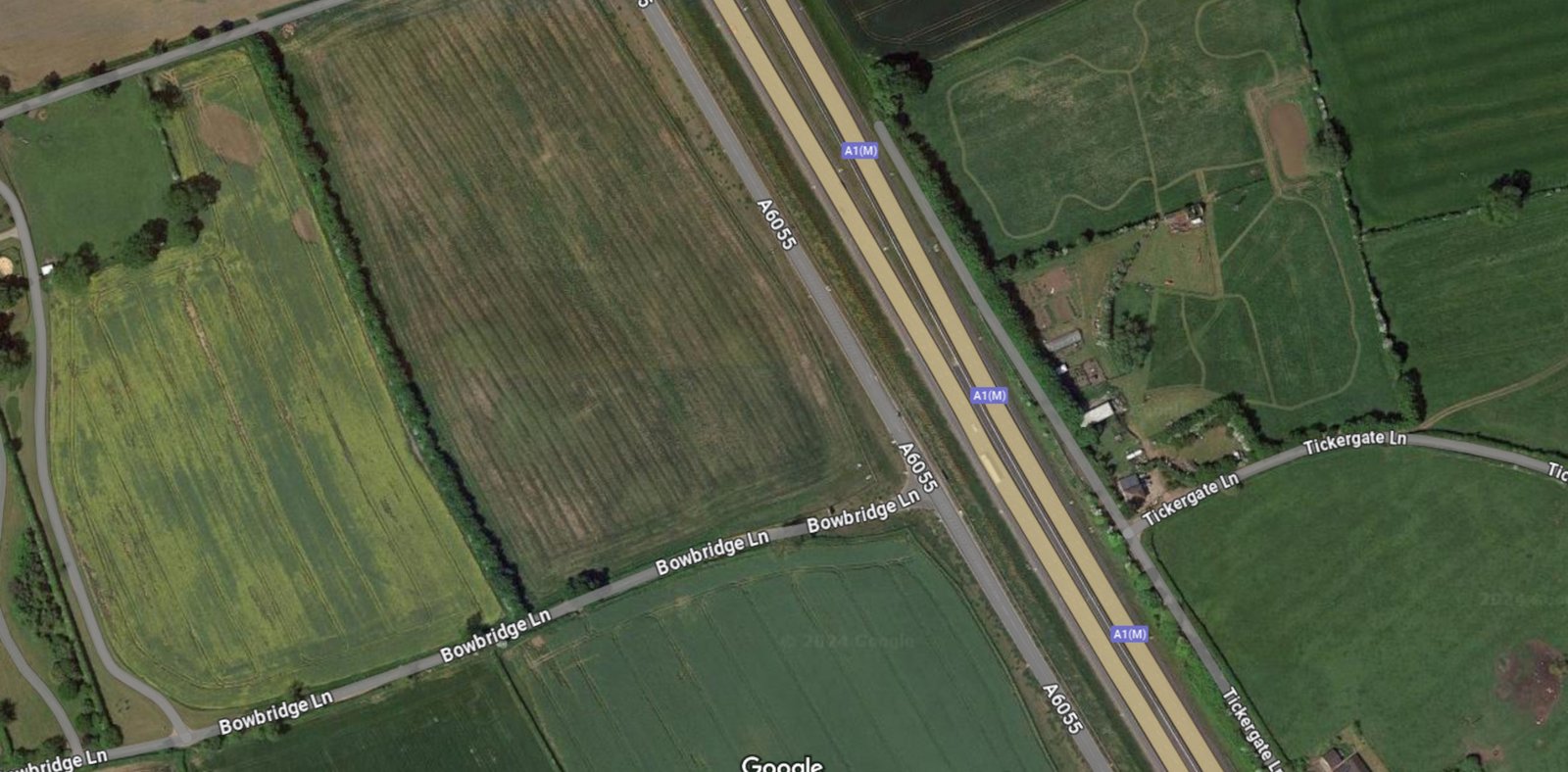
Barrow (NY 704494) 2 miles NNW of Alston. Finds in Museum of Antiquities, Newcastle.
Location
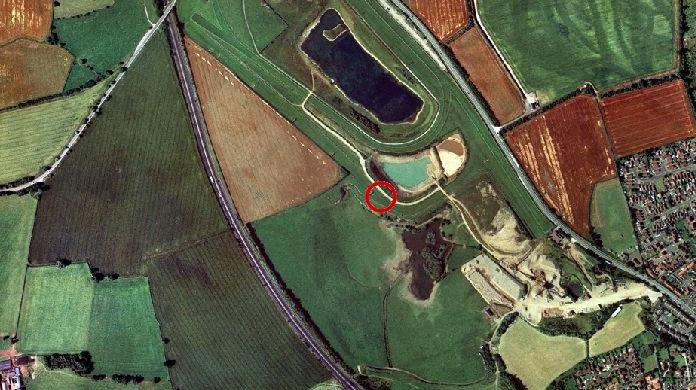
Kirkhaugh Cairns form one of the most intriguing Early Bronze-Age funerary complexes in northern England, renowned for the spectacular “hair-braid” gold rings found in association with a metal-worker’s burial. Situated in South Tynedale, they occupy a gentle terrace on the south bank of the River South Tyne (OS grid NY 785 874; 54.839° N, –2.239° W), approximately 3 km northwest of Alston and just northeast of the Roman fort at Epiacum (en.wikipedia.org).
Geology and Landscape
The cairns sit within the North Pennine ore-field, underlain by Carboniferous limestones and sandstones cut by rich veins of copper and lead. The broad Tyne valley here is floored by fluvioglacial gravels and alluvium; to the north and south the land climbs steeply into heather-clad moorlands, where small springs emerge at the Limestone-Shale junctions. This setting provided both accessible water for ore-processing and easy access to metal-bearing rocks on the adjacent fells (researchframeworks.org).
Originally, two, and possibly three, round cairns stood in a linear group, each about 6–8 m in diameter and up to 1 m high. The turf-covered stone mounds once overlay rock-cut sockets and packed stone burial chambers. By the mid-20th century, ploughing and reservoir works had damaged parts of the group, but the two principal mounds remained identifiable.
1935 Excavation (Herbert Maryon)
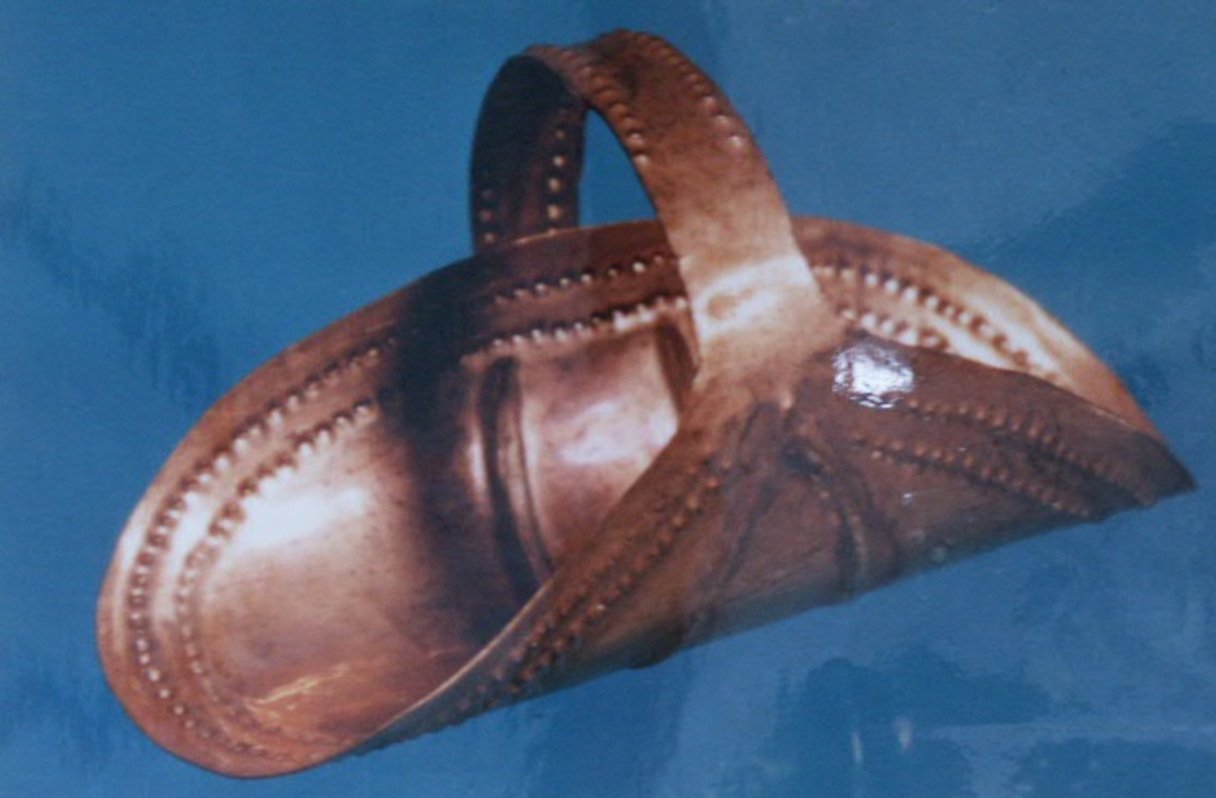
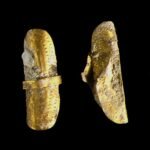
Over five days in September–October 1935, Herbert Maryon (Durham University) and Joseph Alderson opened Cairn 1. Beneath a “continuous layer of flattish stones” they recorded patches of greasy clay on the bedrock - suggestive of a decayed organic burial. They recovered a suite of grave-goods clustered in a central 3–4 m area. Finds included a crushed food-vessel (later identified as an early Bell-Beaker pot), flint tools, a lump of pyrite, a sandstone hone, and notably one small gold “ear-ring,” now reinterpreted as a hair-braid ring, it's typology being of those found with the Amesbury Archer, which are among the earliest gold objects in Britain.
Cairn 2, opened in the same campaign, proved empty. No human remains survived, but the presence of the high-status goods in Cairn 1 strongly suggests a metal-worker of Bell-Beaker affiliation was commemorated here around c. 2400 BC (researchframeworks.org).
Under the Altogether Archaeology programme, volunteers and Durham University’s Archaeological Services returned to Kirkhaugh in 2014. Detailed geomagnetic and resistivity surveys mapped the buried cairn footprints and revealed surrounding field-boundary ditches (northpennines.org.uk). During small-scale re-excavation of Cairn 1, four local schoolboys—two of whom were descendants of Alderson’s helpers—uncovered a matching gold hair-braid ring in situ, confirming that the original metalworker grave was deliberately furnished with a rare pair of braid-rings (bajr.org).
Interpretation and Significance
The twin braid-rings and Bell-Beaker vessel align Kirkhaugh with the broader network of Early Bronze-Age metal elites (cf. the Amesbury Archer). Their deliberate deposition at a prime ore-field locus implies that specialist metallurgists anchored themselves here to exploit local copper and lead veins. Perhaps training apprentices and forging regional trading ties. The fact that one cairn was left empty while the other contained rich goods suggests nuanced funerary choices, possibly reflecting status or professional affiliation.
Local Features of Interest
Epiacum Roman Fort: Just below the cairns, this large fort (Whitley Castle) controlled lead-mining in the Roman period. Its proximity underscores Kirkhaugh’s long-term strategic value.
South Tyne Trail: A public footpath now passes the cairns, offering views of the moorland skyline and access to interpretive panels on the site’s history.
Cup-and-Ring Carvings: Scattered panels on nearby outcrops link the cairns to a wider ritual landscape of rock art across the Pennines.
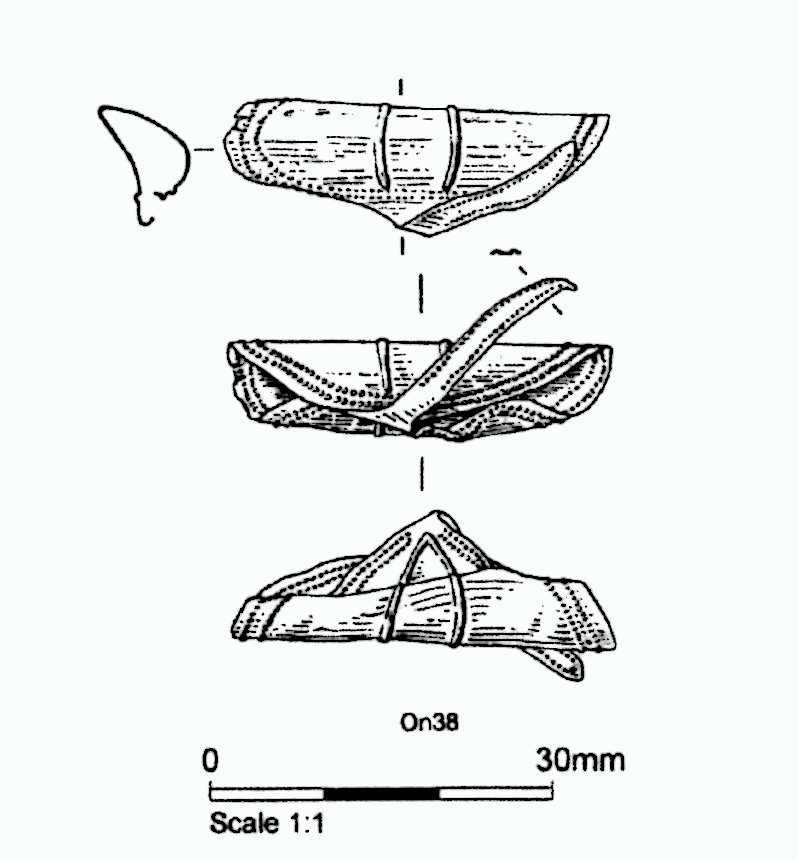
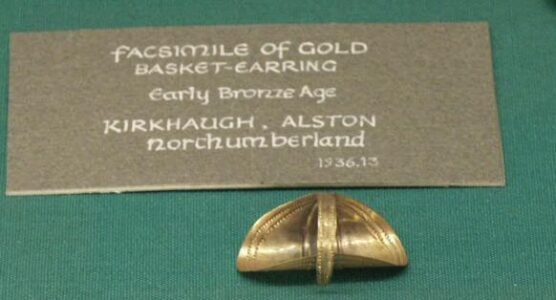
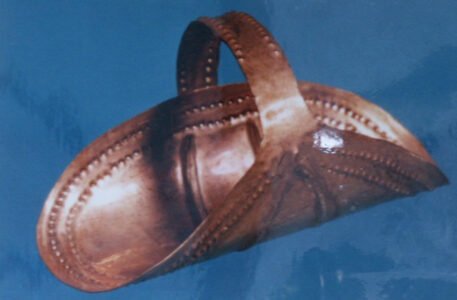
"Basket", gold ornament found at Kirkhaugh Cairns, Cumbria.
"This mound is 22ft. in diam. and about 3ft high. It has been built upon a natural knoll which makes the barrow look larger than it is. Excavation showed that the mound has an earthy core with a rubble capping. Decayed traces of an unburnt body were found at the centre and among the offerings in the mound near the burial there was a basket-shaped gold ear-ring of a type found with beakers in Britain. Date, c. 2,000 - 1,700 BC.
The tiny gold “hair-braid” rings of the Early Bronze Age are among the rarest and most telling artifacts to survive from Britain’s prehistoric past. Far from mere personal ornaments, these finely wrought loops were the insignia of a highly specialized elite—master metalworkers whose skills in copper and gold defined a new social order around 2400 BC. Found only in a handful of burials—most famously with the Amesbury Archer in Wessex and in upland cemeteries at Kirkhaugh, and Boltby Scar—each braid‐ring appears alongside copper tools, fire-steel nodules and distinctive Beaker pottery, marking its owner as part of a tightly knit craft “guild.”
What truly sets these sites apart is their deliberate siting at prime ore sources. Kirkhaugh Cairns lie in the heart of the North Pennine copper-lead fields, Boltby Scar overlooks early Roulston Moor workings, and the Archer’s Wessex homeland linked into continental exchange routes. By anchoring themselves where raw materials were most accessible, these metalworkers not only oversaw smelting and alloying but also trained local apprentices, spreading both technology and its ritual aura across the British Isles.
The arrival of the Amesbury Archer—a man whose strontium-isotope signature traces his youth to the Western Alps—heralded a wider cultural influx. His grave, laden with the earliest gold ever found in Britain, speaks to the importation of Bell-Beaker metallurgical traditions and high-status burial rites. These continental connections dovetailed with an island-wide “revolution” in which metal, monument and memory fused.
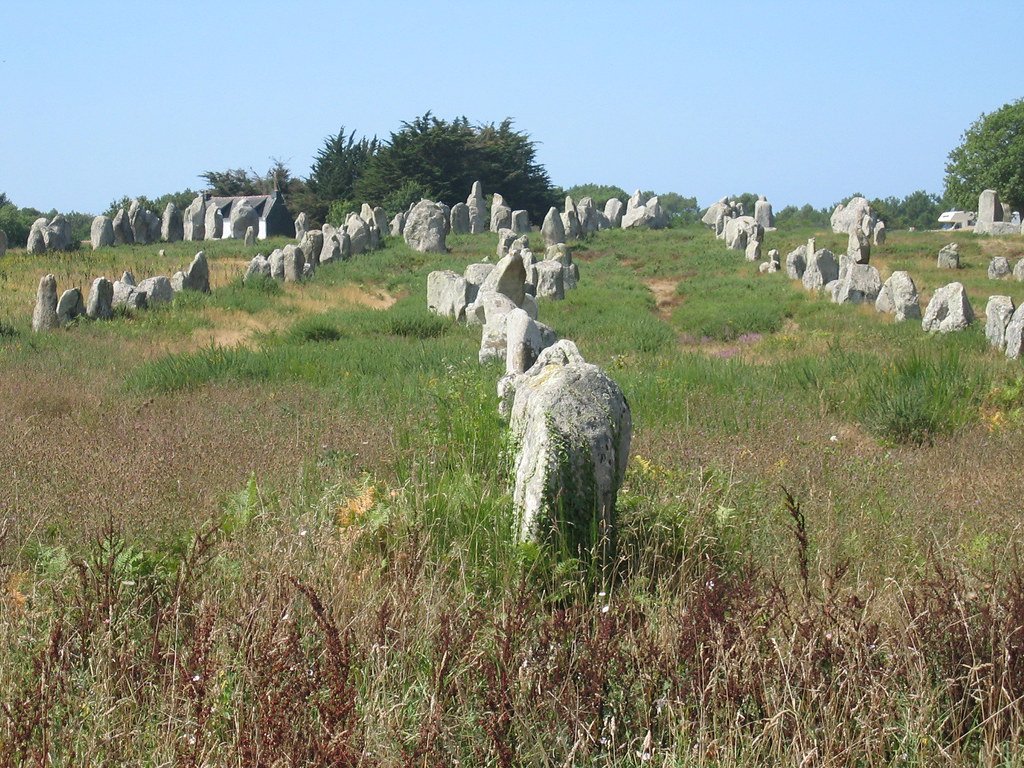
Nowhere is that fusion more dramatically enshrined than at Stonehenge. Built in phases from around 2600 to 2400 BC—well after the first Atlantic stone alignments—its massive trilithons and imported bluestones echo the same networks of mobility that brought gold and copper to Britain’s elites. The monument’s circular Henge and precise stone engineering can be seen as the apogee of a social transformation initiated by those metal-working masters.
Finally, radiocarbon evidence shows that these braid-rings were always deposited in death—ceremonially “retired” in tombs and never recycled. This collective act of deposition, repeated across distant regions, points to a shared cosmology: a belief that the ultimate resting place for these symbols of craft and power lay beneath the earth. Though their makers have vanished into prehistory, the gold hair-braids remain silent testimony to an age when metallurgy and monumental architecture reshaped Britain’s cultural landscape.
References
Herbert Maryon’s 1936 excavation report
Maryon, H. (1936). “Excavation of two Bronze Age barrows at Kirkhaugh, Northumberland.” Archaeologia Aeliana 4th Series, 14: 1–20.
Where to find it: Any good university library with back-runs of Archaeologia Aeliana, or via inter-library loan.
A complete silver Scottish twelve shillings coin of James VI of Scotland and I of England, eighth coinage post-dating accession to English throne, dating to 1603-1625, Lys initial mark. Reverse has a shield with arms of [...]
A silver Post-Medieval shilling of Elizabeth I, third issue with ‘A’ initial mark dating to 1583-1585. Mint of London. As North Vol 2, p.136, no.2014. [...]
A lead alloy pipe tamper dating to the 17th century. The plate has moulded decoration to both sides depicting Charles I (facing right) and Henrietta Maria of France (facing left). Both images are contained in [...]
A damaged lead-alloy Medieval pilgrim's ampulla, 50mm in length and 35mm wide, with a round bodied flask with a flaring open top which is partially complete. One side of the flask body has traces of moulded [...]
An incomplete Medieval cast copper alloy buckle plate, dating to c. AD 1100-1400. The plate is missing its buckle and part of its sprues. The buckle plate is sub-rectangular in plan. Projecting from one long edge [...]
A Roman copper-alloy nummus of the House of Valentinian , dating to AD 364-7 (Reece Period 19), GLORIA RO-MANORVM reverse type depicting the emperor with right hand dragging captive right and holding a labarum in left hand. Mint of [...]
A Post-Medieval copper alloy farthing of Charles I (AD 1625-1649), dating to AD 1636-1644. Rose type 2, with sceptres in saltire through single crown. Mint of London. Unclear initial mark. North (1991: 165) no. 2291. [...]
A clipped and heavily worn Roman copper alloy nummus of Gratian (AD 367-383) dating to the period AD 367-378 (Reece period 19). SECURITAS REI PUBLICAE reverse type depicting Victory advancing left, holding a wreath and palm. Unknown mint. [...]
A silver Roman siliqua of Honorius (AD 393-423) dating to the period AD 397-402 (Reece Period 21) minted in Milan VIRTVS ROMANORVM reverse type depicting Roma seated left on cuirass, holding Victory on globe and spear. Hoxne, p. 145, no. [...]
An incomplete Roman composite plate brooch probably dating to AD 100-200. The brooch is missing it's pin and part of the top and bottom circles. The brooch is flat in cross section and probably originally consisted of [...]
Fragment from a probable buckle frame dating to the Post Medieval period (c.AD 1720-1790). The fragment is broadly rectangular in plan and includes a short section of the corner of the buckle frame. The fragment includes the [...]
Fragment from a buckle frame dating to the Post Medieval period (c.AD 1720-1790). The fragment is broadly C shaped in plan and D shaped in profile. It consists of two corners and one side of a sub-rectangular [...]
A complete copper alloy bovine (bull's head) vessel / bucket mount, dating to the Roman period (c. AD 50-200).The cast copper alloy mount is a sub-inverted triangle with a pointed lower tip and slightly waisted sides to form the nose.The [...]
An incomplete copper-alloy early Medieval stirrup strap mount of uncertain or unclassified type, dating to c.AD 1050-1150. The central part of the object survives with parts of the open work broken off on all sides except [...]
A near complete Medieval-Post Medieval cast copper alloy buckle with integrated plate dating to the period c.AD 1250-1500. The buckle is missing its pin.It has a rectangular frame, which has a sub rectangular cross-section. The integral plate has [...]
A very worn copper-alloy Roman radiate or nummus of unclear ruler dating to AD 260-402. Unclear reverse type, unclear mint.The coin is chipped around its circumference. [...]
A very worn Roman copper alloy radiate of uncertain emperor dating to the period AD 260-275 (Reece period 13). Unclear reverse type depicting. Unclear mint. [...]
An incomplete Medieval cast copper-alloy rectangular buckle with integral looped plate, dating to c. AD 1200-1400. The buckle is missing its pin. The buckle comprises a rectangular loop and an integral plate. The plate is made [...]