
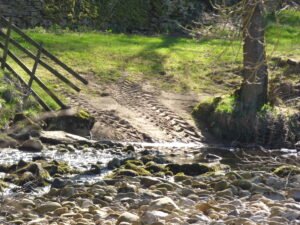
In the field of Bridge Barn, close to Nathwaite Bridge, there are two fords marked on the OS Series 1 map. This site page holds the details of our investigation into the fording point we think may be called Intach Ford.
In the field of Bridge Barn, close to Nathwaite Bridge, there are two fords marked on the OS Series 1 map. This site page holds the details of our investigation into the fording point we think may be called Intach Ford.
May 20
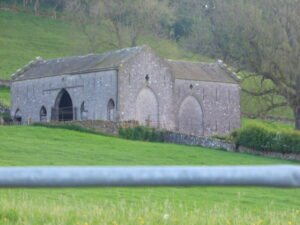
Even in a rural community of mainly farmers, there are often reasons to wish to build or create a structure that is for, at least in part, for defensive purposes. Thus, some barns in Yorkshire and other places can be seen to have “arrow slits”, and later, square “gun ports”. This article provides a brief overview of what these structures are, why they were built and how they were used.
May 20
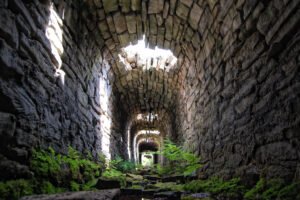
Coverdale never possessed the thick, profitable seams that powered the great Yorkshire coalfield; instead it sat on the very feather-edge of the Yoredale Series where thin coal bands (18 – 50 cm) lie between the well-known limestone, sandstone and shale rhythms.
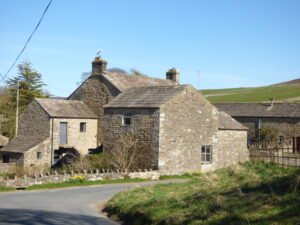
West Scrafton is a village located in Coverdale in the Yorkshire Dales. It sits on the southern upward slops of Coverdale, and had its most recent heyday in the 19th century when coal mining took over the village.

The Foresters Arms Inn in Carlton-in-Coverdale has a long history that reflects the local culture and community. Although there are some signs of interesting and possibly older masonry, it’s proximity to the motte/mound at the rear would indicate it to be largely a more recent addition to the village.
Feb 07
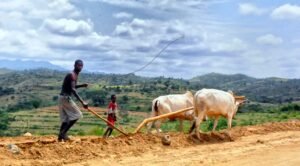
The ard, also known as a scratch plough, represents one of the earliest forms of agricultural technology used by the people of ancient Brigantia.
Jul 08

The Border Reivers were a formidable force in the history of Britain, particularly during the tumultuous period from the late 13th century to the early 17th century. These raiders, hailing from both Scottish and English descent, operated along the Anglo-Scottish border, a region marked by constant strife and conflict.
Jul 05

The Lawson-Tancred family, with its roots deeply embedded in English history, boasts several notable figures who have made significant contributions to their fields and society. The lineage of the family can be traced back to the Norman Conquest, with Richard Tankard, who owned lands at Boroughbridge in Yorkshire shortly after this pivotal event in English history.

The Morpeth Clock Tower, a distinguished landmark in Northumberland, stands as a testament to the town’s rich history. Constructed between 1604 and 1634
 NLS Map Explorer
 Google Earth
 Google Maps
 Lidar Finder
 TMA
TMA
 Megalithic Portal
 Yorkshire Arch. Air Mapping
 ADS
ADS
 Brigantian Adventure FB Group
Stone Bothering FB Group
Stone Faces FB Group
Brigantian Adventure FB Group
Stone Bothering FB Group
Stone Faces FB Group
 Heritage Gateway
 ARCHI® MAPS: UK
 Atlas of Hillforts
 Portable Antiquities
 British History Online
Brigantes Nation FB Group
British History Online
Brigantes Nation FB Group

