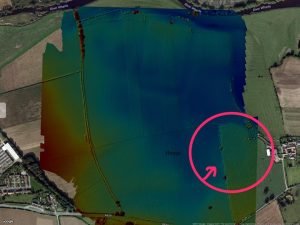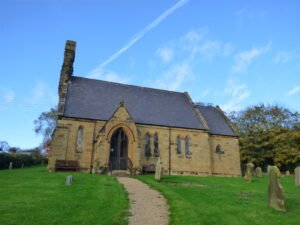
Boltby is a very important ancient site IMO. A gold “hair braid”, was found there, linking it to the Amesbury Archer, buried with two similar hair braids. This also provides a link to the founding of Stonehenge, which helps set a potential scene for a possible “zeitgeist”, of the day.
Period: Early Bronze Age
Nov 23
The Story of Boltby Scar
- Filed under Brigantes, Brigantia, Brigantia England, Britain, Bronze Age, Celtic Tribes, Defensive Dike, Defensive Walls, Dike, Europe, Fort, Hair Braid - Ring, Hill Fort, Iron Age, Landscape Archaeology, Linear Earthworks, Mining Landscape, Promontory fort, Stories of Brigantia
Long Meg and her Daughters standing stone and stone circle
- Filed under Agriculture, Archaeology, Medieval, Neolithic, ploughing, Stone Circle
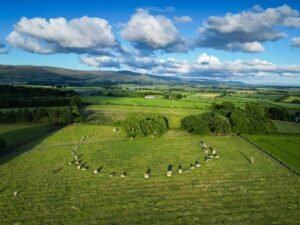
Long Meg and her Daughters is a remarkable Neolithic monument located near Penrith in Cumbria, England.
Wellhill, Dunning Early Neolithic Farm – Perthshire
- Filed under Agriculture, Early Neolithic, Field Systems, Mesolithic, Neolithic, New Sites, Norman, Pottery, Scotland
The village of Dunning in Perthshire, Scotland, has been revealed through excavation as having traces of human activity dating back 10,000 years. This included evidence of what could be the earliest farming activity recorded in Scotland so far, and also remains of hunter-gathering activity dating back to the Mesolithic period.
Kirkhaugh Cairns – Cumbria
- Filed under Barrow, Brigantia, Brigantia England, Britain, Bronze Age, Cairn, Europe, Finds, Funerary Urns, Hair Braid - Ring, Megalithic, Mining, New Sites, Rock Art
This mound is 22ft. in diam. and about 3ft high. It has been built upon a natural knoll which makes the barrow look larger than it is. Excavation showed that the mound has an earthy core with a rubble capping.
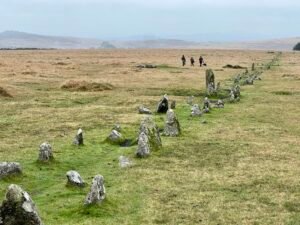
What might Stonehenge Mean? Dartmoor and Carnac add to the Picture
- Filed under Barrow, Bell Barrow, Britain, Bronze Age, France, Funerary Urns, Hair Braid - Ring, Landscape feature, Megalithic, Mining, Neolithic, News, Radiocarbon Dating, Smelting, Stone alignment, Stone Circle, Stone Row, Wales
Stonehenge has always been enigmatic, due to its use of those definitive morticed trilithons, all of which where squared of, more like the structures of the Maltese temples and other stone structures closer to Africa, as opposed to those of the rest of Britain and most of the wider North-west European ritual landscape.
- amesbury, Anglesey, archer, boltby, Boltby Scar, britain, Bronze Age, Carnac, Dartmoor, France, Gold Tresses, Great Orme, Hill Fort, Kirkhaugh, Llanymynech, Nabta Playa, nenthead, Neolithic, North Yorkshire, Parys Mountain, Powys, Rouslton Moor, Shropshire, Stonehenge, Tabular Hills, wales, Yorkshire Moors
- 4 comments
Oval Barrow east of Ulshaw Bridge
- Filed under Brigantia, Brigantia England, Burial Mound, Landscape feature, Long Barrow
This unexcavated and undated barrow matches many of other Late Neolithic / Early Bronze-Age round barrows (c. 2400–1500 BC) dotted along the flanks of the Yorkshire Dales.
Newton Kyme Henge
- Filed under Brigantia England, Class IIa, Henge, Neolithic
Newton Kyme Henge occupies a slight rise on the south bank of the River Wharfe immediately west of the village of Newton Kyme (OS grid SE 45945 44982), its maximum external diameter extending to around 250 m (heritagegateway.org.uk). The monument is best understood as a Class IIa henge of Late Neolithic–Early Bronze Age date, defined by three concentric ditch circuits with a turf-and-earth bank wedged between the inner and middle ditches.
Articles
- Bronze Age
- Iron Age
- Roman
- Dark Ages
- Early Christian
- Viking
- Saxon
- Medieval
- Vitrified Fort
- Archaeology Guide
- Guide – Introduction to Critical Thinking in Archaeological Research
- Guide – Challenging Assumptions with Free Thinking
- Guide – Congruence in Archaeological Interpretation: Holistic Analysis
- Guide – Critical Thinking: Lack of Evidence Does Not Mean Evidence of Lack
- Guide – Critical Thinking: The Simple Assumption
- Guide – Applying critical thinking to historic and archaeological research
- Guide – Empathic Archaeology Introduction
- Guide – Landscape Archaeology Introduction
- Guide – What is Landscape Archaeology?
- Guide – Introduction to Glacial Archaeology
- Guide – The Flora and Fauna of Prehistoric Britain
- Guide – Landscape Archaeology: Post-Ice Age Landscape of Thornborough
- Guide – Archaeological Periods in Western Europe
- Guide – Visible Remains
- Guide – Hidden Remains
- Guide – Getting Started
- Guide – Landscape Features
- Guide – Agricultural practices through time
- Guide – Introduction to Glacial Archaeology
- Guide: In Depth – Church Doors and Windows
- Guide – Mining
- Guide – Archaeological Terms
- Guide – Glossary
- Latin Translation – Choosing the meaning of AUG
- Reports
- An introduction to Brigantian Druidry
- Brigantia during the Dark Ages
- Celtic Heads
- Finding Bardon – An Arthurian Quest
- Early Christian syncretism and how the old ones hid amongst the new religion
- Rome: The Emperors Claim to Divinity
- Syncretism through the ages
- The Border Reivers
- The Gallus Frontier – Brigantia against the Romans
- The growth of Christianity 50AD – 1100AD
- The Kingdom of Venutius
- The use of the word Lady in relation to water related structures
- The walled gardens of Brigantia
- Yorkshire’s “Sacred Vale” – The Dawn of Brigantia
- Brigantia Espania
- Iberian Peninsular
- Galicia
- Biefing – The Myth of Breogán and the Tower of Heracles
- Briefing – Galicia’s Political History and Separatist Sentiment
- Briefing – Geography and Geology of Galicia
- Briefing – Design of Galician Hillforts
- Briefing – Roman Interaction with Galicia and the Iberian Peninsula
- Church of Santa María de Cambre, Cambre near A Coruña
Categories
- Agriculture (6)
- Field Systems (1)
- ploughing (2)
- Angle (2)
- Archaeological Periods (312)
- Anglo-saxon (6)
- Bronze Age (52)
- Late Bronze Age (1)
- Dark Ages (24)
- Dark Ages Brigantia (9)
- Early Christian (37)
- Early Medieval (8)
- Georgian (9)
- Gothic (3)
- Ice Age (1)
- Iron Age (133)
- Late Iron Age (5)
- Jacobite (7)
- Medieval (61)
- Medieval Brigantia (9)
- Mesolithic (11)
- Neolithic (45)
- Early Neolithic (5)
- Norman (40)
- Palaeolithic (6)
- Roman (94)
- Saxon (9)
- Stuart (6)
- Suspect (1)
- Tudor (10)
- Undated (7)
- Viking (4)
- Archaeology (93)
- Archaeobotanical (1)
- Empathic Archaeology (11)
- Free Thinking (7)
- Battle (1)
- Brigantia (147)
- Brigantia England (134)
- Brigantia Espania (11)
- Civil Structure (6)
- Defensive Structures (45)
- Castle (5)
- Defensive Dike (2)
- Defensive Walls (1)
- Fort (20)
- Fortified Barn (1)
- Marching Camp (5)
- Motte and Bailey (6)
- Ring Work (1)
- Class A (1)
- Dialects (1)
- Earthworks (51)
- Dike (8)
- Field Systems (26)
- Enclosure (12)
- Enclosure Acts (1)
- Europe (51)
- Festivals (2)
- Finds (42)
- Altar (10)
- Amphora (1)
- Animal Remains (4)
- Auroch (1)
- Hoof marks (1)
- Antler Pick (2)
- Arrowhead (1)
- Leaf-shaped (1)
- Axe (1)
- Bone Comb (1)
- Celtic Head (8)
- Celtic Head (2)
- Clock (1)
- Curse Tablet (1)
- Flint Scatters (4)
- Gaming Pieces (1)
- Hair Braid – Ring (4)
- Human Remains (2)
- Adult (1)
- Couched Burial (1)
- Juvinile (1)
- Mace Head (1)
- S-curved (1)
- Mosaic (1)
- Polished Stone Adze (1)
- Pottery (8)
- Funerary Urns (2)
- Grooved ware (1)
- Peterborough ware (1)
- Mortlake ware (1)
- Planig‑Friedberg ware (1)
- Samian ware (2)
- Vasi a Bocca Quadrata ware (1)
- Quern Stones (1)
- Statue (1)
- Geography (16)
- Maps (7)
- Geology (13)
- Anthracite – Coal (2)
- Geomorphology (2)
- Gods (9)
- Guide (72)
- Critical Thinking (8)
- Socratic Thought (1)
- Glossary (1)
- Hidden Remains (8)
- Geophysics (5)
- LiDAR (1)
- Radiocarbon Dating (1)
- Remote Sensing and Analysis (1)
- Regional Surveys (13)
- Research Tools (4)
- Visible Remains (12)
- Air Mapping (2)
- Air Photography (2)
- Fieldwalking (2)
- Lithics (1)
- Photography (6)
- Critical Thinking (8)
- Henge (18)
- Hill Fort (61)
- Castro Hillfort (3)
- Contour/Plateau Fort (1)
- Multivallete Hillfort (1)
- Oppidum (1)
- Oppidum (1)
- Promontory fort (4)
- Slavic Gord (1)
- Univallet Hillfort (4)
- Vitrified Fort (27)
- Historic Buildings (20)
- Amphitheatre (1)
- Barn (2)
- Beacon (1)
- Broch (1)
- Coaching Inn/Hostelry (1)
- Folly (4)
- Hall (2)
- Hospital (1)
- House (1)
- Tower (7)
- Walled Garden (1)
- Industrial Heritage (9)
- Chimney (1)
- Mining (9)
- Spoil Heap (1)
- Smelting (2)
- Iron-Age (1)
- Landscape Archaeology (38)
- Glacial Archaeology (2)
- Landscape Legislation (1)
- Mining Landscape (1)
- Ritual Landscape (6)
- Landscape feature (49)
- Barrow (18)
- Bell Barrow (2)
- Bowl Barrow (1)
- Cairn (2)
- Disc Barrow (1)
- Long Barrow (5)
- Ring Barrow (1)
- Ring Cairn (1)
- Round Barrow (1)
- Square Barrow (1)
- Steppe Kurgan (1)
- Boundary Marker (2)
- Burial Mound (9)
- Ceremonial Mount (1)
- Cursus (2)
- Hill Figure (5)
- Linear Earthworks (2)
- Mound (6)
- Passage Tomb (1)
- Ring Cairn (2)
- Snake Mound (1)
- Terraces (3)
- Barrow (18)
- Leaders (33)
- Agricola (2)
- Arthur (1)
- Augustus Caesar (2)
- Breogans (3)
- Caratacus (1)
- Cnut (1)
- Julius Caesar (1)
- Petilius Cerialis (1)
- Liminal Spaces (1)
- Market (1)
- Megalithic (10)
- Rock Art (3)
- Stone alignment (1)
- Stone Circle (7)
- stone circles (1)
- Stone Row (2)
- Myth and Legend (5)
- New Sites (23)
- Publications (21)
- Biographies (2)
- Henge Capital of Britain (10)
- News (4)
- Stories of Brigantia (4)
- Walking Guides (1)
- Rabbit Warren (1)
- Religious Structures (31)
- Abbey (3)
- Church (24)
- Crosses (1)
- Memorial Planting (1)
- Priory (2)
- Religious Orders (3)
- Ritual walkway/pilrimage path (1)
- Reports (148)
- Roman Culture (11)
- Roman army (8)
- Roman baths (1)
- Roman City (1)
- Roman Gods (1)
- Mercury (1)
- Roman navy (1)
- Roman pottery (3)
- Samian ware (2)
- Roman Road (1)
- Roman Roads (2)
- Roman Villa (2)
- The Celtic World (35)
- Celtic Gods (1)
- Lugh (1)
- Celtic Industry (1)
- Celtic Life (9)
- Celtic Trade (1)
- Celtic Tribes (27)
- Celtic Gods (1)
- Trade (4)
- Minting (3)
- Coins (1)
- Spoil Heaps (2)
- Minting (3)
- Translation (7)
- Inscription (4)
- Latin (5)
- Uncategorized (24)
- Water Works (13)
Research Links
Heritage Gateway
Announcing: The Brigantian News!
- Roman Road to the West uncovered under Manchester Street 16 July 2025
- What might Stonehenge Mean? Dartmoor and Carnac add to the Picture 3 July 2025
- Megalithic Stone Monuments in France May Be Europe’s Oldest 1 July 2025
- Drumanagh Promontory Fort – First Ever Intact Roman Pot Found in Ireland 5 June 2025
Portable Antiquities News
Incomplete post-medieval copper alloy spoon, with most of the round-sectioned stem and the distal end of the bowl missing (non-recent breaks). The bowl is oval with a rat tail on the underside. Weight 3.51g. Extant length 34.1mm. [...]
Post-medieval copper alloy button consisting of a solid plano-convex head with a central nipple and an integral non-drilled loop. Cf. Read 2010 no. 228. Weight 1.66g. Diameter 9.6mm. Length 12.4mm. 16th century.Finder's no. HK6F45 [...]
Fragment of a probably kidney-shaped medieval copper alloy buckle consisting of part of the widened and angled outside edge, one side and one end of an iron bar within the rolled over end of the [...]
Rim sherd of a medieval to post-medieval cast copper alloy cooking vessel with old breaks. A copper alloy sheet repair patch is folded over the top and secured with one rolled sheet rivet. Only a [...]
A copper alloy fragment of a Roman hair pin dating to the Roman period (c. AD 100-200). The remains of the object consist of the head and partial shaft. The head is dome-shaped with a flat [...]
Post-medieval copper alloy finger ring with the D-sectioned hoop complete but quite recently broken and distorted. The bezel is in the form of a circular buckle frame, the pin of which is missing. Rather obscure [...]
A Gallo Belgic import broad-flan gold stater (22.23mm, 7.24g), left type, attributed to the Bellovaci (from the region of Oise, Picardy). Obverse: flamboyant wreathed bust, left. Reverse: horse, left, with charioteer. As ABC 4. [...]
Just over half of a post-medieval copper alloy double-looped buckle frame, both loops oval, with a pin groove on a pronounced knop on the extant edge. There are traces of white-metal coating. The breaks are [...]
A complete lead alloy musket shot dating to the Post Medieval period (c. AD 1600-1800). The object is sub-spherical in shape with a pitted surface. The shot has a light grey patina and does not appear to have impacted. As stated by [...]
Post-medieval iron spherical object, probably shot, with a heavily pitted surface. Very close in dimensions and weight to LVPL-FFB98B and NMS-02C1E8. Diameter 22 - 23mm, weight 38.15g. 17th - 19th century.Rather than being a martial [...]
Complete early post-medieval hooked tag of Read’s (2008) class E, type 8. The plate is scallop-shaped and the loop is square. The hook projects from the plate opposite the loop and tapers in width to [...]
Basal sherd with foot-ring of Oxfordshire-type red-slipped pottery bowl. Not a mortarium: although the central part of the interior surface is highly abraded and has lost all its slip, the upper and outer parts are [...]
Incomplete early post-medieval copper-alloy hooked strap or belt fitting. It consists of a relatively long plate, flat on both faces, with an incomplete circular or oval loop at one end and a narrowed strip, folded [...]
A complete copper alloy strap loop, of Medieval dating (AD 1200 to AD 1400).The strap loop is square in shape, with an attachment spike located centrally at the base. The top edge is slightly rounded, [...]
An incomplete copper alloy belt or strap mount dating to the Post Medieval period (c. AD 1500-1700). The object is formed of a flat octofoil plate: four wide lobes interspersed with four narrow lobes. One [...]
Two copper alloy Roman nummi of uncertain emperors (c. AD 300-402). The reverses of each are fused together with only the bust of each coin facing outwards. mints uncertain. Coins are bent out of shape. Overall [...]
An incomplete copper alloy Roman sestertius or as of an uncertain emperor (c. AD 43-260). [...] Reverse type depicting figure standing to right with cornucopia and second figure standing to left. Mint uncertain. The edge is heavily [...]
A Roman copper alloy probable radiate of an uncertain emperor (c. AD 260-296). [...] Reverse type and mint uncertain. Coin is extremely worn.Overall dimensions: 20.7mm in diameter, 1.6mm in thickness and 2.26g in weight. [...]
An incomplete copper alloy Roman nummus of an uncertain emperor (c. AD 296-402). [...] Reverse type depicting figure standing left. Mint uncertain. Coin is heavily chipped around the edge. Overall dimensions: 18.6mm in diameter, 2.6mm in [...]
An incomplete copper alloy Roman sestertius or as of an uncertain emperor (c. AD 43-260). [...] Reverse type depicting figure standing. Mint uncertain. The edge is heavily chipped. Overall dimensions: 31.2mm in diameter, 3.7mm in thickness [...]
Recent Articles and Site Pages
- The Story of Boltby Scar
- Swaledale
- Guide: Parliamentary-walls and the Northern Enclosures
- County Durham
- The hero archetype and Lugh
- Head One – St Michaels Church, Kirklington
- Long Meg and her Daughters standing stone and stone circle
- Cana Barn Henge
- Anciens Arsenaux Neolithic Settlement, Sion – Switzerland
- Gnaeus Julius Agricola
- Snake Iconography in the British Isles
- Wiltshire
- Liverpool Street Roman Road, Manchester
- South Street Long Barrow, Avebury
- Mamucium Roman Fort, Manchester
Locations
- Czechia (1)
- England (198)
- Bedfordshire (1)
- Cumbria (13)
- Dorset (2)
- Durham (9)
- East Yorkshire (1)
- Lancashire (7)
- North Derbyshire (8)
- North Yorkshire (118)
- Yorkshire Dales (4)
- Yorkshire Moors (1)
- Northumberland (9)
- Oxfordshire (2)
- Somerset (2)
- South Yorkshire (10)
- Staffordshire (3)
- West Yorkshire (7)
- Wiltshire (4)
- Europe (8)
- France (3)
- Germany (2)
- Global (3)
- Ireland (4)
- County Dublin (1)
- Scotland (21)
- Dumphries and Galloway (3)
- Grampian (4)
- Highlands (8)
- Perthshire (4)
- Tayside (3)
- Spain (4)
- Switzerland (1)
- Wales (4)