Category: Brigantia

Bishopdale

Bishopdale lies within the northern limb of the Askrigg Block, its underlying bedrock dominated by Carboniferous limestones with intermittent shales and sandstones of the Yoredale Series. The Great Scar Limestone, a thick, massive unit formed around 330 million years ago in a shallow tropical sea, underpins the dale’s steeper scarps and cliff lines, while the thinner-bedded limestones and intervening mudstones of the Yoredale Group create the characteristic terraced flanks on which many of Bishopdale’s field systems are laid out
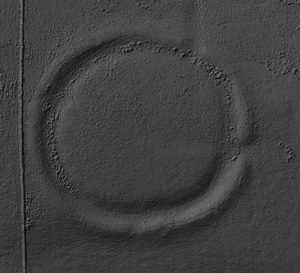
Castle Dykes Henge, Thoralby – North Yorkshire

With kind permission of YAAMAPPING

Castle dykes it is a small class one henge, 90m across, perched on the high ground up in the North Yorkshire dales. The bank survives up to 1.5 m high in places, and the ditch up to 3 m deep. Early 20th-century reports (1908) noted its intact form, and recent LiDAR-based surveys have confirmed its classic henge profile with minimal later disturbance.

Moulton Henge

Moulton Henge - 1m Lidar

Archaeologists now recognise a true Neolithic henge lying immediately south-west of Moulton village, roughly midway between the Swale and Dere Street. The monument is almost 200 m across, with a low earthen bank encircling an inner ditch and a central platform about 110 m wide; the ditch lies inside the bank—the classic “Class II” henge arrangement.

How Hill Hillfort, Swaledale

How Hill Downholme LIDAR

How Hill, near Downholme in North Yorkshire, is the site of a large univallate hillfort.

Brigantes Tribe

Thornborough Henges c.2004

The name Brigantia represents three separate concepts: a goddess, a people, and a tribal federation. By the Roman period, the name represented a tribal federation compromising all of what would become the Roman province of Britannia Secunda, except for the Parisi territory, east of the River Derwent.

Aldborough Roman Town

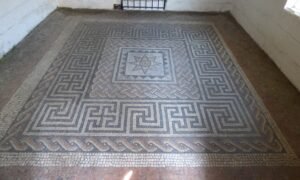
Aldborough Roman Town mosaic

Aldborough, or Isurium Brigantia as it was known in Roman times was the capital of Brigantia, at least from some point during Cartimandua’s acceptance as client Queen, governed by Rome. As such, it is a key site in our search for Brigantia

Mam Tor Hill Fort, Castleton, Derbyshire

Despite is unusually high position, this fort contains traces of a number of huts, and on investigation these have yielded plentiful pottery, as well as charcoal giving a surprisingly early radio carbon date

Coverdale: Nathwaite Bridge river crossing points

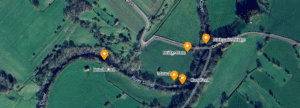
Fords and River crossings at Nathwaite Bridge Coverdale - Google satellite - Thanks to National Library of Scotland

Nathwaite Bridge, over the river Cover in Coverdale, is just about the only way any heavy traffic can easily cross between the key villages of Carlton and West Scrafton.  The importance of the location is perhaps underlined as the last place down the river Cover where it remains reasonably ford-able, and therefore crossable in past times when no closer bridge existed.

Guide: North Yorkshire Dialect Notes

The Yorkshire Dales, close to Kettlewell

Every region in Brigantia has its own accent and ways of speaking. North Yorkshire, being such a large county, has quite a significant variance in its dialects and this glossary may not be universally applicable in the whole of the region.

Cow Ford close to Nathwaite Bridge

Fords and River crossings at Nathwaite Bridge Coverdale - OS Series 1 - Thanks to National Library of Scotland

In the field of Bridge Barn, close to Nathwaite Bridge, there are two fords marked on the OS Series 1 map. This site page holds the details of our investigation into the fording point we think may be called Cow Ford.

Contact Us
close slider