Site Section: Global Heritage

Barry Hill Fort

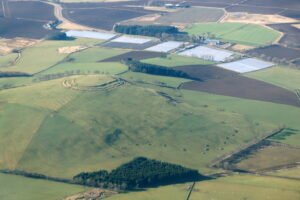
Hillfort on Hill of Barra, near Old Meldrum, from the air

Barry Hill is a textbook “big fort waiting for a small trench”: its spectacular vitrified rampart, enigmatic outer works and Arthurian folklore offer equal attraction to scientists and story-lovers—yet almost everything we know comes from surface survey. A single, well-designed excavation season could pivot the site from picturesque curiosity to a securely dated anchor point in the defensive story of eastern Scotland.
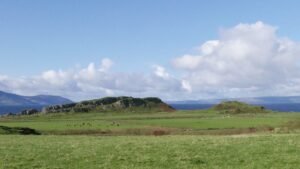
Dunagoil Hillfort, (Isle of Bute, Argyll & Bute)

Dunagoil Hillfort

Dunagoil crowns a 30 m-high columnar-basalt promontory on the south-west coast of Bute, overlooking the Sound of Bute and the Cumbraes. Cliffs on the north and west form natural ramparts; only the gentle ESE saddle gives easy access.

Vitrified Forts: Glossary of Terms

Glossary

This page holds our Glossary of Terms for Vitrified Forts.

Tap O’Noth Hill Fort

Tap O Noth Hillfort

This is one of the best examples of a vitrified fort, it is near the village of Rhynie in northeastern Scotland. This massive fort from prehistory is on the summit of a mountain of the same name which, being 1,859 feet (560 metres) high, commands an impressive view of the Aberdeenshire countryside.

Brigantes Tribe

Thornborough Henges c.2004

The name Brigantia represents three separate concepts: a goddess, a people, and a tribal federation. By the Roman period, the name represented a tribal federation compromising all of what would become the Roman province of Britannia Secunda, except for the Parisi territory, east of the River Derwent.

Aldborough Roman Town

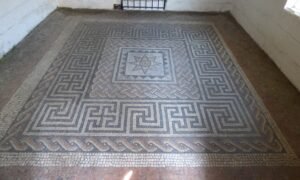
Aldborough Roman Town mosaic

Aldborough, or Isurium Brigantia as it was known in Roman times was the capital of Brigantia, at least from some point during Cartimandua’s acceptance as client Queen, governed by Rome. As such, it is a key site in our search for Brigantia

Mam Tor Hill Fort, Castleton, Derbyshire

Despite is unusually high position, this fort contains traces of a number of huts, and on investigation these have yielded plentiful pottery, as well as charcoal giving a surprisingly early radio carbon date

Farley Moor Stone Circle, Derbyshire

Farley Moor Standing Stone, now part of Farley Moor Stone Circle, thanks to Time Team. Image taken from their video, below.

Geophysics and three hand-excavated trenches uncovered ten further uprights, in addition to the known standing stone at Farley Moor Woods, lying just below the leaf-litter, defining a ring c. 18 m in diameter around the visible stone. A low stone-built platform or “kerb cairn” occupies the circle’s south-eastern arc; charcoal lenses and a smashed Collared-Urn sherd in its make-up gave an early Bronze-Age radiocarbon estimate of c. 1700 BCE (3,700 cal BP).

Hutton Rudby

Hutton Rudby

Hutton Rudby was once known as Hutton-juxta-Rudby, or Hutton-nigh-Rudby, because it is really two villages: Hutton and Rudby, separated from each other by the River Leven. How old is the village? There have been people living here for thousands of years. Stone Age tools have been found in North End.

John O’Gaunt’s Castle and Beaver Dyke – Harrogate

John OGaunts Castle - Harrogate 2025-02-06 222818

John O’Gaunt’s Castle, located near Harrogate in North Yorkshire, is a historical site with roots that intertwine myth, history, and medieval legend.

Contact Us
close slider