In a series of annual military campaigns Agricola put down revolts in north Wales, subdued the Brigantes tribe in the north, extended Roman control over the Scottish lowlands, where he established a string of forts between the Forth and the Clyde, sent troops into Galloway, and made inroads into the eastern Highlands. During the latter campaign his vessels were the first to circumnavigate the islands.
Period: 1st Century AD
Liverpool Street Roman Road, Manchester
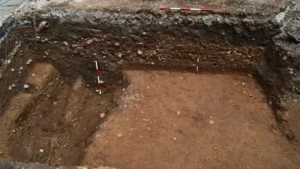
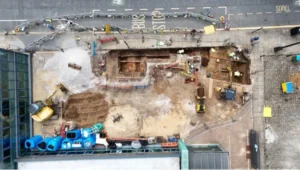
Archaeologists have exposed a well-preserved cambered Roman road surface in Manchester’s Castlefield area (Liverpool Road/Liverpool Street reporting), astonishingly only c. 15 inches (≈38–40 cm) below modern tarmac, with an assemblage of Romano-British pottery and other small finds broadly dating its active use to the 1st–3rd centuries AD.
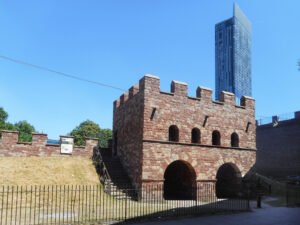
Mamucium Roman Fort, Manchester
Mamucium occupies a low sandstone promontory at the junction of the Rivers Medlock and Irwell. The bedrock is the Triassic Sherwood Sandstone Group, a firm, well‑drained red sandstone that gave Roman engineers a stable platform for earthworks and timber palisades, while nearby river gravels supplied road‑making aggregate.
Doncaster Roman Fort (Danum)
← South Yorkshire Roman Rig Defensive Works The Roman Rig is a defensive dyke built to defend against attack from the south. It runs from Sheffield, past Read more Templeborough Roman Fort – Rotherham Templeborough Roman Fort occupies a commanding position on the north bank of the River Don at Rotherham (OS grid SK Read …