

Sitting on the south‑east shoulder of Windmill Hill (grid ref. SU 086 070), 140 ft (43 m) above the Kennet valley, the Horslip long barrow commands the same chalk ridge that carries the famous Early‑Neolithic causewayed enclosure 400 m upslope.
Sitting on the south‑east shoulder of Windmill Hill (grid ref. SU 086 070), 140 ft (43 m) above the Kennet valley, the Horslip long barrow commands the same chalk ridge that carries the famous Early‑Neolithic causewayed enclosure 400 m upslope.
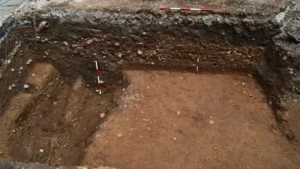
A stretch of Roman road just 38-40 cm (15 in) below Liverpool Road in Castlefield. The trench shows the classic Roman construction sequence – a cambered rubble core surfaced with tightly packed cobbles – and runs on a north-east/south-west alignment that leaves Mamucium’s north gate and heads towards modern Salford.

The village of Dunning in Perthshire, Scotland, has been revealed through excavation as having traces of human activity dating back 10,000 years. This included evidence of what could be the earliest farming activity recorded in Scotland so far, and also remains of hunter-gathering activity dating back to the Mesolithic period.

This mound is 22ft. in diam. and about 3ft high. It has been built upon a natural knoll which makes the barrow look larger than it is. Excavation showed that the mound has an earthy core with a rubble capping.
Stonehenge has always been enigmatic, due to its use of those definitive morticed trilithons, all of which where squared of, more like the structures of the Maltese temples and other stone structures closer to Africa, as opposed to those of the rest of Britain and most of the wider North-west European ritual landscape.

RTE Ireland has reported that more recently they have made yet another remarkable discovery—an intact Roman pot. the first one to be uncovered on Irish soil, and providing more tantalising clues about ancient Roman-Irish interactions.
Although the Roman Empire they never reached Ireland (except, seemingly, in myth). That does not mean, that Roman influence and goods did enter Ireland, and it means that Drumanagh continues to headline as one of Irelands most tantalising archaeological sites for that same reason – exactly what were the Romans doing in Ireland?
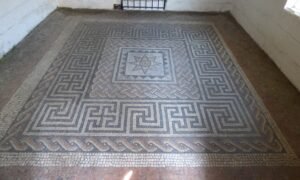
Aldborough, or Isurium Brigantia as it was known in Roman times was the capital of Brigantia, at least from some point during Cartimandua’s acceptance as client Queen, governed by Rome. As such, it is a key site in our search for Brigantia
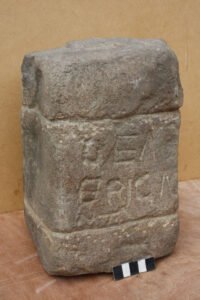
‘To the god Bregneus I give the axe which I have lost from my house, (the house) of Hegemon. […] has stolen, he is not to be permitted sleep or health (until) he has brought it to your temple as we ?arrange. The hammer which I previously lost, it also […] ?I give.’
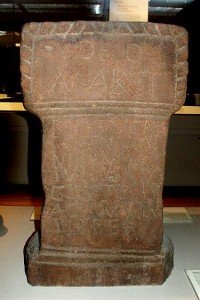
Altar dedicated to Bregans and the Divinity of the Emperor
‘The goddess Brigantia.’
 NLS Map Explorer
 Google Earth
 Google Maps
 Lidar Finder
 TMA
TMA
 Megalithic Portal
 Yorkshire Arch. Air Mapping
 ADS
ADS
 Brigantian Adventure FB Group
Stone Bothering FB Group
Stone Faces FB Group
Brigantian Adventure FB Group
Stone Bothering FB Group
Stone Faces FB Group
 Heritage Gateway
 ARCHI® MAPS: UK
 Atlas of Hillforts
 Portable Antiquities
 British History Online
Brigantes Nation FB Group
British History Online
Brigantes Nation FB Group

