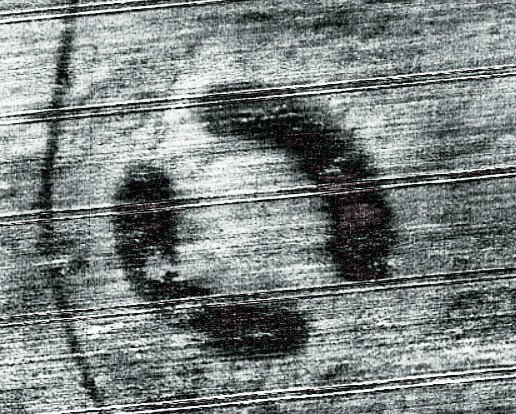
Newton Kyme Henge occupies a slight rise on the south bank of the River Wharfe immediately west of the village Read more
Castlerigg stone circle is one of the oldest and most scenic megalithic monuments in Britain, dating back to the late Neolithic period, around 3000 BC (English Heritage, n.d.). It consists of 38 stones arranged in a flattened circle, with a rectangular enclosure of 10 stones inside it. The circle is located on a plateau near Keswick, Cumbria, overlooking the Thirlmere Valley and surrounded by the mountains of Helvellyn and High Seat. The purpose and function of the stone circle are not fully understood, but it may have served as a meeting place, a trading centre, or a religious site for the Neolithic communities in the Lake District (English Heritage, n.d.). The site has also been associated with astronomical alignments, although there is no conclusive evidence for this (Wikipedia, 2021). Castlerigg stone circle is a remarkable example of the megalithic tradition that flourished in Britain and Brittany between 3200 BC and 2500 BC, and reflects the cultural and social complexity of the early farmers who built it (Archaeology Magazine, 2020).
A Medieval silver penny of Edward I (AD 1272-1307). Class 1c (North 1012) dating to AD 1279. London mint. North (1991: 28). Overall dimensions: 18.2mm in diameter, 0.6mm in thickness and 1.23g in weight. [...]
A Post Medieval silver penny of Elizabeth I (AD 1558-1603). Uncertain initial mark and issue (North 1988, 2001, or 2017. London mint. North (1991: 133-137). Coin has been bent into a V-shape and has cracked [...]
A group of two lead alloy weights, most likely dating to the post medieval period (c.AD 1600-1800), all found in the same field. WA Number Outside Diameter mm Inside Diameter mm Thickness mm Weight grams [...]
A group of two lead alloy weights, most likely dating to the post medieval period (c.AD 1600-1800), all found in the same field. WA Number Outside Diameter (mm) Inside Diameter (mm) Thickness (mm) Weight (g) [...]
A group of five lead alloy shot dating to the post medieval period (c.AD 1600-1800), all found in the same field. WA Number Diameter (mm) Weight (g) Comments 5589 17.4 31.8 Visible sprue and seam. [...]
A group of two lead alloy shot dating to the post medieval period (c.AD 1600-1800). WA No. Length Diameter Weight Comments 5543 15.2 9.3 8.1 Small bullet. Three grooves around circumference 5594 9.2 4.8 Cream [...]
Silver coin. Worn long cross penny on a markedly oval flan, probably later medieval issue, perhaps of 1422-1485, probably York mint. Obverse description: facing bust with tall splayed bifoliate open crown whose ornaments appear to [...]
A square biface lead weight depicting a Chi-rho / shield of uncertain age, probably dating to the Late Medieval to Post Medieval period.Sub-square in plan with bevelled edges. One face has a linear depiction of [...]
Copper alloy brooch fragment. Cast headstud brooch, Mackreth type Headstud 5.a. A tubular case retaining the axis bar for a hinged pin [lost] is masked by short wings with two vertical ridges apiece; the stubs [...]
Copper alloy seal matrix. Cast octagonal tapered ‘chess piece’ seal matrix with a collared oval top loop and a circular face. The matrix bears the image of a cockerel with long curling tail feathers facing [...]
Copper alloy brooch, as kindly identified by the finder. A small cast Colchester brooch, probably Mackreth type C 4. A small brooch with the stub of a forward pointing loop and tiny oval wings at [...]
A heavily worn copper-alloy Nuremburg rose/orb jetton of Hans Kravwinckel II dating to c.1586-1635.Obverse: alternating crowns and lis around central rose. Inscription: HANNS KRAVWINCKEL IN NVR. Reverse: orb surmounted by a cross within a three [...]
Silver coin. Republican denarius, as kindly identified by the finder, very worn, issue of Calpurnius Piso Frugis [which one is uncertain], probably issue of 90-67BC, Reece period 1Obverse description: Helmeted head of Roma right, small [...]
Base metal plated denarius or forgery, as kindly identified by the finder, of Plautilla (202-205), Reece period 10Obverse description: bust coiffed and draped rightObverse inscription: PLAVTILLA AVGVS[TA]Reverse description: facing figure with propped hoplon shield lower [...]
A Medieval silver cut farthing of John (AD 1199-1216). Class 5b2 (North 970) dating to AD 1204-1209. Mint and moneyer uncertain. North (1994: 221).Overall dimensions: 8.4mm in length, 9.9mm in width, 0.5mm in thickness and [...]
Copper alloy token. Milled halfpenny token issue of 1650-1671, possibly 1668Obverse description: wire-drawn circle with text over three lines: THEIR/HALF/PENYObverse inscription: *GABRIEL[---]ORDReverse description: Tudor-style rose within circleReverse inscription: *HOL[--]?OL?[--]This partial rendition elicited further information as [...]
A complete Iron Age gold stater of the East Wiltshire region, dating to the period 50-20 BC. Savernake Forest type. Plain obverse. Reverse: skinny horse right, pellet mane, solar spiral above and large wheel below, torc motif in front [...]
Copper alloy brooch fragment. The bow and foot of a cast Colchester brooch, Mackreth type C 2. A thin bow of plain rounded section tapers to its foot end where an integral unpierced catch plate [...]
Copper alloy brooch. Cast rear-hook fastening Colchester derivative brooch, cf. Mackreth types CD RH 5.c/?5.i. Plain semi-circular wings with a central blob of solder in the gutter formerly retained a spring [now lost] assisted by [...]

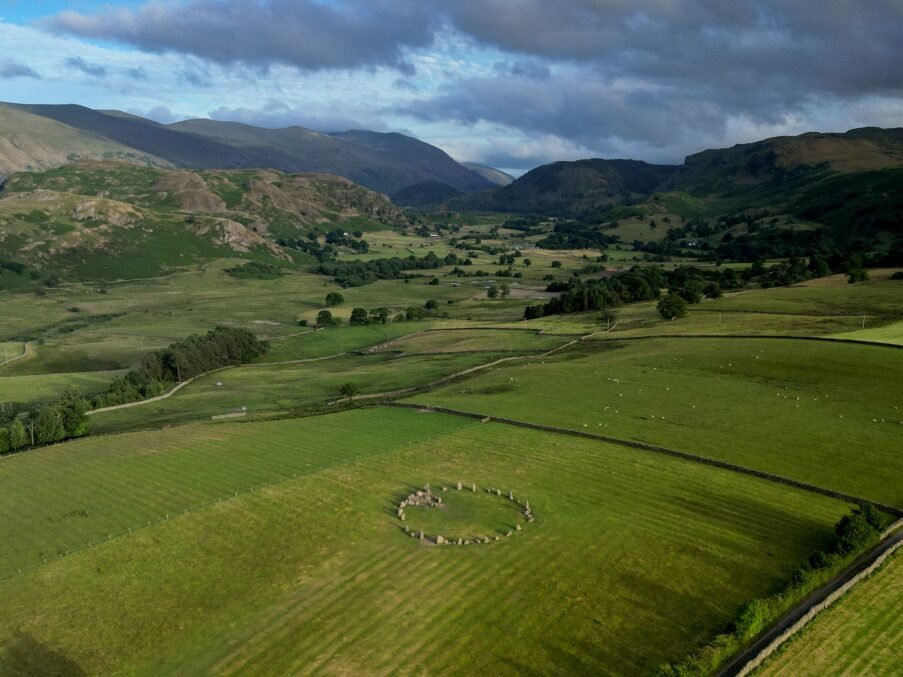





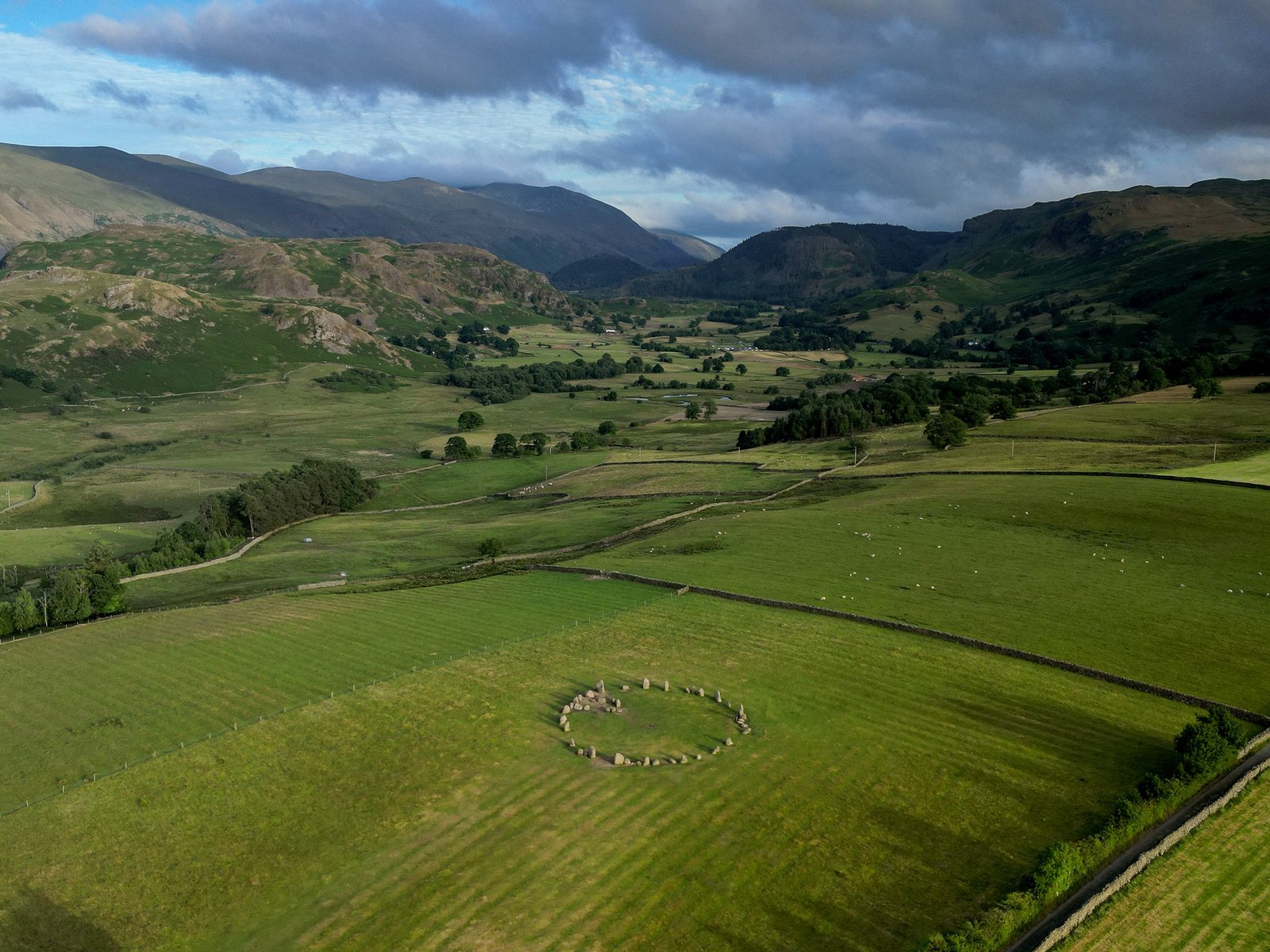 Castlerigg stone circle is one of the oldest and most scenic megalithic monuments in Britain, dating back to the late Neolithic period, around 3000 BC (English Heritage, n.d.). It consists of 38 stones arranged in a flattened circle, with a rectangular enclosure of 10 stones inside it. The circle is located on a plateau near Keswick, Cumbria, overlooking the Thirlmere Valley and surrounded by the mountains of Helvellyn and High Seat.
  The purpose and function of the stone circle are not fully understood, but it may have served as a meeting place, a trading centre, or a religious site for the Neolithic communities in the Lake District (English Heritage, n.d.). The site has also been associated with astronomical alignments, although there is no conclusive evidence for this (Wikipedia, 2021). Castlerigg stone circle is a remarkable example of the megalithic tradition that flourished in Britain and Brittany between 3200 BC and 2500 BC, and reflects the cultural and social complexity of the early farmers who built it (Archaeology Magazine, 2020).