
Despite is unusually high position, this fort contains traces of a number of huts, and on investigation these have yielded plentiful pottery, as well as charcoal giving a surprisingly early radio carbon date
Blog Archive
Lady Hill, East Scrafton – Coverdale
- Filed under Memorial Planting, Mound, Rabbit Warren
Located in East Scrafton, a small hill called Lady Hill is marked on the OS Series 1 map. The term “Lady” is of interest, since it has been used elsewhere in sites that appear important for religious purposes.
Cow Ford close to Nathwaite Bridge
- Filed under Archaeology, Brigantia England, Ford, Medieval, Medieval Brigantia
In the field of Bridge Barn, close to Nathwaite Bridge, there are two fords marked on the OS Series 1 map. This site page holds the details of our investigation into the fording point we think may be called Cow Ford.
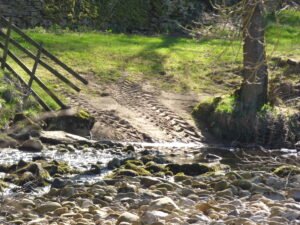
Intach Ford: Upstream of Nathwaite Bridge, Coverdale
- Filed under Brigantia England, Ford, Georgian, Jacobite, Medieval, Medieval Brigantia, Norman, Stuart, Tudor
In the field of Bridge Barn, close to Nathwaite Bridge, there are two fords marked on the OS Series 1 map. This site page holds the details of our investigation into the fording point we think may be called Intach Ford.
Mound in field of Bridge Barn, Nathwaite Bridge
- Filed under Archaeology, Brigantia England, Mound
Located in the same field as Bridge Barn, close to the Cow Ford, there is a mound. In may be around 4-5m in diameter and perhaps 1.5-2m high. Our initial search drew a blank as to what it may be. But it’s proximity to Cow Ford suggests it may have a mining, or masonic origin.
Nathwaite Bridge – Coverdale
- Filed under Bridge, Georgian, Regional Surveys
Nathwaite bridge over the River Cover is a strategically placed river crossing, for centuries it has been the only crossing point over the river Cover, and with a fortified barn right next door to it, this is an enigmatic site worthy of closer attention.
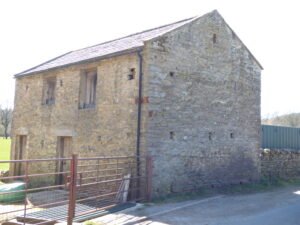
Bridge Barn just south-east of Nathwaite Bridge – Coverdale
- Filed under Barn, Brigantia England
The barn that is located closest to Nathwaite Bridge seems important, but is poorly understand and recorded. It’s position, in close proximity to the bridge, together with three arrow-slot style defensive features indicate it may have served to protect the Carlton side of the river from raiders, and is in a perfect position, strategically. Yet, it is not recorded as such, and may be later in its creation, as it does not appear on some earlier maps.
Farley Moor Stone Circle, Derbyshire
- Filed under Brigantia England, Bronze Age, Stone Circle
Geophysics and three hand-excavated trenches uncovered ten further uprights, in addition to the known standing stone at Farley Moor Woods, lying just below the leaf-litter, defining a ring c. 18 m in diameter around the visible stone. A low stone-built platform or “kerb cairn” occupies the circle’s south-eastern arc; charcoal lenses and a smashed Collared-Urn sherd in its make-up gave an early Bronze-Age radiocarbon estimate of c. 1700 BCE (3,700 cal BP).
Brigantia Espania
- Filed under Brigantia Espania, Geography, Geology, Landscape Archaeology, Portugal, Spain
Brigantia Espania is our name for our Spanish Brigantian research pages and sites. This is the beginning of our journey, and we start at the beginning.
Hutton Rudby
- Filed under Bronze Age, Early Christian, Medieval, Regional Surveys, Roman, Village
Hutton Rudby was once known as Hutton-juxta-Rudby, or Hutton-nigh-Rudby, because it is really two villages: Hutton and Rudby, separated from each other by the River Leven. How old is the village? There have been people living here for thousands of years. Stone Age tools have been found in North End.
Articles
- Bronze Age
- Iron Age
- Roman
- Dark Ages
- Early Christian
- Viking
- Saxon
- Medieval
- Vitrified Fort
- Archaeology Guide
- Guide – Introduction to Critical Thinking in Archaeological Research
- Guide – Challenging Assumptions with Free Thinking
- Guide – Congruence in Archaeological Interpretation: Holistic Analysis
- Guide – Critical Thinking: Lack of Evidence Does Not Mean Evidence of Lack
- Guide – Critical Thinking: The Simple Assumption
- Guide – Applying critical thinking to historic and archaeological research
- Guide – Empathic Archaeology Introduction
- Guide – Landscape Archaeology Introduction
- Guide – What is Landscape Archaeology?
- Guide – Introduction to Glacial Archaeology
- Guide – The Flora and Fauna of Prehistoric Britain
- Guide – Landscape Archaeology: Post-Ice Age Landscape of Thornborough
- Guide – Archaeological Periods in Western Europe
- Guide – Visible Remains
- Guide – Hidden Remains
- Guide – Getting Started
- Guide – Landscape Features
- Guide – Agricultural practices through time
- Guide – Introduction to Glacial Archaeology
- Guide: In Depth – Church Doors and Windows
- Guide – Mining
- Guide – Archaeological Terms
- Guide – Glossary
- Latin Translation – Choosing the meaning of AUG
- Reports
- An introduction to Brigantian Druidry
- Brigantia during the Dark Ages
- Celtic Heads
- Finding Bardon – An Arthurian Quest
- Early Christian syncretism and how the old ones hid amongst the new religion
- Rome: The Emperors Claim to Divinity
- Syncretism through the ages
- The Border Reivers
- The Gallus Frontier – Brigantia against the Romans
- The growth of Christianity 50AD – 1100AD
- The Kingdom of Venutius
- The use of the word Lady in relation to water related structures
- The walled gardens of Brigantia
- Yorkshire’s “Sacred Vale” – The Dawn of Brigantia
- Brigantia Espania
- Iberian Peninsular
- Galicia
- Biefing – The Myth of Breogán and the Tower of Heracles
- Briefing – Galicia’s Political History and Separatist Sentiment
- Briefing – Geography and Geology of Galicia
- Briefing – Design of Galician Hillforts
- Briefing – Roman Interaction with Galicia and the Iberian Peninsula
- Church of Santa María de Cambre, Cambre near A Coruña
Categories
- Agriculture (6)
- Field Systems (1)
- ploughing (2)
- Angle (2)
- Archaeological Periods (312)
- Anglo-saxon (6)
- Bronze Age (52)
- Late Bronze Age (1)
- Dark Ages (24)
- Dark Ages Brigantia (9)
- Early Christian (37)
- Early Medieval (8)
- Georgian (9)
- Gothic (3)
- Ice Age (1)
- Iron Age (133)
- Late Iron Age (5)
- Jacobite (7)
- Medieval (61)
- Medieval Brigantia (9)
- Mesolithic (11)
- Neolithic (45)
- Early Neolithic (5)
- Norman (40)
- Palaeolithic (6)
- Roman (94)
- Saxon (9)
- Stuart (6)
- Suspect (1)
- Tudor (10)
- Undated (7)
- Viking (4)
- Archaeology (93)
- Archaeobotanical (1)
- Empathic Archaeology (11)
- Free Thinking (7)
- Battle (1)
- Brigantia (147)
- Brigantia England (134)
- Brigantia Espania (11)
- Civil Structure (6)
- Defensive Structures (45)
- Castle (5)
- Defensive Dike (2)
- Defensive Walls (1)
- Fort (20)
- Fortified Barn (1)
- Marching Camp (5)
- Motte and Bailey (6)
- Ring Work (1)
- Class A (1)
- Dialects (1)
- Earthworks (51)
- Dike (8)
- Field Systems (26)
- Enclosure (12)
- Enclosure Acts (1)
- Europe (51)
- Festivals (2)
- Finds (42)
- Altar (10)
- Amphora (1)
- Animal Remains (4)
- Auroch (1)
- Hoof marks (1)
- Antler Pick (2)
- Arrowhead (1)
- Leaf-shaped (1)
- Axe (1)
- Bone Comb (1)
- Celtic Head (8)
- Celtic Head (2)
- Clock (1)
- Curse Tablet (1)
- Flint Scatters (4)
- Gaming Pieces (1)
- Hair Braid – Ring (4)
- Human Remains (2)
- Adult (1)
- Couched Burial (1)
- Juvinile (1)
- Mace Head (1)
- S-curved (1)
- Mosaic (1)
- Polished Stone Adze (1)
- Pottery (8)
- Funerary Urns (2)
- Grooved ware (1)
- Peterborough ware (1)
- Mortlake ware (1)
- Planig‑Friedberg ware (1)
- Samian ware (2)
- Vasi a Bocca Quadrata ware (1)
- Quern Stones (1)
- Statue (1)
- Geography (16)
- Maps (7)
- Geology (13)
- Anthracite – Coal (2)
- Geomorphology (2)
- Gods (9)
- Guide (72)
- Critical Thinking (8)
- Socratic Thought (1)
- Glossary (1)
- Hidden Remains (8)
- Geophysics (5)
- LiDAR (1)
- Radiocarbon Dating (1)
- Remote Sensing and Analysis (1)
- Regional Surveys (13)
- Research Tools (4)
- Visible Remains (12)
- Air Mapping (2)
- Air Photography (2)
- Fieldwalking (2)
- Lithics (1)
- Photography (6)
- Critical Thinking (8)
- Henge (18)
- Hill Fort (61)
- Castro Hillfort (3)
- Contour/Plateau Fort (1)
- Multivallete Hillfort (1)
- Oppidum (1)
- Oppidum (1)
- Promontory fort (4)
- Slavic Gord (1)
- Univallet Hillfort (4)
- Vitrified Fort (27)
- Historic Buildings (20)
- Amphitheatre (1)
- Barn (2)
- Beacon (1)
- Broch (1)
- Coaching Inn/Hostelry (1)
- Folly (4)
- Hall (2)
- Hospital (1)
- House (1)
- Tower (7)
- Walled Garden (1)
- Industrial Heritage (9)
- Chimney (1)
- Mining (9)
- Spoil Heap (1)
- Smelting (2)
- Iron-Age (1)
- Landscape Archaeology (38)
- Glacial Archaeology (2)
- Landscape Legislation (1)
- Mining Landscape (1)
- Ritual Landscape (6)
- Landscape feature (49)
- Barrow (18)
- Bell Barrow (2)
- Bowl Barrow (1)
- Cairn (2)
- Disc Barrow (1)
- Long Barrow (5)
- Ring Barrow (1)
- Ring Cairn (1)
- Round Barrow (1)
- Square Barrow (1)
- Steppe Kurgan (1)
- Boundary Marker (2)
- Burial Mound (9)
- Ceremonial Mount (1)
- Cursus (2)
- Hill Figure (5)
- Linear Earthworks (2)
- Mound (6)
- Passage Tomb (1)
- Ring Cairn (2)
- Snake Mound (1)
- Terraces (3)
- Barrow (18)
- Leaders (33)
- Agricola (2)
- Arthur (1)
- Augustus Caesar (2)
- Breogans (3)
- Caratacus (1)
- Cnut (1)
- Julius Caesar (1)
- Petilius Cerialis (1)
- Liminal Spaces (1)
- Market (1)
- Megalithic (10)
- Rock Art (3)
- Stone alignment (1)
- Stone Circle (7)
- stone circles (1)
- Stone Row (2)
- Myth and Legend (5)
- New Sites (23)
- Publications (21)
- Biographies (2)
- Henge Capital of Britain (10)
- News (4)
- Stories of Brigantia (4)
- Walking Guides (1)
- Rabbit Warren (1)
- Religious Structures (31)
- Abbey (3)
- Church (24)
- Crosses (1)
- Memorial Planting (1)
- Priory (2)
- Religious Orders (3)
- Ritual walkway/pilrimage path (1)
- Reports (148)
- Roman Culture (11)
- Roman army (8)
- Roman baths (1)
- Roman City (1)
- Roman Gods (1)
- Mercury (1)
- Roman navy (1)
- Roman pottery (3)
- Samian ware (2)
- Roman Road (1)
- Roman Roads (2)
- Roman Villa (2)
- The Celtic World (35)
- Celtic Gods (1)
- Lugh (1)
- Celtic Industry (1)
- Celtic Life (9)
- Celtic Trade (1)
- Celtic Tribes (27)
- Celtic Gods (1)
- Trade (4)
- Minting (3)
- Coins (1)
- Spoil Heaps (2)
- Minting (3)
- Translation (7)
- Inscription (4)
- Latin (5)
- Uncategorized (24)
- Water Works (13)
Research Links
Heritage Gateway
Announcing: The Brigantian News!
- Roman Road to the West uncovered under Manchester Street 16 July 2025
- What might Stonehenge Mean? Dartmoor and Carnac add to the Picture 3 July 2025
- Megalithic Stone Monuments in France May Be Europe’s Oldest 1 July 2025
- Drumanagh Promontory Fort – First Ever Intact Roman Pot Found in Ireland 5 June 2025
Portable Antiquities News
A complete Roman copper-alloy nummus of House of Constantine (AD 306-361), dating to the period AD 330-335 (Reece Period 17). GLORIA EXERCITVS reverse type depicting two soldiers, standing facing each other, each holding spear in outer hand and resting inner [...]
Copper alloy possible stirrup mount fragment [MF]. Urnes style fragment with incised decoration. Lead corrosion products on reverse. Suggested date: Early Medieval, 1000-1100Length: 32.5mm, Width: 11.6mm, Thickness: 3.7mm [...]
A copper-alloy token farthing of James I (1603-25) Harrington type 2, dating to c.1613-14. Reverse privy-mark : mullet. Cf. North (1991) vol 2, p.149, no.2132.Diameter 14.5mm, thickness 0.7mm, weight 0.4g. [...]
Rectangular copper plate with incised lines. Traces of silver coloured material on back, possibly solder. Suggested date: probably Early Medieval, 700-850Length: 28.6mm, Width: 16.5mm, Thickness: 1.1mm [...]
An incomplete Medieval copper-alloy strap end with integral box chape, dating to circa AD 1200–1400. The surviving element comprises the rectangular-sectioned, trapezoidal box chape, which would originally have enclosed the end of a leather strap. [...]
A Medieval silver farthing of Edward I (AD 1272-1307), Withers Type 12, North Class 3d-f, dating to AD 1280. Mint of London. Ref: Withers and Withers 2001: 22. [...]
An unidentified copper-alloy decorative mount or fitting, likely Post Medieval date. The object is flat and cast, with a symmetrical T-shaped/anchor-like outline, comprising a transverse upper bar with two rounded lobes and a central projection [...]
An incomplete Roman copper-alloy headstud brooch dating to c. AD 75–200. The brooch is heavily worn and missing the decorative loop, the outer edges of the wings, the foot and the pin. The wings are [...]
An incmplete Iron Age to Roman copper-alloy penannular brooch dating to circa AD 1-100. It has a rectangular-sectioned frame. The frame is decorated with an incised groove running allong the outer and in edge. The [...]
A Roman copper-alloy radiate or nummus of an uncertain ruler dating to circa AD 260-402. Uncertain reverse type. Unclear mint. [...]
A Roman copper-alloy radiate of an uncertain Gallic ruler dating to circa AD 270-273 (Reece Period 13). PIETAS AVGVSTORVM reverse type depicting a collection of priestly implements. Unclear mint. [...]
A Roman copper-alloy radiate of Carausius (AD 286-293) dating to circa AD 286-293 (Reece Period 14). Unclear reverse type. Unclear mint. [...]
A Roman copper-alloy nummus of the House of Constantine (AD 306-364) dating to circa AD 330-335 (Reece Period 17). GLORIA EXERCITVS reverse type depicting two soldiers holding two standard. Unclear mint. [...]
An incomplete Medieval copper-alloy strap end dating to circa AD 1150-1450. A composite strap end, it comprises a forked spacer with an integral acorn-knop terminal and one remaining sheet plate on the reverse, held in [...]
An incomplete Early Medieval copper-alloy trefoil brooch dating to circa AD 850-1050. The extant elements of the brooch consists three partially complete arms, central element and on the reverse a small portion of the double [...]
A cast lead 27.8g (c.1 oz) disc weight of an uncertain age, but probably dating to the Post-Medieval period.Sub-circular and flat with no official markings on the weight. The surface has several scrapes and displays a light buff colour.Diameter 29.4mm, thickness [...]
A cast pewter double loop annular shoe buckle, 22.2mm in diameter and of late medieval to early post medieval date (c. 15th-16th century). The frame has a beaded rim. The strap bar has a worn notch at [...]
A post Medieval copper alloy trader's farthing issued in Postern Gate (Cripplegate), London. Obverse: a bell, AT. THE. YEARNE. SHOP. Reverse: D • C, AT • THE • POSTERN • GATE. As Williamson (London) 2261. [...]
An incomplete cast copper alloy Roman Colchester derivative brooch of the Harlow double-lug type, dating from c. AD 20-100. The wings, which are C-shaped in section, the spring and approximately half of the bow survive; [...]
A fragment of a cast copper alloy button probbly of post-medieval date. The button has a simple line around the outer edge; no other decoration is visible. The reverse is slightly concaved and the edge [...]
Recent Articles and Site Pages
- The Story of Boltby Scar
- Swaledale
- Guide: Parliamentary-walls and the Northern Enclosures
- County Durham
- The hero archetype and Lugh
- Head One – St Michaels Church, Kirklington
- Long Meg and her Daughters standing stone and stone circle
- Cana Barn Henge
- Anciens Arsenaux Neolithic Settlement, Sion – Switzerland
- Gnaeus Julius Agricola
- Snake Iconography in the British Isles
- Wiltshire
- Liverpool Street Roman Road, Manchester
- South Street Long Barrow, Avebury
- Mamucium Roman Fort, Manchester
Locations
- Czechia (1)
- England (198)
- Bedfordshire (1)
- Cumbria (13)
- Dorset (2)
- Durham (9)
- East Yorkshire (1)
- Lancashire (7)
- North Derbyshire (8)
- North Yorkshire (118)
- Yorkshire Dales (4)
- Yorkshire Moors (1)
- Northumberland (9)
- Oxfordshire (2)
- Somerset (2)
- South Yorkshire (10)
- Staffordshire (3)
- West Yorkshire (7)
- Wiltshire (4)
- Europe (8)
- France (3)
- Germany (2)
- Global (3)
- Ireland (4)
- County Dublin (1)
- Scotland (21)
- Dumphries and Galloway (3)
- Grampian (4)
- Highlands (8)
- Perthshire (4)
- Tayside (3)
- Spain (4)
- Switzerland (1)
- Wales (4)

