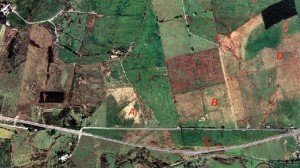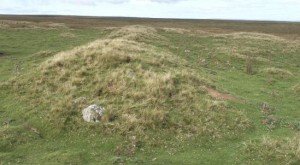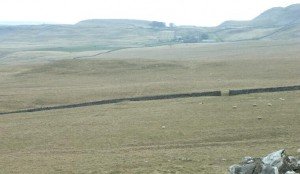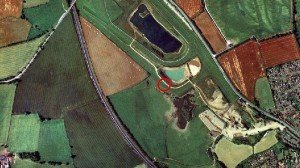
The henge at Catterick racecourse is an intriguing prehistoric site. Initially thought to be a Roman amphitheatre, it is now believed to be a henge, a type of Neolithic earthwork. Crop-mark mapping defined the henge, the 1990s rescue dig explained its mixed bank and cairn fabric, Roman-town excavations showed how much of it was levelled in antiquity, and the motorway programme set the site back into a much larger prehistoric landscape.
Blog Archive
Castle Dykes Roman Villa
This earthwork was partially excavated in 1870, these revealed the foundations for a Roman villa of obvious opulence. It’s final Roman owners were believed to have suffered a grisly death as the villa burnt around them. It is likely that future excavations will reveal that the villa was built over of an earlier tribal centre. Probably replacing the shrine to the “Light Water” with a more Mediterranean alternative.
Pickhill Mound
A large artificial mound here, apparently raised for defensive purposes, bears the name of Picts’ Hill, and an improbable belief prevails that the Picts defeated the Romans in battle at a spot, not far off, called Roman Castle. This mound is also known as Money Hill, but, though partially cut away for the construction of the railway, the traditionary hidden treasure was not found
Near Moor
At SE48090 98917 this Neolithic Pointer lay’s close to a Bronze Age Field System. I have explored this area several times and find that much more time is needed as it is a vast area called Near Moor and was due in pre-history connected to Scratch Wood Moor to the north west.
Malham Roman Marching Camp
← The Yorkshire Dales Greta Bridge Roman Fort The fort lies between the River Greta and the Tutta Beck, just south of their junction, while the Rom,an Road Read more Fremington Hagg Kilgram Bridge Ford Kilgram bridge itself is of known ancient construction, and is believed to date from the early 12th century – probably …