
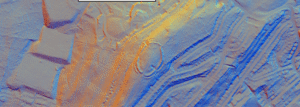
This is an oval fort with an internal area of 2.5 acres. A bank, ditch and counterscarp bank are continuous around it except on the N side where ditch and counterscarp have been destroyed.
This is an oval fort with an internal area of 2.5 acres. A bank, ditch and counterscarp bank are continuous around it except on the N side where ditch and counterscarp have been destroyed.
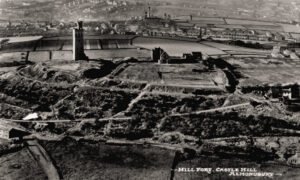
This page is a master placeholder for all vitrified fort sites in the Vitrified Forts section of Brigantes Nation.
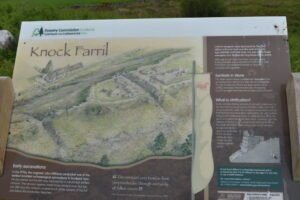
This had substantial ramparts made of stones with a timber frame, enclosing a large area and making good use of the natural defences of the hill-top.
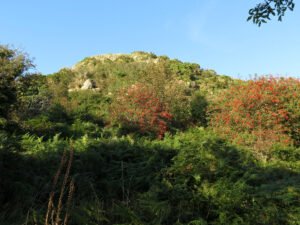
The Mote of Mark is a defended hilltop overlooking the Urr estuary. It was the court or citadel of a powerful Dark Age chieftain, possibly one of the princes of Rheged. The site was occupied during the 6th century and appears to have been destroyed by fire in the 7th century.
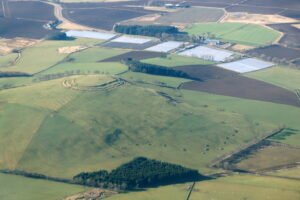
Barry Hill is a textbook “big fort waiting for a small trench”: its spectacular vitrified rampart, enigmatic outer works and Arthurian folklore offer equal attraction to scientists and story-lovers—yet almost everything we know comes from surface survey. A single, well-designed excavation season could pivot the site from picturesque curiosity to a securely dated anchor point in the defensive story of eastern Scotland.
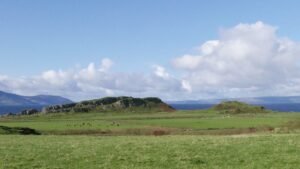
Dunagoil crowns a 30 m-high columnar-basalt promontory on the south-west coast of Bute, overlooking the Sound of Bute and the Cumbraes. Cliffs on the north and west form natural ramparts; only the gentle ESE saddle gives easy access.
May 30
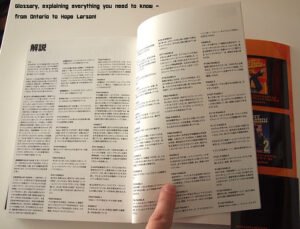
This page holds our Glossary of Terms for Vitrified Forts.

This is one of the best examples of a vitrified fort, it is near the village of Rhynie in northeastern Scotland. This massive fort from prehistory is on the summit of a mountain of the same name which, being 1,859 feet (560 metres) high, commands an impressive view of the Aberdeenshire countryside.

Finavon Hill has attracted a great deal of archaeological interest from antiquarians and archaeologists over the years especially since it displayed traces of vitrified rock.

This island, locally termed Eilean na Goar, is the most eastern and is bounded on all sides by precipitous gneiss rocks; it is the abode and nesting place of numerous sea birds. The flat surface on the top is 120 feet from the sea level, and the remains of the vitrified fort are situated on this, oblong in form, with a continuous rampart of vitrified wall five feet thick, attached at the SW end to a large upright rock of gneiss
 NLS Map Explorer
 Google Earth
 Google Maps
 Lidar Finder
 TMA
TMA
 Megalithic Portal
 Yorkshire Arch. Air Mapping
 ADS
ADS
 Brigantian Adventure FB Group
Stone Bothering FB Group
Stone Faces FB Group
Brigantian Adventure FB Group
Stone Bothering FB Group
Stone Faces FB Group
 Heritage Gateway
 ARCHI® MAPS: UK
 Atlas of Hillforts
 Portable Antiquities
 British History Online
Brigantes Nation FB Group
British History Online
Brigantes Nation FB Group

