Understanding the archaeological periods across Western Europe is essential for exploring the evolution of human societies from prehistory to the Read more
What Is a Barrow?
A barrow is a mound of earth and/or stones raised over a grave or group of graves. Used from the Neolithic through to the Iron Age (roughly 4000 BCE to 500 CE), barrows were often constructed to honour elite individuals, such as tribal leaders, warriors, or chieftains. They are frequently found singly or in cemeteries known as barrow fields.
Barrows vary in shape, construction, and size, and these differences can reflect chronological developments, regional styles, or cultural practices.
Main Types of Barrows
Round Barrows
These are circular mounds of earth or stone, often with a central burial. They are common from the Late Neolithic through the Bronze Age, and usually contain one or more graves (inhumations or cremations), often within a central cist, pit, or chamber. They are found widespread across Europe, especially in Britain, Scandinavia, and Central Europe.
Example: The Wessex Round Barrows, near Stonehenge, England, are classic Bronze Age barrows often associated with elite burials and rich grave goods.
These are elongated mounds, often hundreds of feet in length. They date mainly to the Neolithic period (mainly 4000–3000 BCE). They typically contain multiple burials, often collective, sometimes in chambered tombs. Long Barrows are found in western and Northern Europe, including Britain, France, and Scandinavia.
Example: West Kennet Long Barrow in Wiltshire, England, is a prominent Neolithic monument with a long stone-built burial chamber within the mound.
These are a subtype of Round Barrow with a prominent mound separated from an encircling ditch by a flat platform (berm). They are mainly Bronze Age in date, and are often associated with single, prestigious burials and grave goods. These are particularly common in southern England.
These have low, wide circular features defined by a ditch and bank with one or more small central mounds. They date from the Later Bronze Age, and are frequently ceremonial, with fewer or no burials. They are found mostly in southern Britain and are rare elsewhere.
These consist of a ring-shaped bank and ditch, with little or no central mound. They date from the late Bronze Age into the Iron Age and may have had ceremonial or symbolic functions, possibly as cenotaphs. They are found in Ireland, Britain, and northern France.
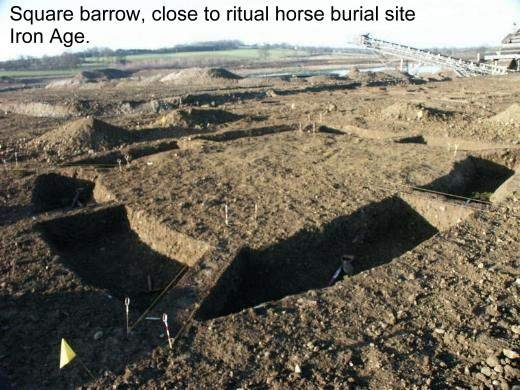
These are square (or sometimes rectangular) ditched enclosure, normally 6-12 m across, raised into a low mound with a single central grave. The ditch is dug first; its spoil provides the mound core, so most barrows now survive only as cropmarks. (historicengland.org.uk).
The earliest examples belong to the Middle–Late Iron Age (c. 5th–1st century BC), contemporary with La Tène culture on the Continent and the Arras tradition in East Yorkshire. A few later, early-Roman imitations exist. Square barrows are also known from the Roman and Scottish Pictish cultures.
Usually an inhumation is placed on its back or side; grave-goods range from plain pots to chariots, weapons, brooches and horse gear.
Steppe Kurgans (Eurasian Tumuli)
These are large, often monumental burial mounds found across the Eurasian steppe. They date from the Bronze Age to the early medieval periods, and are understood to be elite burials of nomadic tribes (e.g. Scythians, Sarmatians) with rich artifacts and horse burials. They can be found in Eastern Europe, especially Ukraine, southern Russia, and into Central Asia.
Example: The Royal Kurgans of the Scythians in Ukraine, such as the Solokha and Chertomlyk mounds, contain vast underground chambers and gold-laden burials.
“Scythian capital and royal kurgans” by Janmad is licensed under CC BY 3.0
File:Царський курган 007.jpg” by Anatoly Shcherbak is licensed under CC BY-SA 3.0
Regional Variations
Britain and Ireland: Strong emphasis on Neolithic long barrows and Bronze Age round barrows. Barrow cemeteries often align with major ritual landscapes, like Stonehenge or Avebury.
Scandinavia: Includes large burial mounds (e.g., Gokstad and Oseberg in Norway), often associated with ship burials in the Viking Age.
Central Europe: Rich Hallstatt culture barrows in Austria and Germany, often with chariot burials and luxury goods.
Iberian Peninsula: Fewer classic barrows; instead, Megalithic Tombs with earthen covering are more typical.
Eastern Europe: Kurgan-style mounds dominate, associated with Indo-European migrations and later nomadic empires.
Purpose and Significance
Barrows served not only as graves but also as:
Territorial markers
Religious or ceremonial sites
Symbols of status and memory
They remain important archaeological sites today, revealing burial customs, social hierarchies, and long-distance trade through the study of grave goods.
Timeline of Barrow development in Europe
How to read the chart
Years to the left of “0” are BCE, years to the right are CE.
Each horizontal bar shows when a particular barrow-building tradition was most active across Europe. (Local outliers exist, but these ranges capture the main pulse of construction in the archaeological record.)
A very long tradition – from the first Neolithic communal tombs (long barrows) right through to high-status Viking Age mounds, the basic idea of commemorating the dead with an earthen or stone mound persisted for almost five millennia.
Changing meanings – while Neolithic mounds emphasised collective ancestors, later Bronze-Age and Iron-Age barrows increasingly marked individual or elite burials, reflecting shifts in social hierarchy and belief.
Regional peaks :
Britain & Atlantic façade: strong Neolithic and Early Bronze-Age phases.
Central Europe: flourishing Hallstatt and La Tène “princely” barrows.
Scandinavia: a remarkably long Nordic Bronze-Age barrow tradition that blends into Viking Age ship-mound burials.
Interruptions & revivals – Roman fashions temporarily dampened barrow-building in many areas, but early-medieval elites (Anglo-Saxon, Slavic, Scandinavian) revived the custom as statements of power and identity.
Key observations
Era
Main concentration(s)
Notes
Early Neolithic long barrows
Britain, northern France, Denmark, north Germany, Poland
First communal monuments; linked to early farming.
A complete silver Scottish twelve shillings coin of James VI of Scotland and I of England, eighth coinage post-dating accession to English throne, dating to 1603-1625, Lys initial mark. Reverse has a shield with arms of [...]
A silver Post-Medieval shilling of Elizabeth I, third issue with ‘A’ initial mark dating to 1583-1585. Mint of London. As North Vol 2, p.136, no.2014. [...]
A lead alloy pipe tamper dating to the 17th century. The plate has moulded decoration to both sides depicting Charles I (facing right) and Henrietta Maria of France (facing left). Both images are contained in [...]
A damaged lead-alloy Medieval pilgrim's ampulla, 50mm in length and 35mm wide, with a round bodied flask with a flaring open top which is partially complete. One side of the flask body has traces of moulded [...]
An incomplete Medieval cast copper alloy buckle plate, dating to c. AD 1100-1400. The plate is missing its buckle and part of its sprues. The buckle plate is sub-rectangular in plan. Projecting from one long edge [...]
A Roman copper-alloy nummus of the House of Valentinian , dating to AD 364-7 (Reece Period 19), GLORIA RO-MANORVM reverse type depicting the emperor with right hand dragging captive right and holding a labarum in left hand. Mint of [...]
A Post-Medieval copper alloy farthing of Charles I (AD 1625-1649), dating to AD 1636-1644. Rose type 2, with sceptres in saltire through single crown. Mint of London. Unclear initial mark. North (1991: 165) no. 2291. [...]
A clipped and heavily worn Roman copper alloy nummus of Gratian (AD 367-383) dating to the period AD 367-378 (Reece period 19). SECURITAS REI PUBLICAE reverse type depicting Victory advancing left, holding a wreath and palm. Unknown mint. [...]
A silver Roman siliqua of Honorius (AD 393-423) dating to the period AD 397-402 (Reece Period 21) minted in Milan VIRTVS ROMANORVM reverse type depicting Roma seated left on cuirass, holding Victory on globe and spear. Hoxne, p. 145, no. [...]
An incomplete Roman composite plate brooch probably dating to AD 100-200. The brooch is missing it's pin and part of the top and bottom circles. The brooch is flat in cross section and probably originally consisted of [...]
Fragment from a probable buckle frame dating to the Post Medieval period (c.AD 1720-1790). The fragment is broadly rectangular in plan and includes a short section of the corner of the buckle frame. The fragment includes the [...]
Fragment from a buckle frame dating to the Post Medieval period (c.AD 1720-1790). The fragment is broadly C shaped in plan and D shaped in profile. It consists of two corners and one side of a sub-rectangular [...]
A complete copper alloy bovine (bull's head) vessel / bucket mount, dating to the Roman period (c. AD 50-200).The cast copper alloy mount is a sub-inverted triangle with a pointed lower tip and slightly waisted sides to form the nose.The [...]
An incomplete copper-alloy early Medieval stirrup strap mount of uncertain or unclassified type, dating to c.AD 1050-1150. The central part of the object survives with parts of the open work broken off on all sides except [...]
A near complete Medieval-Post Medieval cast copper alloy buckle with integrated plate dating to the period c.AD 1250-1500. The buckle is missing its pin.It has a rectangular frame, which has a sub rectangular cross-section. The integral plate has [...]
A very worn copper-alloy Roman radiate or nummus of unclear ruler dating to AD 260-402. Unclear reverse type, unclear mint.The coin is chipped around its circumference. [...]
A very worn Roman copper alloy radiate of uncertain emperor dating to the period AD 260-275 (Reece period 13). Unclear reverse type depicting. Unclear mint. [...]
An incomplete Medieval cast copper-alloy rectangular buckle with integral looped plate, dating to c. AD 1200-1400. The buckle is missing its pin. The buckle comprises a rectangular loop and an integral plate. The plate is made [...]