Over the last five years Iron-Age specialists have been re-examining what British hillforts were really for. The question is no Read more
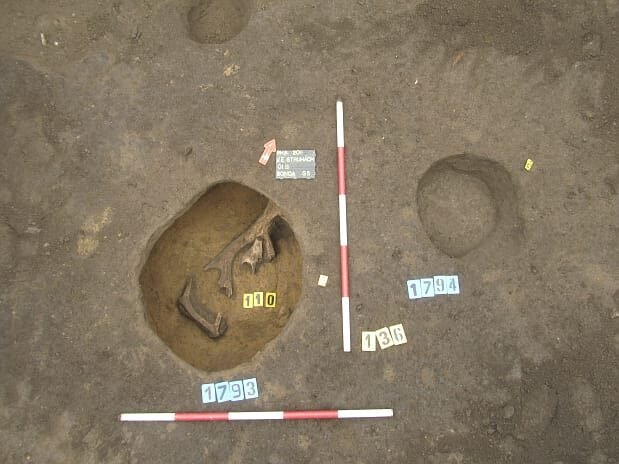
Horslip Long Barrow plan
Horslip (Windmill Hill) Long Barrow, Avebury
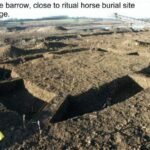
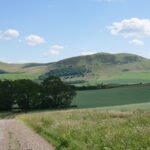
Sitting on the south‑east shoulder of Windmill Hill (grid ref. SU 086 070), 140 ft (43 m) above the Kennet valley, the Horslip long barrow commands the same chalk ridge that carries the famous Early‑Neolithic causewayed enclosure 400 m upslope. First sketched by William Stukeley in 1743, the mound had been badly ploughed when P. Ashbee and I. F. Smith completely excavated it in 1959 to rescue what remained. They revealed a single‑phase monument c. 46 m long, flanked by deep quarry ditches and resting on a buried turf that had already supported open grassland crops by about 3300 BC, according to land‑snail and pollen analyses.
Construction and layout
Mound & berm – a chalk‐rubble Cairn with chalk‑block revetment sat on a c. 12 ft wide berm; only a skin of mound survived after centuries of plough‑levelling.
Flanking ditches – V‑shaped, 3.5 m deep at the proximal end and shallower toward the east; primary fills were pure chalk weathering, sealing an antler pick dated 3240 ± 150 BC (BM‑180) that anchors construction in the early fourth millennium BC.
Internal features – two arcs of large intersecting pits and two axial pits cut the chalk beneath the mound; their sequence shows organised quarrying for core material, not funerary chambers.
Artefacts and eco-facts
Category
Highlights
Why important
Antler toolkit
Two in‑situ antler picks and a tine rake, plus further fragments, used to quarry and shape the mound; one pick supplied the radiocarbon date.
Rare direct evidence of Neolithic construction technology and workforce practice.
Pottery
Earlier Neolithic: c. 50 sherds in three fabrics; includes Mortlake‑style rims. Later Neolithic: 60 sherds of Beakers (All‑over‑Cord and All‑over‑Comb) and Fengate ware.
Earliest sherds show pre‑mound settlement; Beaker group in ditch secondary silts points to later ritual visits and helps date the ditch backfill.
Worked flint
95 cores, >1 100 flakes, six arrowheads (barbed‑and‑tanged, oblique, chisel), 35 scrapers, 15 knives, 14 borers, serrated flakes; many knapping by‑products clustered in the distal east ditch.
Demonstrates on‑site lithic production and a broad tool kit linked to late Neolithic domestic activity.
Stone objects
Fragment of sarsen quern, three pounders, 197 burnt sarsen lumps; exotic sandstones, Jurassic limestones and Old Red Sandstone pebbles.
Suggests food processing in or near the barrow and long‑distance pebble collecting, echoing Avebury’s exchange networks.
Bone pendant
192 mm “paper‑knife”‑shaped split‑bone ornament, perforated for suspension; longer than Bronze‑Age analogues.
A unique prestige item, probably worn, linking the site to wider Early Bronze‑Age personal‑ornament traditions.
Faunal remains
Primary ditch: cattle, sheep/goat, pig, dog, red and roe deer, aurochs; later silts dominated by cattle (62 %), pigs (17 %), sheep/goat (11 %).
Indicates mixed farming with selective deposition of domestic stock; aurochs skull fragment underscores survival of wild cattle.
Environmental samples
Land‑snail column shows open grassland with minor woodland; pollen signals initial cultivation then hazel scrub regeneration; buried soil is Rendzina directly on Lower Chalk.
Provides rare local snapshot of early farming impact and subsequent vegetation change.
Significance
Horslip stands out because, unlike many Wessex Long Barrows, no primary burials or chambers were found; the builders invested labour in quarrying and piling chalk, perhaps as a territorial marker or ceremonial Earthwork rather than a funerary tomb. The antler‑pick radiocarbon age of c. 3240 BC makes it one of the earliest securely dated monuments in the Avebury landscape, contemporary with Windmill Hill’s ditch system. Its rich lithic scatter and Beaker sherds show that people revisited the mounded landmark over a millennium after construction, weaving new rites into an already ancient feature. Together, the structural evidence, organic tools and environmental data make Horslip a key reference for how Early Neolithic communities engineered, used and later reinterpreted long Barrows in the Kennet valley.
A complete silver Scottish twelve shillings coin of James VI of Scotland and I of England, eighth coinage post-dating accession to English throne, dating to 1603-1625, Lys initial mark. Reverse has a shield with arms of [...]
A silver Post-Medieval shilling of Elizabeth I, third issue with ‘A’ initial mark dating to 1583-1585. Mint of London. As North Vol 2, p.136, no.2014. [...]
A lead alloy pipe tamper dating to the 17th century. The plate has moulded decoration to both sides depicting Charles I (facing right) and Henrietta Maria of France (facing left). Both images are contained in [...]
A damaged lead-alloy Medieval pilgrim's ampulla, 50mm in length and 35mm wide, with a round bodied flask with a flaring open top which is partially complete. One side of the flask body has traces of moulded [...]
An incomplete Medieval cast copper alloy buckle plate, dating to c. AD 1100-1400. The plate is missing its buckle and part of its sprues. The buckle plate is sub-rectangular in plan. Projecting from one long edge [...]
A Roman copper-alloy nummus of the House of Valentinian , dating to AD 364-7 (Reece Period 19), GLORIA RO-MANORVM reverse type depicting the emperor with right hand dragging captive right and holding a labarum in left hand. Mint of [...]
A Post-Medieval copper alloy farthing of Charles I (AD 1625-1649), dating to AD 1636-1644. Rose type 2, with sceptres in saltire through single crown. Mint of London. Unclear initial mark. North (1991: 165) no. 2291. [...]
A clipped and heavily worn Roman copper alloy nummus of Gratian (AD 367-383) dating to the period AD 367-378 (Reece period 19). SECURITAS REI PUBLICAE reverse type depicting Victory advancing left, holding a wreath and palm. Unknown mint. [...]
A silver Roman siliqua of Honorius (AD 393-423) dating to the period AD 397-402 (Reece Period 21) minted in Milan VIRTVS ROMANORVM reverse type depicting Roma seated left on cuirass, holding Victory on globe and spear. Hoxne, p. 145, no. [...]
An incomplete Roman composite plate brooch probably dating to AD 100-200. The brooch is missing it's pin and part of the top and bottom circles. The brooch is flat in cross section and probably originally consisted of [...]
Fragment from a probable buckle frame dating to the Post Medieval period (c.AD 1720-1790). The fragment is broadly rectangular in plan and includes a short section of the corner of the buckle frame. The fragment includes the [...]
Fragment from a buckle frame dating to the Post Medieval period (c.AD 1720-1790). The fragment is broadly C shaped in plan and D shaped in profile. It consists of two corners and one side of a sub-rectangular [...]
A complete copper alloy bovine (bull's head) vessel / bucket mount, dating to the Roman period (c. AD 50-200).The cast copper alloy mount is a sub-inverted triangle with a pointed lower tip and slightly waisted sides to form the nose.The [...]
An incomplete copper-alloy early Medieval stirrup strap mount of uncertain or unclassified type, dating to c.AD 1050-1150. The central part of the object survives with parts of the open work broken off on all sides except [...]
A near complete Medieval-Post Medieval cast copper alloy buckle with integrated plate dating to the period c.AD 1250-1500. The buckle is missing its pin.It has a rectangular frame, which has a sub rectangular cross-section. The integral plate has [...]
A very worn copper-alloy Roman radiate or nummus of unclear ruler dating to AD 260-402. Unclear reverse type, unclear mint.The coin is chipped around its circumference. [...]
A very worn Roman copper alloy radiate of uncertain emperor dating to the period AD 260-275 (Reece period 13). Unclear reverse type depicting. Unclear mint. [...]
An incomplete Medieval cast copper-alloy rectangular buckle with integral looped plate, dating to c. AD 1200-1400. The buckle is missing its pin. The buckle comprises a rectangular loop and an integral plate. The plate is made [...]