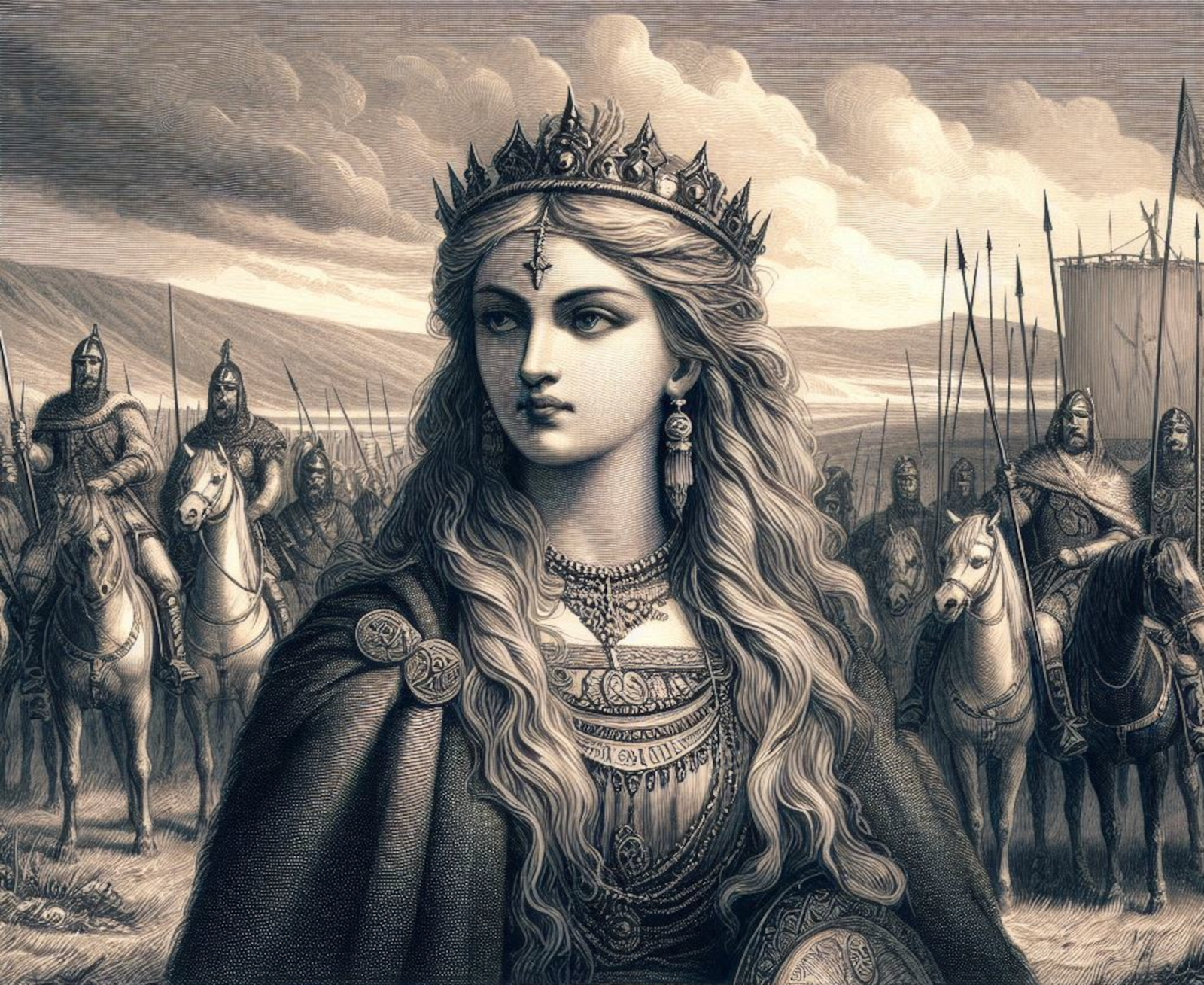
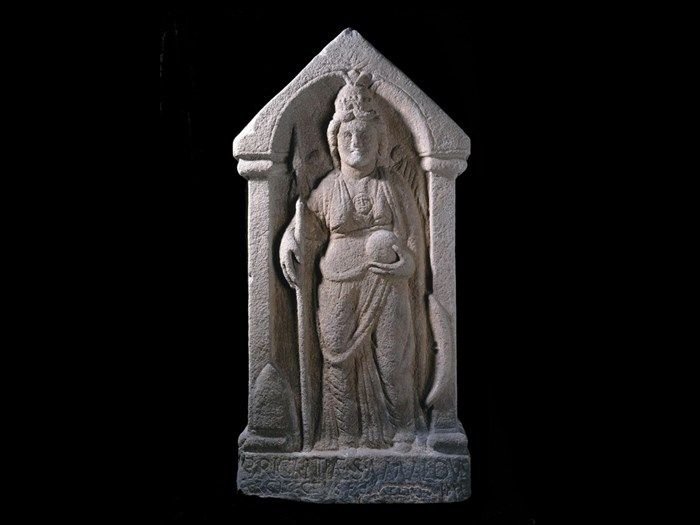
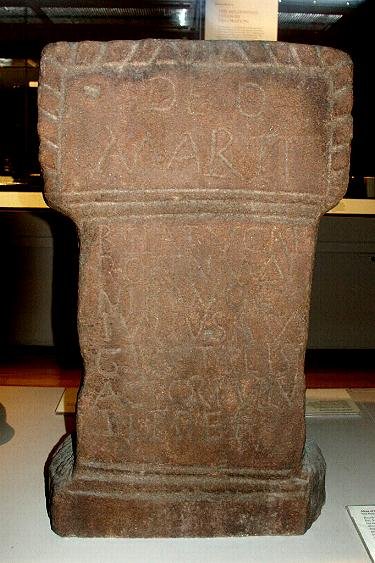
Votive inscriptions to the Goddess Brigantia have been found in the North of England using four names: Caelestis Brigantia, Nympha Read more
Short Glossary of North Yorkshire Terms
Every region in Brigantia has its own accent and ways of speaking. North Yorkshire, being such a large county, has quite a significant variance in its dialects and this glossary may not be universally applicable in the whole of the region.
Airt – direction point of the compass.
Aither – furrowed ground.
Balk – A strip of land.
Bargh, Barugh, Barf – A hill forming part of a low ridge.
Beck, Gill – Small stream.
Beeld, bield, beild – A shelter from weather.
Bladdry – Soft splashy mud.
Blashment – Melted snow or soft mud.
Bleb – Air rising in water.
Blue-flint – Whinstone from the Cleveland Dyke.
Blutherment – Puddle or slush.
Boddums – Lowest ground.
Bounder-stoups – Upright boundary stones.
Bow-bridge – A Packhorse bridge.
Brigg – a natural promontory into the sea or bridge.
Brae – The overhanging bank of a river.
Brant – Steep. Cam – The sloping bank from a hedge bottom.
Carr – Low-lying boggy ground.
Causer, caus’ay – A paved footpath.
Cinder Hills – Ancient slag heaps.
Cleugh – A narrow ravine.
Clum – Sodden, heavy clayey land.
Coo-yat – Cow pasture.
Coo-grip – a channel to carry off urine.
Covin-scar – A low, flat expanse of rock.
Cross gang/gate – A crossroads.
Crow-ling – Heath.
Dale – A valley.
Dale-end The end or widest part of a dale.
Dale-head – The upper and narrowest portion of a dale.
Dike – A ditch. Dike-back – The bank forming one side of a ditch.
Dub – A large pond.
Dump – Deep hole in the bed of a river.
Faugh – Fallow land.
Fold Garth – Farmyard.
Foss – A waterfall.
Gain-way – A shorter path.
Garth – A small enclosure of land.
Gate – a way, road or street.
Gessing-land – Grassland.
Gill – A narrow valley or ravine.
Gimmal – A narrow passage.
Gote – A narrow natural ravine.
Griff – A deep, narrow valley.
Grip – A channel or small ditch.
Hag – A broken, rugged bank.
Hays – Enclosure fence acting as a boundary.
Head rig – The part of a field where the horses and plough turn.
Hipping steans – Stepping stones.
Holl – A deep depression in the land.
Holm – Land which is at times surrounded by water.
Hoss trod – A bridle road.
Hottery – A bumpy, uneven road.
Houe, Howe – A Hill.
Hossocks – Coarse tufts of grass.
Ing. Ings – low-lying pasture.
Intak – Enclosed land from a common for cultivation.
Kansh – A hard ridge of gravel or a rock in a river, dangerous to navigation.
Keld – A spring of water.
Liberty – The parish or township.
Lits – A spring or source of a stream.
Loning, loaning, lonnin’, lo’nin – A narrow lane.
Marrish – Low lying ground liable to flood.
Mere, mere-stone – A boundary mark or stone.
Moor stone – A large exposed stone embedded in the soil of the moor.
Nab – A hill, rocky point, headland.
Ness – A projecting headland.
Neuk – a corner of a field.
Out-end, out-gang, out-gaat – An exit, way out.
Owergait – A gap in a hedge.
Plother, plodder – Soft mud. Rack – a bend in a river.
Ramper – The sloping side of a raised footpath.
Rands, reeands – The unploughed edges of a field.
Rein – The sides of a field overgrown with brushwood.
Riding – An open space in a wood.
Rigg – A long, narrow hill.
Rook, ruck –A pile, a carefully made heap of stones/turf.
Scau’p – Bare spots of rock and stones on a hillside.
Skaff, skeeaf – A rough, steep, broken bank.
Slack – The hollow part of an undulation in the ground.
Sloke – The scum or slime on stagnant water.
Smout-hole – An opening at the bottom of a wall to allow hares or sheep to pass through.
Snake-stone – An Ammonite.
Spout – A waterfall.
Sprunt – A steep hill.
Strand – The beach.
Sump – A bog or marsh.
Swang – A boggy stretch of land.
Swarth – The quality and quantity of grass upon the land.
Swidden – Part of the moor cleared by burning.
Syke – A small stream. Toft – A small grove of trees.
Trod – A footpath.
Upgang – A pathway up a hill.
Warp – Alluvium.
Wath – A ford.
White flint – A hard, sedimentary rock found on the moors and used for road stone.
A complete silver Scottish twelve shillings coin of James VI of Scotland and I of England, eighth coinage post-dating accession to English throne, dating to 1603-1625, Lys initial mark. Reverse has a shield with arms of [...]
A silver Post-Medieval shilling of Elizabeth I, third issue with ‘A’ initial mark dating to 1583-1585. Mint of London. As North Vol 2, p.136, no.2014. [...]
A lead alloy pipe tamper dating to the 17th century. The plate has moulded decoration to both sides depicting Charles I (facing right) and Henrietta Maria of France (facing left). Both images are contained in [...]
A damaged lead-alloy Medieval pilgrim's ampulla, 50mm in length and 35mm wide, with a round bodied flask with a flaring open top which is partially complete. One side of the flask body has traces of moulded [...]
An incomplete Medieval cast copper alloy buckle plate, dating to c. AD 1100-1400. The plate is missing its buckle and part of its sprues. The buckle plate is sub-rectangular in plan. Projecting from one long edge [...]
A Roman copper-alloy nummus of the House of Valentinian , dating to AD 364-7 (Reece Period 19), GLORIA RO-MANORVM reverse type depicting the emperor with right hand dragging captive right and holding a labarum in left hand. Mint of [...]
A Post-Medieval copper alloy farthing of Charles I (AD 1625-1649), dating to AD 1636-1644. Rose type 2, with sceptres in saltire through single crown. Mint of London. Unclear initial mark. North (1991: 165) no. 2291. [...]
A clipped and heavily worn Roman copper alloy nummus of Gratian (AD 367-383) dating to the period AD 367-378 (Reece period 19). SECURITAS REI PUBLICAE reverse type depicting Victory advancing left, holding a wreath and palm. Unknown mint. [...]
A silver Roman siliqua of Honorius (AD 393-423) dating to the period AD 397-402 (Reece Period 21) minted in Milan VIRTVS ROMANORVM reverse type depicting Roma seated left on cuirass, holding Victory on globe and spear. Hoxne, p. 145, no. [...]
An incomplete Roman composite plate brooch probably dating to AD 100-200. The brooch is missing it's pin and part of the top and bottom circles. The brooch is flat in cross section and probably originally consisted of [...]
Fragment from a probable buckle frame dating to the Post Medieval period (c.AD 1720-1790). The fragment is broadly rectangular in plan and includes a short section of the corner of the buckle frame. The fragment includes the [...]
Fragment from a buckle frame dating to the Post Medieval period (c.AD 1720-1790). The fragment is broadly C shaped in plan and D shaped in profile. It consists of two corners and one side of a sub-rectangular [...]
A complete copper alloy bovine (bull's head) vessel / bucket mount, dating to the Roman period (c. AD 50-200).The cast copper alloy mount is a sub-inverted triangle with a pointed lower tip and slightly waisted sides to form the nose.The [...]
An incomplete copper-alloy early Medieval stirrup strap mount of uncertain or unclassified type, dating to c.AD 1050-1150. The central part of the object survives with parts of the open work broken off on all sides except [...]
A near complete Medieval-Post Medieval cast copper alloy buckle with integrated plate dating to the period c.AD 1250-1500. The buckle is missing its pin.It has a rectangular frame, which has a sub rectangular cross-section. The integral plate has [...]
A very worn copper-alloy Roman radiate or nummus of unclear ruler dating to AD 260-402. Unclear reverse type, unclear mint.The coin is chipped around its circumference. [...]
A very worn Roman copper alloy radiate of uncertain emperor dating to the period AD 260-275 (Reece period 13). Unclear reverse type depicting. Unclear mint. [...]
An incomplete Medieval cast copper-alloy rectangular buckle with integral looped plate, dating to c. AD 1200-1400. The buckle is missing its pin. The buckle comprises a rectangular loop and an integral plate. The plate is made [...]