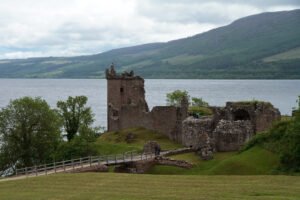
C’est lors d’un voyage en Ecosse, au cours de l’été 1997, que nous avons entendu parler pour la première fois de forts vitrifiés. C’était au château d’Urqhart, au sud d’Inverness. Les monuments historiques fermant tôt, dans ce pays, nous ne pûmes voir que de loin cette impressionnante forteresse en ruine du XIIe siècle qui domine la rive occidentale du Loch Ness. Nous nous contentâmes juste de faire des photos au téléobjectif depuis le parking et de lire les panneaux retraçant l’historique du site.
Category: Articles
Sep 27
Vitrified Forts Gazeteer
Celtic Heads Celtic Head from Witham, 2nd c B.C. (British Museum) “Celtic” carved heads are found throughout the Read more Timeline 60BC – 138AD This timeline is focussed on the British Celtic culture and those cultures which had influence on the British Celts. It Read more Heads at St Michael, Kirklington An analysis of head …
Sep 27
Mystery of Vitrified Forts
It was during a trip to.Scotland, in the Summer of 1997, that I first heard of vitrified hillforts. It was near Urqhart Castle, south of Inverness. As ancient monuments close early in that country, I could only see from a distance that impressive ruined fortress overlooking the west bank of Loch Ness.
Sep 25
Guide – Mining Glossary
Celtic Heads Celtic Head from Witham, 2nd c B.C. (British Museum) “Celtic” carved heads are found throughout the Read more Timeline 60BC – 138AD This timeline is focussed on the British Celtic culture and those cultures which had influence on the British Celts. It Read more Heads at St Michael, Kirklington An analysis of head …
Sep 25
Guide – Bronze Age Mining
Celtic Heads Celtic Head from Witham, 2nd c B.C. (British Museum) “Celtic” carved heads are found throughout the Read more Timeline 60BC – 138AD This timeline is focussed on the British Celtic culture and those cultures which had influence on the British Celts. It Read more Heads at St Michael, Kirklington An analysis of head …
Sep 25
Guide – Mining
This section illustrates the history of mining and aims to give sufficient information for a researcher to be able to recognise mining features and to be able to identify the periods of working on a site. Mine works are an extensive subject, complicated by the use of different terms for similar features, depending on the type of mine and the region under review.
Sep 25
Guide – Resistivity
Celtic Heads Celtic Head from Witham, 2nd c B.C. (British Museum) “Celtic” carved heads are found throughout the Read more Timeline 60BC – 138AD This timeline is focussed on the British Celtic culture and those cultures which had influence on the British Celts. It Read more Heads at St Michael, Kirklington An analysis of head …
Sep 25
Guide – Hidden Remains
Identification of features is simplified when the full extent of remains such as earthworks, can be easily seen. However, once the roof has gone, the walls perished or robbed, the interior burnt and the wreck left to perish for hundreds of years, the remainder flattened and used as a field for crops, the job of recognition is made all the more difficult.
Sep 25
Guide – Visible Remains
Celtic Heads Celtic Head from Witham, 2nd c B.C. (British Museum) “Celtic” carved heads are found throughout the Read more Timeline 60BC – 138AD This timeline is focussed on the British Celtic culture and those cultures which had influence on the British Celts. It Read more Heads at St Michael, Kirklington An analysis of head …