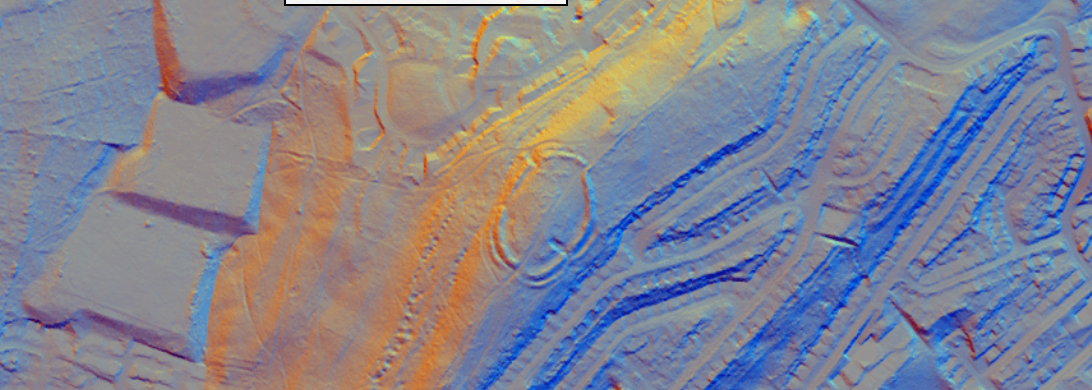
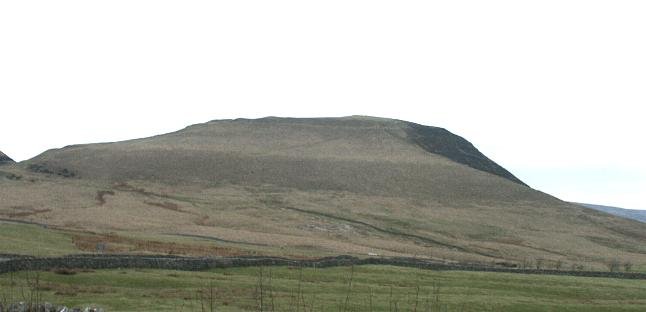
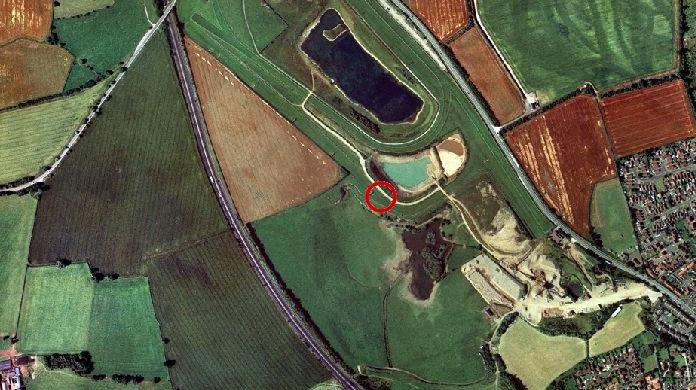
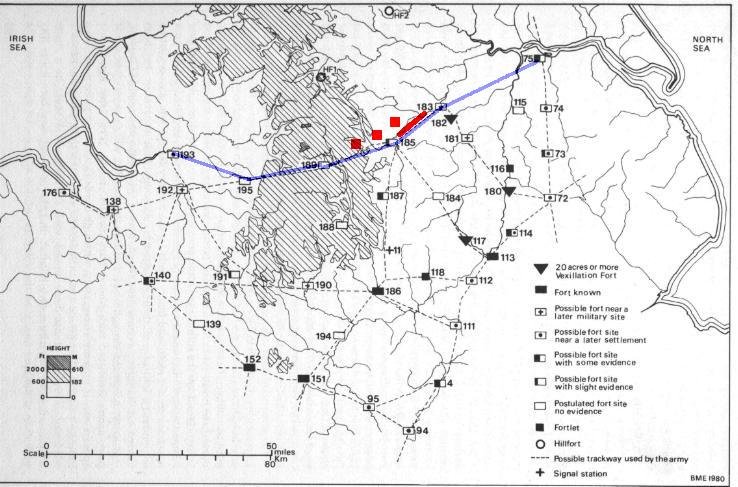
Templeborough Roman Fort occupies a commanding position on the north bank of the River Don at Rotherham (OS grid SK Read more
Danes Camp Hathersage
Camp Green (often called “Danes Camp”) crowns a Limestone-capped knoll immediately north-east of St Michael’s Church in Hathersage (OS grid SK 234 819). Perched above the Hope Valley, it commands wide views down the River Derwent corridor and sits at the transition between the Millstone Grit plateaux to the north and the lower limestone and sandstone vale to the south (gatehouse-gazetteer.info).
Structure & Materials
Danes Camp Hathersage
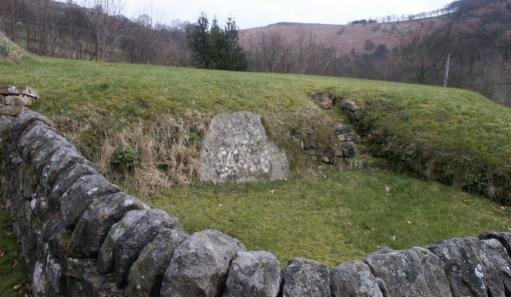
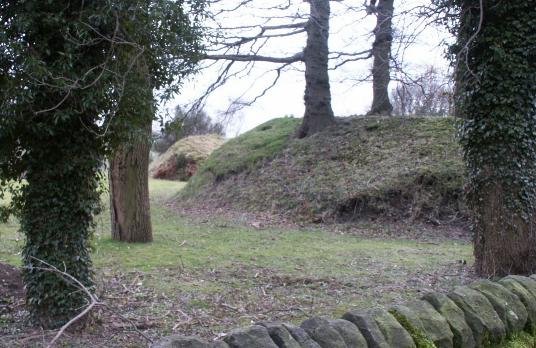
Originally a complete oval enclosure of roughly 50 × 40 m internally, Camp Green’s defences consist of a turf-faced earthen bank up to 3 m high, backed by a broad external ditch almost 8 m across at its widest surviving points. The southern half of the circuit has been largely obliterated by modern buildings and landscaping, but the northern rampart and ditch remain sharply defined, cut into the natural Magnesian Limestone nodules and Glacial Drift that cap the hill (heritagegateway.org.uk).
Dating & Excavation History
Danes Camp Hathersage
In 1976–77 R.A. Hodges of Sheffield University conducted small trial-trenches across the bank and ditch. No structural timbers or in-situ occupation layers were found; the only datable artifact was a solitary 13th-century Brackenfield-ware pottery sherd from the back-dirt of the ditch. By analogy with better-studied sites, however, Hodges concluded that Camp Green is a Norman ring-work castle—essentially a motte-less earth-and-timber fortress—constructed in the late 11th or early 12th century to control the Hope Valley approaches and the trans-Pennine Packhorse routes (gatehouse-gazetteer.info).
Archaeological Interpretation
Camp Green belongs to the “Class A” ring-work typology in King & Alcock’s 1969 survey of English and Welsh minor castles. Its siting on a natural knoll provided a defensible platform without the need for a raised motte, while the wide ditch—described as “moat-like” in early surveys—would have been revetted in timber and water-logged in places to impede attackers. The scarcity of medieval domestic debris suggests it served primarily as a watch post or local lord’s stronghold, rather than a permanent garrison (gatehouse-gazetteer.info).
Landscape & Legacy
Over centuries, Camp Green’s defences fell into disuse. Medieval and post-medieval buildings now occupy much of its southern circuit, and the ditch has silted up in places. Today, the surviving bank and northern ditch segment are scheduled by Historic England and form part of the village’s heritage trail, interpreted alongside the church and the nearby early Saxon cross Shaft. Camp Green thus provides a tangible link between Hathersage’s Norman past and its later industrial innovations—such as Christopher Schutz’s 16th-century wire-drawing works—reminding us how this valley has long been a crossroads of defence, faith and industry (en.wikipedia.org).
A Probable Neolithic flint piece of debitage possbily intended to be a blade.The fragment is made from a tertiary flake of semi-glossy light grey flint with slightly darker grey patches. It is sub-triangular in plan [...]
A very worn and chipped Roman copper alloy radiate of uncertain emperor dating to the period AD 260-275 (Reece period 13). Unclear reverse type depicting figure standing left. Unclear mint. [...]
A heavily worn Medieval silver 'short cross' cut farthing of an uncertain monarch, Henry II to Henry III dating to the period c.1180-1247. Not further defined.Length: 9.6mm; width: 9.4mm; thickness: 0.5mm; weight: 0.4g. [...]
Silver medieval penny of an uncertain ruler, probably Henry V to Henry VI (1413 - 1461) minted at York. The coin is in poor condition, is 16mm in diameter and weighs 1.00g. [...]
A Roman copper-alloy radiate of Tetricus I/II dating to circa AD 271-274 (Reece Period 13). PAX AVG reverse type depicting Pax standing left holding branch and vertical sceptre. Gallic Mint I. [...]
A Roman copper-alloy nummus of Magnentius or Decentius dating to AD 250-253 (Reece Period 18). VICTORIAE DD NN AVG ET CAE reverse type depicting two Victories holding wreath inscribed [VOT/V/MVLT/X]. Mint of Trier. [...]
A Roman silver denarius of Antoninus Pius (AD 138-161) dating to AD 154-155 (Reece Period 7). COS [IIII] reverse type depicting Fortuna, draped, standing right, holding rudder, vertical on globe, in right hand and cornucopiae, with tip [...]
A Roman copper-alloy barbarous radiate copying a coin of Victorinus (AD 268-270) dating to circa AD 275-285 (Reece Period 14). Copying PAX AVG reverse type depicting Pax standing left holding branch and transverse sceptre. Unclear [...]
A Roman copper-alloy radiate of Carausius (AD 286-293) dating to circa AD 286-293 (Reece Period 14). PAX AVG reverse type depicting Pax standing holding branch and vertical sceptre. Unclear mint. [...]
A Roman copper alloy radiate of Tetricus II (AD 272-274) dating to circa AD 272-274 (Reece Period 1). [SPES AVG] reverse type depicting Spes walking left holding branch and raising hem of robe. Unclear mint. [...]
A free-standing pierced stone weight of uncertain age, but probably dating to the Post Medieval period.The object is sub-square in plan and rectangular in cross section. Its sides appear to have been sanded to give [...]
A Roman copper-alloy barbarous radiate copying a coin of Divus Claudius II (AD 270-271) dating to circa AD 275-285 (Reece Period 14). Copying CONSECRATIO reverse type depicting altar with crescent. Unclear prototype mint. [...]
A free-standing cast lead conical 12.43g weight of uncertain age, but probably dating to the Post Medieval period.It has a sub-circular base with concave tapering sides up to a slightly flattened apex. A circular hole runs through [...]
A free-standing cast lead conical 20.79g weight of uncertain age, but probably dating to the Post Medieval period.It has a sub-circular base with tapering sides up to a slightly flattened apex. A circular hole runs through the [...]
A clipped Post Medieval silver halfgroat of James I (AD 1603-1625). First coinage, dating to AD 1603-1604. Mint of London. North (1991: 144) No. 2076, thistle mintmark. [...]
A very worn Post Medieval silver three pence of Elizabeth I (AD 1558-1603) second coinage dating to AD 1561-1582. Mint of London. Unclear initial mark. North (1991: 135) no. 1998. [...]