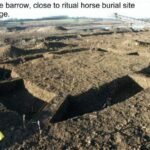
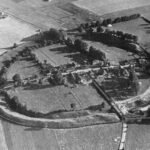
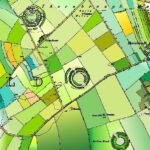
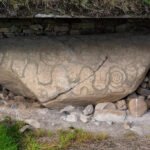
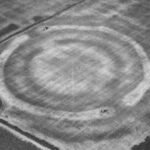
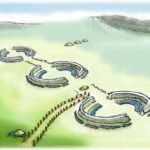
These are raised platforms created first and foremost for cult, procession, assembly or conversion—not for fortification or routine boundary-making. They Read more
The recent University of Gothenburg–led excavations at Le Plasker, and their startling radiocarbon dates of 4600–4300 BC for the Carnac Read more
Bubenec plough marks - Institute of Archeology of Academy of Sciences
Early Neolithic ploughing at Bubeneč
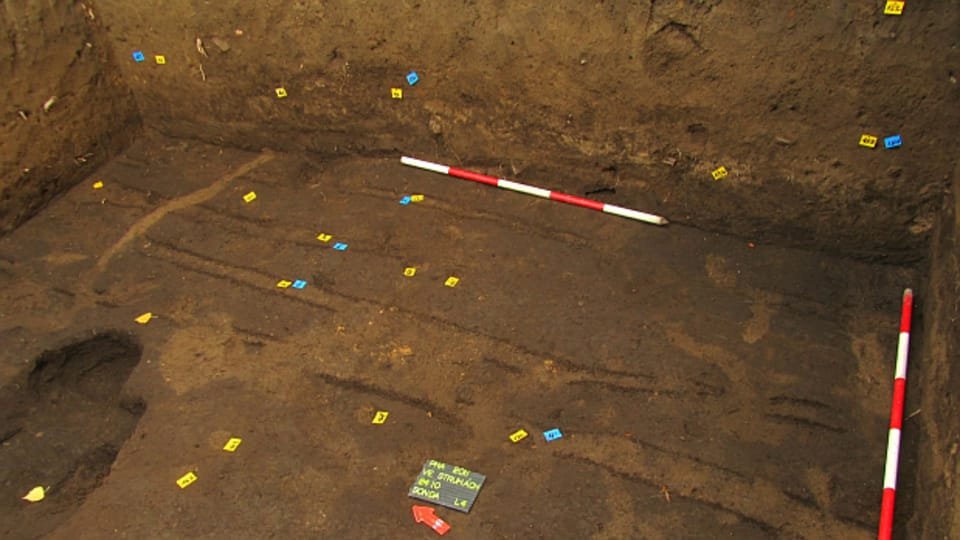
Quite recently, initial excavation evidence from Bubenec, close to Prague was first announced to the public, pending full publication. As part of that media activity, the head archaeologist for the dig, Petra Maříková Vlčková explained that the excavation; below the future Canadian Embassy, in Prague’s Bubeneč district, cut through almost two metres of undisturbed deposits – a rarity in Central Europe. At the very bottom of this “Tell of Bubeneč”, the team exposed a set of parallel furrows impressed in the prehistoric ground surface.
What exactly was found
A band of clean, linear, parallel plough‑marks running across the lowest (earliest) occupation level.
No intersecting or “cross‑hatched” furrows of the kind normally recorded beneath Eneolithic burial mounds.
No trace of a burial mound or Barrow above the furrows.
Associated pottery and hearth debris suggest an early Eneolithic date (c. 3500 BC), but radiocarbon samples are still in the lab.
Why the find matters
If the date is confirmed, the Bubeneč furrows double the age‑range of plough evidence in the Czech lands.
They would rank among the oldest securely identified plough‑marks in Central Europe.
The discovery shows that arable cultivation had reached Prague’s hinterland 700–800 years before the Corded Ware horizon, previously thought to mark the first heavy tillage here.
The furrows demonstrate that early farmers on the Vltava flood‑terrace were already using an ard or scratch‑plough capable of cutting long, straight drills – suggesting fields large enough to justify animal traction.
Linear versus crosswise ploughing
“Crosswise” (criss‑cross) patterns under Barrows have long been labelled ritual ploughing, perhaps symbolically “feeding” the dead.
Bubeneč presents only single‑direction furrows, more consistent with everyday cultivation.
The contrast hints at two contemporaneous ploughing traditions:
Early Eneolithic farmers here were already experimenting with metal (copper/early bronze) and expanding long‑distance trade links to the Mediterranean.
More efficient ploughing would have boosted crop yields and population density, laying groundwork for sharper social hierarchies.
The tell‑like build‑up at Bubeneč shows continuous re‑occupation and waste accumulation, implying that the same fertile riverside plot remained desirable across millennia.
These plough‑marks, if authenticated, would position Bubeneč as a type‑site for early arable technology in Central Europe and open a new line of enquiry into how, and why, the first farmers transformed Prague’s landscape.
Ritual‑versus‑functional ploughing: the core argument
Across north‑west Europe archaeologists sometimes find ard‑ or plough‑marks sealed beneath Neolithic and Bronze‑Age barrows. Two patterns repeat: (1) dense, cross‑hatched furrows that criss‑cross at right‑angles and lie directly under the mound core; (2) ordinary, single‑direction drills that appear in open settlement soils or former fields. The puzzle is whether the cross‑hatched type represents everyday ground preparation for mound building or a symbolic act carried out to “feed” or bless the dead.
The functional view
(Rowley‑Conwy and others) holds that ploughing a chalk or gravel surface before a barrow loosens turf, yields neat sods for construction and helps drainage; the criss‑cross pattern simply reflects practical efficiency—two passes at right‑angles break up the ground fastest.
The ritual view
(Henning‑Berg, Nielsen et al.) notes that these furrows occur exactly where mortuary rites took place and argues they form a deliberate offering: labour invested, crops symbolised, territory claimed for the ancestors. The same ard could serve agriculture elsewhere, but under a barrow its strokes became part of the funerary performance.
Most recent studies accept a middle ground: cross‑ploughing probably did both jobs at once—providing construction material and enacting a brief, visible rite of transition from farmland to ancestral monument. Linear furrows in settlement contexts, like those just found at Bubeneč, are taken as straightforward cultivation. Key tests ahead are tighter dating of the ploughed surfaces, micro‑analysis of furrow soils to spot cultivation residues, and wider geophysical prospection to see how consistent the pattern really is.
2012 Radio Prague
Below is a verbatim transcript of the final exchange in the 2012 Radio Prague interview where archaeologist Petra Maříková Vlčková explains why some prehistoric furrows are labelled “ritual ploughing.” The clip begins with the interviewer’s question and ends just before the closing credits. Minor hesitations (uh/um) and repeated words have been removed for readability; no other edits have been made.
Interviewer (Christian Falvey):What kind of rituals might we be talking about in the case of these ritual furrows?Petra Maříková Vlčková:
“Well, who knows? No one knows for sure. It’s called ritual ploughing because the cross‑hatched marks are usually found underneath burial mounds. We can only suggest that when you want to bury someone in the ground you also want to give him—or her—the possibility of eternal life, and for that you need to fulfil certain conditions, like giving a blessing or providing some means of subsistence.
“In an agricultural society that subsistence is crops, so ploughing the soil could symbolise feeding the dead or perhaps opening the earth in a special, sacred way. But—and I always add this—archaeologists tend to use the word ritual when we don’t really know what something means, so it becomes an easy answer to almost everything. In other words, we can’t say with certainty; we can only observe the context and propose that ploughing beneath a barrow was probably not practical farming but part of the ceremony.”
(End of quoted passage. The programme then moves on to closing remarks and credits.)
A complete silver Scottish twelve shillings coin of James VI of Scotland and I of England, eighth coinage post-dating accession to English throne, dating to 1603-1625, Lys initial mark. Reverse has a shield with arms of [...]
A silver Post-Medieval shilling of Elizabeth I, third issue with ‘A’ initial mark dating to 1583-1585. Mint of London. As North Vol 2, p.136, no.2014. [...]
A lead alloy pipe tamper dating to the 17th century. The plate has moulded decoration to both sides depicting Charles I (facing right) and Henrietta Maria of France (facing left). Both images are contained in [...]
A damaged lead-alloy Medieval pilgrim's ampulla, 50mm in length and 35mm wide, with a round bodied flask with a flaring open top which is partially complete. One side of the flask body has traces of moulded [...]
An incomplete Medieval cast copper alloy buckle plate, dating to c. AD 1100-1400. The plate is missing its buckle and part of its sprues. The buckle plate is sub-rectangular in plan. Projecting from one long edge [...]
A Roman copper-alloy nummus of the House of Valentinian , dating to AD 364-7 (Reece Period 19), GLORIA RO-MANORVM reverse type depicting the emperor with right hand dragging captive right and holding a labarum in left hand. Mint of [...]
A Post-Medieval copper alloy farthing of Charles I (AD 1625-1649), dating to AD 1636-1644. Rose type 2, with sceptres in saltire through single crown. Mint of London. Unclear initial mark. North (1991: 165) no. 2291. [...]
A clipped and heavily worn Roman copper alloy nummus of Gratian (AD 367-383) dating to the period AD 367-378 (Reece period 19). SECURITAS REI PUBLICAE reverse type depicting Victory advancing left, holding a wreath and palm. Unknown mint. [...]
A silver Roman siliqua of Honorius (AD 393-423) dating to the period AD 397-402 (Reece Period 21) minted in Milan VIRTVS ROMANORVM reverse type depicting Roma seated left on cuirass, holding Victory on globe and spear. Hoxne, p. 145, no. [...]
An incomplete Roman composite plate brooch probably dating to AD 100-200. The brooch is missing it's pin and part of the top and bottom circles. The brooch is flat in cross section and probably originally consisted of [...]
Fragment from a probable buckle frame dating to the Post Medieval period (c.AD 1720-1790). The fragment is broadly rectangular in plan and includes a short section of the corner of the buckle frame. The fragment includes the [...]
Fragment from a buckle frame dating to the Post Medieval period (c.AD 1720-1790). The fragment is broadly C shaped in plan and D shaped in profile. It consists of two corners and one side of a sub-rectangular [...]
A complete copper alloy bovine (bull's head) vessel / bucket mount, dating to the Roman period (c. AD 50-200).The cast copper alloy mount is a sub-inverted triangle with a pointed lower tip and slightly waisted sides to form the nose.The [...]
An incomplete copper-alloy early Medieval stirrup strap mount of uncertain or unclassified type, dating to c.AD 1050-1150. The central part of the object survives with parts of the open work broken off on all sides except [...]
A near complete Medieval-Post Medieval cast copper alloy buckle with integrated plate dating to the period c.AD 1250-1500. The buckle is missing its pin.It has a rectangular frame, which has a sub rectangular cross-section. The integral plate has [...]
A very worn copper-alloy Roman radiate or nummus of unclear ruler dating to AD 260-402. Unclear reverse type, unclear mint.The coin is chipped around its circumference. [...]
A very worn Roman copper alloy radiate of uncertain emperor dating to the period AD 260-275 (Reece period 13). Unclear reverse type depicting. Unclear mint. [...]
An incomplete Medieval cast copper-alloy rectangular buckle with integral looped plate, dating to c. AD 1200-1400. The buckle is missing its pin. The buckle comprises a rectangular loop and an integral plate. The plate is made [...]