
Interfluve – More generally, an Interfluve is defined as an area of higher ground between two rivers in the same drainage system.
Blog Archive
Periglacial deposits
Periglacial deposits are sediments and landforms created by Periglacial processes in cold, non-glacial environments, characterized by freeze-thaw cycles. These deposits include features like coombe and head deposits, patterned ground, solifluction lobes, and blockfields, often found in areas near glaciers or in regions with permafrost. The deposits are formed by a variety of processes, including frost …
Frost shatter
Frost shattering, also known as freeze-thaw weathering, is a type of mechanical weathering that occurs in cold climates where water repeatedly freezes and thaws within cracks in rocks. When water freezes, it expands, putting pressure on the surrounding rock. This expansion and contraction cycle, repeated over time, can cause the rock to fracture and break …
Devensian
The Devensian is the name given to the last glacial period in Britain, which occurred within the broader Pleistocene epoch. It represents the most recent major period of glaciation in the region, with the peak extent of the ice sheet around 22,000 years ago. The Devensian is broadly equivalent to the Weichselian glacial maximum in …
Gault Formation
The Gault Formation (also known as the Gault Clay) is a sequence of clays, mudstone and thin siltstones with bands of phosphatic nodules deposited between 100 and 112 million years ago in the Cretaceous period. Its outcrop stretches south-westward from East Anglia through Wessex to west Dorset, and surrounds the Weald in an arc from …
Upper Greensand Formation
The Upper Greensand Formation is a Cretaceous formation of Albian to Cenomanian in age, found within the Wessex Basin and parts of the Weald Basin in southern England.[1] It overlies the Gault Clay and underlies the Chalk Group. It varies in thickness from zero to 75 m. It is predominantly a glauconitic fine-grained sandstone, locally …
Dip slope
A Dip slope is a topographic or geomorphic surface which slopes in the same direction, and often by the same angle, as the true dip or apparent dip of the underlying strata.[1][2] A dip slope consists of the upper surface of a resistant layer of rock, often called caprock, that is commonly only slightly lowered …
Rendzina
Rendzina (or Rendsina) is a soil type recognized in various soil classification systems, including those of Britain and Germany as well as some obsolete systems. They are humus-rich shallow soils that are usually formed from carbonate- or occasionally sulphate-rich parent material. Rendzina soils are often found in karst and mountainous regions.
Polished flint axes
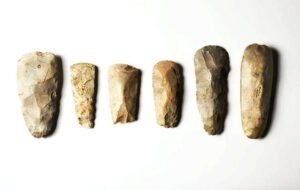
Early Neolithic Polished flint axes from Grimes Graves flint mines in Norfolk. Neolithic people made stone and flint axes in a different way to Mesolithic people. After using hammer stones to knap a nodule and produce a rough shape, the axes were ground or polished to produce a sharp edge and the smooth shape shown …
Micromorphology
Micromorphology is the study of the microscopic structure and arrangement of materials, particularly sediments and soils, using microscopic techniques. It provides detailed information about the composition, texture, and fabric of these materials, revealing insights into their formation processes, history, and interactions. In archaeology, it helps understand site formation processes, human activities, and environmental changes.
Research Links
 NLS Map Explorer
 Google Earth
 Google Maps
 Lidar Finder
 TMA
TMA
 Megalithic Portal
 Yorkshire Arch. Air Mapping
 ADS
ADS
 Brigantian Adventure FB Group
Stone Bothering FB Group
Stone Faces FB Group
Brigantian Adventure FB Group
Stone Bothering FB Group
Stone Faces FB Group
 Heritage Gateway
 ARCHI® MAPS: UK
 Atlas of Hillforts
 Portable Antiquities
 British History Online
Brigantes Nation FB Group
British History Online
Brigantes Nation FB Group

