
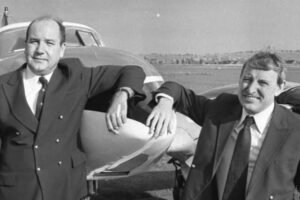
Ray Selkirk was a trailblazing landscape archaeologist who revolutionized how we interpret the hidden past beneath our feet. As a former World War II pilot, Selkirk brought a unique aerial perspective to archaeological surveying, allowing him to recognize subtle patterns in the landscape that often went unnoticed at ground level.

Category: Biographies
Feb 08
Guide: Francis Prior
- Filed under Archaeology, Biographies, Guide
Francis Pryor stands as a luminary in British archaeology, whose profound insights into prehistoric Britain have reshaped our understanding of ancient societies.
Articles
- Bronze Age
- Iron Age
- Roman
- Dark Ages
- Early Christian
- Viking
- Saxon
- Medieval
- Vitrified Fort
- Archaeology Guide
- Guide – Introduction to Critical Thinking in Archaeological Research
- Guide – Challenging Assumptions with Free Thinking
- Guide – Congruence in Archaeological Interpretation: Holistic Analysis
- Guide – Critical Thinking: Lack of Evidence Does Not Mean Evidence of Lack
- Guide – Critical Thinking: The Simple Assumption
- Guide – Applying critical thinking to historic and archaeological research
- Guide – Empathic Archaeology Introduction
- Guide – Landscape Archaeology Introduction
- Guide – What is Landscape Archaeology?
- Guide – Introduction to Glacial Archaeology
- Guide – The Flora and Fauna of Prehistoric Britain
- Guide – Landscape Archaeology: Post-Ice Age Landscape of Thornborough
- Guide – Archaeological Periods in Western Europe
- Guide – Visible Remains
- Guide – Hidden Remains
- Guide – Getting Started
- Guide – Landscape Features
- Guide – Agricultural practices through time
- Guide – Introduction to Glacial Archaeology
- Guide: In Depth – Church Doors and Windows
- Guide – Mining
- Guide – Archaeological Terms
- Guide – Glossary
- Latin Translation – Choosing the meaning of AUG
- Reports
- An introduction to Brigantian Druidry
- Brigantia during the Dark Ages
- Celtic Heads
- Finding Bardon – An Arthurian Quest
- Early Christian syncretism and how the old ones hid amongst the new religion
- Rome: The Emperors Claim to Divinity
- Syncretism through the ages
- The Border Reivers
- The Gallus Frontier – Brigantia against the Romans
- The growth of Christianity 50AD – 1100AD
- The Kingdom of Venutius
- The use of the word Lady in relation to water related structures
- The walled gardens of Brigantia
- Yorkshire’s “Sacred Vale” – The Dawn of Brigantia
- Brigantia Espania
- Iberian Peninsular
- Galicia
- Biefing – The Myth of Breogán and the Tower of Heracles
- Briefing – Galicia’s Political History and Separatist Sentiment
- Briefing – Geography and Geology of Galicia
- Briefing – Design of Galician Hillforts
- Briefing – Roman Interaction with Galicia and the Iberian Peninsula
- Church of Santa María de Cambre, Cambre near A Coruña
Categories
- Agriculture (6)
- Field Systems (1)
- ploughing (2)
- Angle (2)
- Archaeological Periods (312)
- Anglo-saxon (6)
- Bronze Age (52)
- Late Bronze Age (1)
- Dark Ages (24)
- Dark Ages Brigantia (9)
- Early Christian (37)
- Early Medieval (8)
- Georgian (9)
- Gothic (3)
- Ice Age (1)
- Iron Age (133)
- Late Iron Age (5)
- Jacobite (7)
- Medieval (61)
- Medieval Brigantia (9)
- Mesolithic (11)
- Neolithic (45)
- Early Neolithic (5)
- Norman (40)
- Palaeolithic (6)
- Roman (94)
- Saxon (9)
- Stuart (6)
- Suspect (1)
- Tudor (10)
- Undated (7)
- Viking (4)
- Archaeology (93)
- Archaeobotanical (1)
- Empathic Archaeology (11)
- Free Thinking (7)
- Battle (1)
- Brigantia (147)
- Brigantia England (134)
- Brigantia Espania (11)
- Civil Structure (6)
- Defensive Structures (45)
- Castle (5)
- Defensive Dike (2)
- Defensive Walls (1)
- Fort (20)
- Fortified Barn (1)
- Marching Camp (5)
- Motte and Bailey (6)
- Ring Work (1)
- Class A (1)
- Dialects (1)
- Earthworks (51)
- Dike (8)
- Field Systems (26)
- Enclosure (12)
- Enclosure Acts (1)
- Europe (51)
- Festivals (2)
- Finds (42)
- Altar (10)
- Amphora (1)
- Animal Remains (4)
- Auroch (1)
- Hoof marks (1)
- Antler Pick (2)
- Arrowhead (1)
- Leaf-shaped (1)
- Axe (1)
- Bone Comb (1)
- Celtic Head (8)
- Celtic Head (2)
- Clock (1)
- Curse Tablet (1)
- Flint Scatters (4)
- Gaming Pieces (1)
- Hair Braid – Ring (4)
- Human Remains (2)
- Adult (1)
- Couched Burial (1)
- Juvinile (1)
- Mace Head (1)
- S-curved (1)
- Mosaic (1)
- Polished Stone Adze (1)
- Pottery (8)
- Funerary Urns (2)
- Grooved ware (1)
- Peterborough ware (1)
- Mortlake ware (1)
- Planig‑Friedberg ware (1)
- Samian ware (2)
- Vasi a Bocca Quadrata ware (1)
- Quern Stones (1)
- Statue (1)
- Geography (16)
- Maps (7)
- Geology (13)
- Anthracite – Coal (2)
- Geomorphology (2)
- Gods (9)
- Guide (72)
- Critical Thinking (8)
- Socratic Thought (1)
- Glossary (1)
- Hidden Remains (8)
- Geophysics (5)
- LiDAR (1)
- Radiocarbon Dating (1)
- Remote Sensing and Analysis (1)
- Regional Surveys (13)
- Research Tools (4)
- Visible Remains (12)
- Air Mapping (2)
- Air Photography (2)
- Fieldwalking (2)
- Lithics (1)
- Photography (6)
- Critical Thinking (8)
- Henge (18)
- Hill Fort (61)
- Castro Hillfort (3)
- Contour/Plateau Fort (1)
- Multivallete Hillfort (1)
- Oppidum (1)
- Oppidum (1)
- Promontory fort (4)
- Slavic Gord (1)
- Univallet Hillfort (4)
- Vitrified Fort (27)
- Historic Buildings (20)
- Amphitheatre (1)
- Barn (2)
- Beacon (1)
- Broch (1)
- Coaching Inn/Hostelry (1)
- Folly (4)
- Hall (2)
- Hospital (1)
- House (1)
- Tower (7)
- Walled Garden (1)
- Industrial Heritage (9)
- Chimney (1)
- Mining (9)
- Spoil Heap (1)
- Smelting (2)
- Iron-Age (1)
- Landscape Archaeology (38)
- Glacial Archaeology (2)
- Landscape Legislation (1)
- Mining Landscape (1)
- Ritual Landscape (6)
- Landscape feature (49)
- Barrow (18)
- Bell Barrow (2)
- Bowl Barrow (1)
- Cairn (2)
- Disc Barrow (1)
- Long Barrow (5)
- Ring Barrow (1)
- Ring Cairn (1)
- Round Barrow (1)
- Square Barrow (1)
- Steppe Kurgan (1)
- Boundary Marker (2)
- Burial Mound (9)
- Ceremonial Mount (1)
- Cursus (2)
- Hill Figure (5)
- Linear Earthworks (2)
- Mound (6)
- Passage Tomb (1)
- Ring Cairn (2)
- Snake Mound (1)
- Terraces (3)
- Barrow (18)
- Leaders (33)
- Agricola (2)
- Arthur (1)
- Augustus Caesar (2)
- Breogans (3)
- Caratacus (1)
- Cnut (1)
- Julius Caesar (1)
- Petilius Cerialis (1)
- Liminal Spaces (1)
- Market (1)
- Megalithic (10)
- Rock Art (3)
- Stone alignment (1)
- Stone Circle (7)
- stone circles (1)
- Stone Row (2)
- Myth and Legend (5)
- New Sites (23)
- Publications (21)
- Biographies (2)
- Henge Capital of Britain (10)
- News (4)
- Stories of Brigantia (4)
- Walking Guides (1)
- Rabbit Warren (1)
- Religious Structures (31)
- Abbey (3)
- Church (24)
- Crosses (1)
- Memorial Planting (1)
- Priory (2)
- Religious Orders (3)
- Ritual walkway/pilrimage path (1)
- Reports (148)
- Roman Culture (11)
- Roman army (8)
- Roman baths (1)
- Roman City (1)
- Roman Gods (1)
- Mercury (1)
- Roman navy (1)
- Roman pottery (3)
- Samian ware (2)
- Roman Road (1)
- Roman Roads (2)
- Roman Villa (2)
- The Celtic World (35)
- Celtic Gods (1)
- Lugh (1)
- Celtic Industry (1)
- Celtic Life (9)
- Celtic Trade (1)
- Celtic Tribes (27)
- Celtic Gods (1)
- Trade (4)
- Minting (3)
- Coins (1)
- Spoil Heaps (2)
- Minting (3)
- Translation (7)
- Inscription (4)
- Latin (5)
- Uncategorized (24)
- Water Works (13)
Research Links
Heritage Gateway
Announcing: The Brigantian News!
- Roman Road to the West uncovered under Manchester Street 16 July 2025
- What might Stonehenge Mean? Dartmoor and Carnac add to the Picture 3 July 2025
- Megalithic Stone Monuments in France May Be Europe’s Oldest 1 July 2025
- Drumanagh Promontory Fort – First Ever Intact Roman Pot Found in Ireland 5 June 2025
Portable Antiquities News
A worn and pierced silver penny of Charles I (AD 1625-1649) probably dating to 1625. The penny has roses on either face, one side with a wire inner lines, the other made up of pellets. [...]
A partially worn silver voided long cross penny of Henry III (AD 1216-1272) dating to AD 1248-1250. Struck by the moneyer Adam in Newcastle. Class 3bc (with neck lines). North 987/1 [...]
A silver post Medieval threepence of Elizabeth I, dated 1580 on the coin. Unclear initial mark, but probably a long cross. London Tower mint. As North 1998. [...]
A very worn copper-alloy Roman nummus (AE3) of an uncertain ruler, dating to the fourth century AD. The obverse has a bust facing right, and the reverse has an unclear standing figure. [...]
A worn and corroding copper-alloy Roman radiate of an uncertain emperor, dating to the period AD 260-275. Reece Period 13. Reverse may have a figure standing, but it is hard to discern. [...]
A near-complete cast copper alloy Williams (1997) Class A Type 10a stirrup mount of Early Medieval date (c.AD 1000-1100). The mount is sub-triangular or teardrop-shaped in plan with a loop at the apex, convex on [...]
Copper alloy button. Cast discoid button front with a small central spread-eagle motif stamped into the concave front, which is surrounded by a milled tyre-like rim. The back bears a series of tiny stamps in [...]
A complete lead-alloy bifacial token of post-medieval date. One side has an anchor design (Powell Type 5) and the other either a plume of feathers or a stylised fleur-de-lys (Powell Type 4). Lead tokens had a [...]
Copper alloy dress hook, as kindly identified by the finder. Cast circular slightly concavo-convex plate surmounted by a trapezoid loop and with an uncollared short sharp back-ward-pointing hook below. The plate bears a moulded pattern [...]
Lead stylus, as kindly identified by the finder. A cast lead rod of diameter 4.2mm, knife -sharpened in the manner of a pencil at one end, flat at the other; heavily patinated overall and bent [...]
Opaque pale grey - appears buff under transmitted light - flint with cortex spot, biconvex or plano-convex knife. A sub-oval flake of lentoid section with invasive angled scalar retouch across its dorsal side, and with [...]
Copper alloy and iron brooch. Cast hinged Colchester derivative brooch, Mackreth type CD H1.d. Cast tubular wings clenched behind retain an iron axis bar whose rusting has extruded to retain a hinged pin [lost]. The [...]
A base-silver Roman denarius of Elagabalus (AD 218-222) dating to the period AD 220-222 (Reece Period 10). INVICTVS SACERDOS AVG reverse type depicting the Emperor sacrificing over an altar with a bull behind, holding a [...]
Flint scraper. Discoid scraper with four broad flakes struck from its dorsal side and two adjacent flakes struck from a probably smooth bulbar ventral surface, the angle of working differing by 90 degrees on the [...]
An incomplete cast socketed and pegged, copper-alloy decorated spearhead dating to the Late Bronze Age (c. 1100-800 BC). The spearhead is a small example measuring 75.5mm in length. The open, circular socket has an internal [...]
Copper alloy brooch. Cast headstud brooch, Mackreth type Headstud X1. Rectangular flat-faced wings mask a concave gutter behind with solder traces to retain a separate spring [lost] and are surmounted by what appears to be [...]
Two reject sections of hard hammer struck blades from gunflint manufacture. Both of trapezoidal cross section, one much larger than the other, sub-rectangular in plan. Black/dark brown flint of good quality and matt surface with [...]
Incomplete and worn copper alloy coin, possibly an Byzantine Follis, of uncertain date. On the obverse a bust facing, possibly the head of Christ.The reverse is worn and it is unclear what is depicted and therefore what [...]
An incomplete Medieval to Post-Medieval copper-alloy Scabbard chape, dating to c.AD 1450 - 1600. The object is an openwork sword scabbard chape which is sub-triangular in plan with tapering and rounded sides and a knop at the [...]
An incomplete late Early Medieval copper-alloy harness link or bit link, dating to AD 1000 - 1100. The object consists of a triple knobbed loop with projecting collar, it terminates in an old worn break.Williams, D., (2007) Anglo-Scandinavian Horse Harness Fittings [...]
Recent Articles and Site Pages
- The Story of Boltby Scar
- Swaledale
- Guide: Parliamentary-walls and the Northern Enclosures
- County Durham
- The hero archetype and Lugh
- Head One – St Michaels Church, Kirklington
- Long Meg and her Daughters standing stone and stone circle
- Cana Barn Henge
- Anciens Arsenaux Neolithic Settlement, Sion – Switzerland
- Gnaeus Julius Agricola
- Snake Iconography in the British Isles
- Wiltshire
- Liverpool Street Roman Road, Manchester
- South Street Long Barrow, Avebury
- Mamucium Roman Fort, Manchester
Locations
- Czechia (1)
- England (198)
- Bedfordshire (1)
- Cumbria (13)
- Dorset (2)
- Durham (9)
- East Yorkshire (1)
- Lancashire (7)
- North Derbyshire (8)
- North Yorkshire (118)
- Yorkshire Dales (4)
- Yorkshire Moors (1)
- Northumberland (9)
- Oxfordshire (2)
- Somerset (2)
- South Yorkshire (10)
- Staffordshire (3)
- West Yorkshire (7)
- Wiltshire (4)
- Europe (8)
- France (3)
- Germany (2)
- Global (3)
- Ireland (4)
- County Dublin (1)
- Scotland (21)
- Dumphries and Galloway (3)
- Grampian (4)
- Highlands (8)
- Perthshire (4)
- Tayside (3)
- Spain (4)
- Switzerland (1)
- Wales (4)

