The Roman Rig is a defensive dyke built to defend against attack from the south. It runs from Sheffield, past Templeborough and carries on almost to Doncaster. If this is a Brigantian dyke it would certainly add weight to Websters definition of the Roman border in the period.
Map Icon: Palisade / Wood Alignment
Roman Rig Defensive Works
- Filed under Brigantia, Brigantia England, Britain, Dark Ages, Dark Ages Brigantia, Defensive Dike, Defensive Structures, Dike, Europe, Iron Age, Late Iron Age, Linear Earthworks, Medieval, Petilius Cerialis
- Adwick-le-Street Roman Fort, Carl Wark, Cartimandua, Danes Camp, Defensive Earthwork, Defensive Works, Doncaster Roman Fort, Dunum, Dyke, Linear earthwork, Mam Tor, Petilius Cerialis, Roe Wood, Roman Rig, Scoles Coppice, South Yorkshire, Sutton Common, Templeborough Roman Fort, Venutius, Wincobank
- 2 comments
Cleave Dyke Defensive System
- Filed under Brigantia, Brigantia England, Britain, Defensive Structures, Dike, Iron Age, Landscape feature
The Cleave dyke system is several Dykes which combine to create a boundary of between 9 and 18 kilometres running north south to the west of Thirsk.
Studforth Hill Roman Amphitheatre and Motte and Bailey, Aldborough, North Yorkshire
- Filed under Amphitheatre, Brigantia England, Medieval, Motte and Bailey, Norman
Studforth Hill, a site of historical significance located near the village of Aldborough in North Yorkshire, England, is known for its association with Aldborough Castle. The motte is a testament to the area’s rich past, built upon the remnants of a former Roman amphitheatre.
Marne Barracks Neolithic palisaded enclosure
- Filed under Brigantia England, Burial Mound, Enclosure, Neolithic, Ritual Landscape
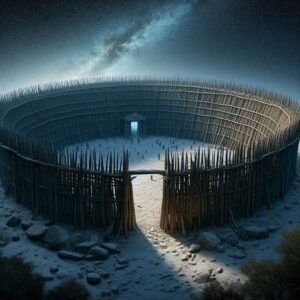
The recent discovery at Catterick has unveiled a significant Late Neolithic palisaded enclosure, shedding light on the prehistoric landscape of North Yorkshire. Excavations revealed two concentric sub-circular palisades, with the outermost having a diameter of up to 200 meters.
Website Sections
- Henge Capital of Britain
- Chapter 1 – Introduction
- Chapter 2 – The Vale of Mowbray and its henges
- Chapter 3 – The British Henge Complexes
- Chapter 4 – The early development of The Sacred Vale
- Chapter 5 – The Later Neolithic Explosion
- Chapter 6 – The Other Monuments of the Sacred Vale
- Chapter 7 – The Importance of Trade
- Chapter 8 – The Early Bronze Age and Beyond
- The Vitrified Forts of the British Isles and Europe
Articles
- Bronze Age
- Iron Age
- Roman
- Dark Ages
- Early Christian
- Viking
- Saxon
- Medieval
- Vitrified Fort
- Archaeology Guide
- Guide – Introduction to Critical Thinking in Archaeological Research
- Guide – Challenging Assumptions with Free Thinking
- Guide – Congruence in Archaeological Interpretation: Holistic Analysis
- Guide – Critical Thinking: Lack of Evidence Does Not Mean Evidence of Lack
- Guide – Critical Thinking: The Simple Assumption
- Guide – Applying critical thinking to historic and archaeological research
- Guide – Empathic Archaeology Introduction
- Guide – Landscape Archaeology Introduction
- Guide – What is Landscape Archaeology?
- Guide – Introduction to Glacial Archaeology
- Guide – The Flora and Fauna of Prehistoric Britain
- Guide – Landscape Archaeology: Post-Ice Age Landscape of Thornborough
- Guide – Archaeological Periods in Western Europe
- Guide – Visible Remains
- Guide – Hidden Remains
- Guide – Getting Started
- Guide – Landscape Features
- Guide – Agricultural practices through time
- Guide – Introduction to Glacial Archaeology
- Guide: In Depth – Church Doors and Windows
- Guide – Mining
- Guide – Archaeological Terms
- Guide – Glossary
- Latin Translation – Choosing the meaning of AUG
- Reports
- An introduction to Brigantian Druidry
- Brigantia during the Dark Ages
- Celtic Heads
- Finding Bardon – An Arthurian Quest
- Early Christian syncretism and how the old ones hid amongst the new religion
- Rome: The Emperors Claim to Divinity
- Syncretism through the ages
- The Border Reivers
- The Gallus Frontier – Brigantia against the Romans
- The growth of Christianity 50AD – 1100AD
- The Kingdom of Venutius
- The use of the word Lady in relation to water related structures
- The walled gardens of Brigantia
- Yorkshire’s “Sacred Vale” – The Dawn of Brigantia
- Brigantia Espania
- Iberian Peninsular
- Galicia
- Biefing – The Myth of Breogán and the Tower of Heracles
- Briefing – Galicia’s Political History and Separatist Sentiment
- Briefing – Geography and Geology of Galicia
- Briefing – Design of Galician Hillforts
- Briefing – Roman Interaction with Galicia and the Iberian Peninsula
- Church of Santa María de Cambre, Cambre near A Coruña
- The Premonstratensians
- The Cistercians in North Yorkshire
Categories
- Agriculture (6)
- Field Systems (1)
- ploughing (2)
- Angle (2)
- Archaeological Periods (312)
- Anglo-saxon (6)
- Bronze Age (52)
- Late Bronze Age (1)
- Dark Ages (24)
- Dark Ages Brigantia (9)
- Early Christian (37)
- Early Medieval (8)
- Georgian (9)
- Gothic (3)
- Ice Age (1)
- Iron Age (133)
- Late Iron Age (5)
- Jacobite (7)
- Medieval (61)
- Medieval Brigantia (9)
- Mesolithic (11)
- Neolithic (45)
- Early Neolithic (5)
- Norman (40)
- Palaeolithic (6)
- Roman (94)
- Saxon (9)
- Stuart (6)
- Suspect (1)
- Tudor (10)
- Undated (7)
- Viking (4)
- Archaeology (94)
- Archaeobotanical (1)
- Empathic Archaeology (11)
- Free Thinking (7)
- Battle (1)
- Brigantia (147)
- Brigantia England (134)
- Brigantia Espania (11)
- Civil Structure (6)
- Defensive Structures (45)
- Castle (5)
- Defensive Dike (2)
- Defensive Walls (1)
- Fort (20)
- Fortified Barn (1)
- Marching Camp (5)
- Motte and Bailey (6)
- Ring Work (1)
- Class A (1)
- Dialects (1)
- Earthworks (51)
- Dike (8)
- Field Systems (26)
- Enclosure (12)
- Enclosure Acts (1)
- Europe (51)
- Festivals (2)
- Finds (42)
- Altar (10)
- Amphora (1)
- Animal Remains (4)
- Auroch (1)
- Hoof marks (1)
- Antler Pick (2)
- Arrowhead (1)
- Leaf-shaped (1)
- Axe (1)
- Bone Comb (1)
- Celtic Head (8)
- Celtic Head (2)
- Clock (1)
- Curse Tablet (1)
- Flint Scatters (4)
- Gaming Pieces (1)
- Hair Braid – Ring (4)
- Human Remains (2)
- Adult (1)
- Couched Burial (1)
- Juvinile (1)
- Mace Head (1)
- S-curved (1)
- Mosaic (1)
- Polished Stone Adze (1)
- Pottery (8)
- Funerary Urns (2)
- Grooved ware (1)
- Peterborough ware (1)
- Mortlake ware (1)
- Planig‑Friedberg ware (1)
- Samian ware (2)
- Vasi a Bocca Quadrata ware (1)
- Quern Stones (1)
- Statue (1)
- Geography (16)
- Maps (7)
- Geology (13)
- Anthracite – Coal (2)
- Geomorphology (2)
- Gods (9)
- Guide (72)
- Critical Thinking (8)
- Socratic Thought (1)
- Glossary (1)
- Hidden Remains (8)
- Geophysics (5)
- LiDAR (1)
- Radiocarbon Dating (1)
- Remote Sensing and Analysis (1)
- Regional Surveys (13)
- Research Tools (4)
- Visible Remains (12)
- Air Mapping (2)
- Air Photography (2)
- Fieldwalking (2)
- Lithics (1)
- Photography (6)
- Critical Thinking (8)
- Henge (18)
- Hill Fort (61)
- Castro Hillfort (3)
- Contour/Plateau Fort (1)
- Multivallete Hillfort (1)
- Oppidum (1)
- Oppidum (1)
- Promontory fort (4)
- Slavic Gord (1)
- Univallet Hillfort (4)
- Vitrified Fort (27)
- Historic Buildings (20)
- Amphitheatre (1)
- Barn (2)
- Beacon (1)
- Broch (1)
- Coaching Inn/Hostelry (1)
- Folly (4)
- Hall (2)
- Hospital (1)
- House (1)
- Tower (7)
- Walled Garden (1)
- Industrial Heritage (9)
- Chimney (1)
- Mining (9)
- Spoil Heap (1)
- Smelting (2)
- Iron-Age (1)
- Landscape Archaeology (38)
- Glacial Archaeology (2)
- Landscape Legislation (1)
- Mining Landscape (1)
- Ritual Landscape (6)
- Landscape feature (49)
- Barrow (18)
- Bell Barrow (2)
- Bowl Barrow (1)
- Cairn (2)
- Disc Barrow (1)
- Long Barrow (5)
- Ring Barrow (1)
- Ring Cairn (1)
- Round Barrow (1)
- Square Barrow (1)
- Steppe Kurgan (1)
- Boundary Marker (2)
- Burial Mound (9)
- Ceremonial Mount (1)
- Cursus (2)
- Hill Figure (5)
- Linear Earthworks (2)
- Mound (6)
- Passage Tomb (1)
- Ring Cairn (2)
- Snake Mound (1)
- Terraces (3)
- Barrow (18)
- Leaders (33)
- Agricola (2)
- Arthur (1)
- Augustus Caesar (2)
- Breogans (3)
- Caratacus (1)
- Cnut (1)
- Julius Caesar (1)
- Petilius Cerialis (1)
- Liminal Spaces (1)
- Market (1)
- Megalithic (10)
- Rock Art (3)
- Stone alignment (1)
- Stone Circle (7)
- stone circles (1)
- Stone Row (2)
- Myth and Legend (5)
- New Sites (23)
- Publications (21)
- Biographies (2)
- Henge Capital of Britain (10)
- News (4)
- Stories of Brigantia (4)
- Walking Guides (1)
- Rabbit Warren (1)
- Religious Structures (31)
- Abbey (3)
- Church (24)
- Crosses (1)
- Memorial Planting (1)
- Priory (2)
- Religious Orders (3)
- Ritual walkway/pilrimage path (1)
- Reports (148)
- Roman Culture (11)
- Roman army (8)
- Roman baths (1)
- Roman City (1)
- Roman Gods (1)
- Mercury (1)
- Roman navy (1)
- Roman pottery (3)
- Samian ware (2)
- Roman Road (1)
- Roman Roads (2)
- Roman Villa (2)
- The Celtic World (35)
- Celtic Gods (1)
- Lugh (1)
- Celtic Industry (1)
- Celtic Life (9)
- Celtic Trade (1)
- Celtic Tribes (27)
- Celtic Gods (1)
- Trade (4)
- Minting (3)
- Coins (1)
- Spoil Heaps (2)
- Minting (3)
- Translation (7)
- Inscription (4)
- Latin (5)
- Uncategorized (24)
- Water Works (13)
Research Links
Heritage Gateway
Tag Cloud
Age (14)
altar (11)
Archaeology (37)
Archaeology Guide (12)
barrow (12)
Brigantes (29)
Brigantia (77)
britain (29)
Bronze Age (42)
Cartimandua (10)
celt (9)
celtic (22)
Christian (17)
Church (15)
Coverdale (17)
Cumbria (13)
Earthworks (18)
England (12)
Fort (21)
France (9)
Galicia (10)
goddess (9)
guide (30)
Henge (20)
Hill Fort (34)
history (11)
ireland (14)
iron (14)
Iron Age (80)
Landscape (9)
Medieval (33)
Mesolithic (9)
Mound (9)
Neolithic (34)
Norman (32)
North Yorkshire (63)
Roman (84)
scotland (20)
Spain (9)
Thornborough Henges (10)
Venutius (9)
vitrified (9)
Wensleydale (11)
Yorkshire (20)
Yorkshire Dales (22)