The Bronze Age discoveries in Mitchell Laithes Farm, Ossett, West Yorkshire, offer an important glimpse into the region’s ancient past. Archaeological appraisals, particularly the one conducted in 2007 at Mitchell Laithes Rye Royds, have unearthed evidence of short episodes of occupation dating back to 3500-2000 BC.
Location: West Yorkshire
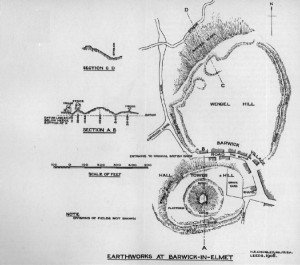
Hall Tower Hill and Wendel Hill – Barwick in Elmet
- Filed under Brigantia England, Dark Ages, Earthworks, Hill Fort, Iron Age, Medieval, Norman
The massive earthworks at Barwick and the continuation of the same profile alongside the River Cock to Aberford and beyond point to it being a place of importance as a large hillfort of some 15 acres. There were several hillforts in northern Britain when it was inhabited by a Celtic tribe called the Brigantes.
- Age, bailey, Barwick, Earthworks, elmet, Fort, hill, iron, motte, univallate
- Leave comment
Elslack Roman Fort
- Filed under Brigantia England, Fort, Roman
← West Yorkshire Castle Hill, Almondbury Castle Hill’s imposing silhouette hides a great prehistoric fort, Norman castle and Victorian tower. Thanks to Varley’s trenches and the Read more West Yorkshire North Yorkshire The County of North Yorkshire is a small part of what was once a much larger collection of tribes in Read more Greta …
Brigantia
The name Brigantia represents three separate concepts: a goddess, a people, and a tribal federation. By the Roman period, the name represented a tribal federation compromising all of what would become the Roman province of Britannia Secunda, except for the Parisi territory, east of the River Derwent.
Barwick in Elmet Iron Age Hill Fort
“The scale and function of the earthworks, which may comprise a rampart, a ditch and a counterscarp bank, is massive and assumed to be defensive though large univallate hillforts may have been built on the sites of earlier non-defensive enclosures such as slight univallate hillforts. In area large univallate hillforts vary between 1 and 10 hectares.
West Yorkshire
- Filed under Brigantia England, Landscape Archaeology
← World Heritage Castle Hill, Almondbury Castle Hill’s imposing silhouette hides a great prehistoric fort, Norman castle and Victorian tower. Thanks to Varley’s trenches and the Read more North Yorkshire The County of North Yorkshire is a small part of what was once a much larger collection of tribes in Read more Maiden Castle Fort …
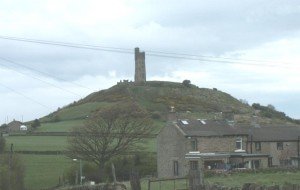
Castle Hill, Almondbury
- Filed under Brigantia England, Britain, Defensive Structures, Hill Fort, Iron Age, Tower, Vitrified Fort
Castle Hill’s imposing silhouette hides a great prehistoric fort, Norman castle and Victorian tower. Thanks to Varley’s trenches and the 1995 RCHME survey we have a solid structural framework, yet key chronological pins, remain to be driven. It is therefore both a celebrated landmark for Huddersfield and a live research asset for Iron-Age, and medieval research.
Articles
- Bronze Age
- Iron Age
- Roman
- Dark Ages
- Early Christian
- Viking
- Saxon
- Medieval
- Vitrified Fort
- Archaeology Guide
- Guide – Introduction to Critical Thinking in Archaeological Research
- Guide – Challenging Assumptions with Free Thinking
- Guide – Congruence in Archaeological Interpretation: Holistic Analysis
- Guide – Critical Thinking: Lack of Evidence Does Not Mean Evidence of Lack
- Guide – Critical Thinking: The Simple Assumption
- Guide – Applying critical thinking to historic and archaeological research
- Guide – Empathic Archaeology Introduction
- Guide – Landscape Archaeology Introduction
- Guide – What is Landscape Archaeology?
- Guide – Introduction to Glacial Archaeology
- Guide – The Flora and Fauna of Prehistoric Britain
- Guide – Landscape Archaeology: Post-Ice Age Landscape of Thornborough
- Guide – Archaeological Periods in Western Europe
- Guide – Visible Remains
- Guide – Hidden Remains
- Guide – Getting Started
- Guide – Landscape Features
- Guide – Agricultural practices through time
- Guide – Introduction to Glacial Archaeology
- Guide: In Depth – Church Doors and Windows
- Guide – Mining
- Guide – Archaeological Terms
- Guide – Glossary
- Latin Translation – Choosing the meaning of AUG
- Reports
- An introduction to Brigantian Druidry
- Brigantia during the Dark Ages
- Celtic Heads
- Finding Bardon – An Arthurian Quest
- Early Christian syncretism and how the old ones hid amongst the new religion
- Rome: The Emperors Claim to Divinity
- Syncretism through the ages
- The Border Reivers
- The Gallus Frontier – Brigantia against the Romans
- The growth of Christianity 50AD – 1100AD
- The Kingdom of Venutius
- The use of the word Lady in relation to water related structures
- The walled gardens of Brigantia
- Yorkshire’s “Sacred Vale” – The Dawn of Brigantia
- Brigantia Espania
- Iberian Peninsular
- Galicia
- Biefing – The Myth of Breogán and the Tower of Heracles
- Briefing – Galicia’s Political History and Separatist Sentiment
- Briefing – Geography and Geology of Galicia
- Briefing – Design of Galician Hillforts
- Briefing – Roman Interaction with Galicia and the Iberian Peninsula
- Church of Santa María de Cambre, Cambre near A Coruña
Categories
- Agriculture (6)
- Field Systems (1)
- ploughing (2)
- Angle (2)
- Archaeological Periods (312)
- Anglo-saxon (6)
- Bronze Age (52)
- Late Bronze Age (1)
- Dark Ages (24)
- Dark Ages Brigantia (9)
- Early Christian (37)
- Early Medieval (8)
- Georgian (9)
- Gothic (3)
- Ice Age (1)
- Iron Age (133)
- Late Iron Age (5)
- Jacobite (7)
- Medieval (61)
- Medieval Brigantia (9)
- Mesolithic (11)
- Neolithic (45)
- Early Neolithic (5)
- Norman (40)
- Palaeolithic (6)
- Roman (94)
- Saxon (9)
- Stuart (6)
- Suspect (1)
- Tudor (10)
- Undated (7)
- Viking (4)
- Archaeology (93)
- Archaeobotanical (1)
- Empathic Archaeology (11)
- Free Thinking (7)
- Battle (1)
- Brigantia (147)
- Brigantia England (134)
- Brigantia Espania (11)
- Civil Structure (6)
- Defensive Structures (45)
- Castle (5)
- Defensive Dike (2)
- Defensive Walls (1)
- Fort (20)
- Fortified Barn (1)
- Marching Camp (5)
- Motte and Bailey (6)
- Ring Work (1)
- Class A (1)
- Dialects (1)
- Earthworks (51)
- Dike (8)
- Field Systems (26)
- Enclosure (12)
- Enclosure Acts (1)
- Europe (51)
- Festivals (2)
- Finds (42)
- Altar (10)
- Amphora (1)
- Animal Remains (4)
- Auroch (1)
- Hoof marks (1)
- Antler Pick (2)
- Arrowhead (1)
- Leaf-shaped (1)
- Axe (1)
- Bone Comb (1)
- Celtic Head (8)
- Celtic Head (2)
- Clock (1)
- Curse Tablet (1)
- Flint Scatters (4)
- Gaming Pieces (1)
- Hair Braid – Ring (4)
- Human Remains (2)
- Adult (1)
- Couched Burial (1)
- Juvinile (1)
- Mace Head (1)
- S-curved (1)
- Mosaic (1)
- Polished Stone Adze (1)
- Pottery (8)
- Funerary Urns (2)
- Grooved ware (1)
- Peterborough ware (1)
- Mortlake ware (1)
- Planig‑Friedberg ware (1)
- Samian ware (2)
- Vasi a Bocca Quadrata ware (1)
- Quern Stones (1)
- Statue (1)
- Geography (16)
- Maps (7)
- Geology (13)
- Anthracite – Coal (2)
- Geomorphology (2)
- Gods (9)
- Guide (72)
- Critical Thinking (8)
- Socratic Thought (1)
- Glossary (1)
- Hidden Remains (8)
- Geophysics (5)
- LiDAR (1)
- Radiocarbon Dating (1)
- Remote Sensing and Analysis (1)
- Regional Surveys (13)
- Research Tools (4)
- Visible Remains (12)
- Air Mapping (2)
- Air Photography (2)
- Fieldwalking (2)
- Lithics (1)
- Photography (6)
- Critical Thinking (8)
- Henge (18)
- Hill Fort (61)
- Castro Hillfort (3)
- Contour/Plateau Fort (1)
- Multivallete Hillfort (1)
- Oppidum (1)
- Oppidum (1)
- Promontory fort (4)
- Slavic Gord (1)
- Univallet Hillfort (4)
- Vitrified Fort (27)
- Historic Buildings (20)
- Amphitheatre (1)
- Barn (2)
- Beacon (1)
- Broch (1)
- Coaching Inn/Hostelry (1)
- Folly (4)
- Hall (2)
- Hospital (1)
- House (1)
- Tower (7)
- Walled Garden (1)
- Industrial Heritage (9)
- Chimney (1)
- Mining (9)
- Spoil Heap (1)
- Smelting (2)
- Iron-Age (1)
- Landscape Archaeology (38)
- Glacial Archaeology (2)
- Landscape Legislation (1)
- Mining Landscape (1)
- Ritual Landscape (6)
- Landscape feature (49)
- Barrow (18)
- Bell Barrow (2)
- Bowl Barrow (1)
- Cairn (2)
- Disc Barrow (1)
- Long Barrow (5)
- Ring Barrow (1)
- Ring Cairn (1)
- Round Barrow (1)
- Square Barrow (1)
- Steppe Kurgan (1)
- Boundary Marker (2)
- Burial Mound (9)
- Ceremonial Mount (1)
- Cursus (2)
- Hill Figure (5)
- Linear Earthworks (2)
- Mound (6)
- Passage Tomb (1)
- Ring Cairn (2)
- Snake Mound (1)
- Terraces (3)
- Barrow (18)
- Leaders (33)
- Agricola (2)
- Arthur (1)
- Augustus Caesar (2)
- Breogans (3)
- Caratacus (1)
- Cnut (1)
- Julius Caesar (1)
- Petilius Cerialis (1)
- Liminal Spaces (1)
- Market (1)
- Megalithic (10)
- Rock Art (3)
- Stone alignment (1)
- Stone Circle (7)
- stone circles (1)
- Stone Row (2)
- Myth and Legend (5)
- New Sites (23)
- Publications (21)
- Biographies (2)
- Henge Capital of Britain (10)
- News (4)
- Stories of Brigantia (4)
- Walking Guides (1)
- Rabbit Warren (1)
- Religious Structures (31)
- Abbey (3)
- Church (24)
- Crosses (1)
- Memorial Planting (1)
- Priory (2)
- Religious Orders (3)
- Ritual walkway/pilrimage path (1)
- Reports (148)
- Roman Culture (11)
- Roman army (8)
- Roman baths (1)
- Roman City (1)
- Roman Gods (1)
- Mercury (1)
- Roman navy (1)
- Roman pottery (3)
- Samian ware (2)
- Roman Road (1)
- Roman Roads (2)
- Roman Villa (2)
- The Celtic World (35)
- Celtic Gods (1)
- Lugh (1)
- Celtic Industry (1)
- Celtic Life (9)
- Celtic Trade (1)
- Celtic Tribes (27)
- Celtic Gods (1)
- Trade (4)
- Minting (3)
- Coins (1)
- Spoil Heaps (2)
- Minting (3)
- Translation (7)
- Inscription (4)
- Latin (5)
- Uncategorized (24)
- Water Works (13)
Research Links
Heritage Gateway
Announcing: The Brigantian News!
- Roman Road to the West uncovered under Manchester Street 16 July 2025
- What might Stonehenge Mean? Dartmoor and Carnac add to the Picture 3 July 2025
- Megalithic Stone Monuments in France May Be Europe’s Oldest 1 July 2025
- Drumanagh Promontory Fort – First Ever Intact Roman Pot Found in Ireland 5 June 2025
Portable Antiquities News
A complete lead alloy button dating to the Post Medieval period (c. AD 1500-1650). The button is circular in shape with a convex face and flat reverse. The face has moulded decoration of a central pellet [...]
A Roman copper alloy nummus of Constantine II (AD 317-337) dating to the period AD 323 (Reece Period 16). BEATA TRAN-QVILLITAS reverse type depicting globe on altar inscribed VOT//IS/XX with three stars above. Mint of Trier. RIC Vol. VII (p.200) No.412 [...]
A Medieval French copper alloy jetton of the four fleurs de lys in a lozenge type dating to AD 1488-97. Mint of Tournai. Mitchiner 1988, page 208, number 589.Obverse description: Four fleurs in a lozenge: within an arched [...]
A Medieval French stock Jetton dating to AD 1415-1497.Obverse: Crown with groups of pellets in field.Reverse: AMOVRS TOV SVI A VOVS SI, tripple-voided cross fleuretty within a double tressure of four arches. In the centre of the [...]
A medieval silver shortcross penny of Henry II (1154-1189), class 1b dating c. 1180-1185. Moneyer Reinald of Northampton mint. North (1994), p. 220 no: 963. [...]
An incomplete cast copper alloy pin of Early Medieval date (c. AD 700-900). It is missing most of its shaft.The pin has a polyhedral pin head, cuboid in form with chamfered corners forming 13 facets of unequal [...]
A complete cast copper alloy scabbard chape dating to the Post Medieval period (c. AD 1500-1700).The chape is made of a sheet folded into a conical tube, oepn at one end and forming a pointed [...]
A complete Medieval cast copper-alloy annular buckle with cast copper-alloy pin, probably dating to c. AD 1200-1450.The frame is circular in plan, and oval in cross-section, with no constriction for the pin. The frame is undecorated. The pin [...]
A near complete cast copper-alloy Early Medieval (Anglo-Saxon) small-long brooch, dating to AD 450-550. The object retains its head plate and bow, but it is missing it's pin.The brooch includes a cruciform head consisting of 3 long pointed, [...]
An incomplete copper alloy Colchester Derivative type brooch dating to the Roman period (c. AD 50-150). The object has complete wings with wing caps. The reverse of the head is concave and the remains of the spring mechanism have [...]
An incomplete copper alloy Colchester Derivative, Polden Hill type brooch dating to the Roman period (c. AD 75-175). The object has complete wings with wing caps and double linear decoration half way along and at the end [...]
An incomplete copper alloy Colchester Derivative, Polden Hill type brooch dating to the Roman period (c. AD 75-175). The object has complete wings with wing caps and moulded double linear decoration half way along each wing. [...]
An Roman copper-alloy nummus of Valens, dating to c. AD 367 - 375. Reece Period 19. SECVRITAS REIPVBLICAE, reverse type shows Victory advancing left holding a wreath. Mint uncertain.Diameter: 18.38 mmWeight: 1.87 g [...]
An incomplete cast copper alloy cloisonne enamel lugged disc brooch (Weetch type 20A), of the late early-medieval period dating c.AD 1000-1100.The brooch is bent and damaged with the enamel design incomplete and crushed. It comprises a [...]
A Roman copper-alloy nummus of Magnentius dating to AD 351 - 353 (Reece period 18). VICTORIAE DD NN AVG ET CAES reverse showing two Victories supporting a wreath inscribed VOT V MVLT X. Mint of Ambianum.RIC VIII [...]
An incomplete medieval copper alloy single loop composite buckle dating c. 1350-1450Only the frame and forked spacers survive, the pin and plate are missing. The frame is circular with a notched pin rest. The frame is bevelled [...]
An incomplete, medieval, copper alloy cast annular buckle dating c. AD 1250-1450.The frame is circular and undecorated, and has a circular cross section. One section is worn thin from wear. The pin is D-shaped in cross section with a [...]
An incomplete Roman copper alloy brooch of Colchester Derivative Harlow type dating c. 50-80. The brooch is missing the spring and pin. It has a semi-cylindrical head with incomplete and worn short wings and a double pierced lug to [...]
An incomplete copper alloy Colchester Derivative, Polden Hill type brooch dating to the Roman period (c. AD 75-175). The object has complete wings with wing caps and double linear decoration half way along and at [...]
A Roman copper-alloy nummus of Constantine I, dating to c.AD 320. Reece Period 16. VIRTVS EXERCIT, reverse type shows Military standard with drapery marked VOT/XX; on either side, seated captive. Mint of Arelate.RIC VII Arelate 205 Diameter: [...]
Recent Articles and Site Pages
- The Story of Boltby Scar
- Swaledale
- Guide: Parliamentary-walls and the Northern Enclosures
- County Durham
- The hero archetype and Lugh
- Head One – St Michaels Church, Kirklington
- Long Meg and her Daughters standing stone and stone circle
- Cana Barn Henge
- Anciens Arsenaux Neolithic Settlement, Sion – Switzerland
- Gnaeus Julius Agricola
- Snake Iconography in the British Isles
- Wiltshire
- Liverpool Street Roman Road, Manchester
- South Street Long Barrow, Avebury
- Mamucium Roman Fort, Manchester
Locations
- Czechia (1)
- England (198)
- Bedfordshire (1)
- Cumbria (13)
- Dorset (2)
- Durham (9)
- East Yorkshire (1)
- Lancashire (7)
- North Derbyshire (8)
- North Yorkshire (118)
- Yorkshire Dales (4)
- Yorkshire Moors (1)
- Northumberland (9)
- Oxfordshire (2)
- Somerset (2)
- South Yorkshire (10)
- Staffordshire (3)
- West Yorkshire (7)
- Wiltshire (4)
- Europe (8)
- France (3)
- Germany (2)
- Global (3)
- Ireland (4)
- County Dublin (1)
- Scotland (21)
- Dumphries and Galloway (3)
- Grampian (4)
- Highlands (8)
- Perthshire (4)
- Tayside (3)
- Spain (4)
- Switzerland (1)
- Wales (4)